BIOCHEMISTRY - L. Stryer - 1984
VOLUME 1
PART I. CONFORMATION AND DYNAMICS
CHAPTER 6. INTRODUCTION TO ENZYMOLOGY
6.4. Enzymes Transform Various Forms of Energy
In many biochemical reactions, the energy of the reacting substances is converted from one form to another with a high degree of efficiency. For example, during Photosynthesis, light energy is converted into chemical bond energy. In Cell/35.html">Mitochondria, the Free energy contained in low-molecular-weight nutrients is transformed into the energy of adenosine triphosphate (ATP), the universal currency of biological energy. The chemical bond energy of ATP is subsequently utilized in numerous processes. During Muscle contraction, ATP energy is converted into mechanical work. Cells and subcellular Organelles contain pumps that utilize ATP to transport molecules and ions against chemical and electrical gradients. These energy transformations are carried out by enzyme molecules that form an integral part of highly organized structures.
6.5. Enzymes Do Not Alter Reaction Equilibrium
An enzyme is a catalyst and, consequently, cannot alter the equilibrium of a chemical reaction. This means that an enzyme accelerates both the forward and reverse reactions to precisely the same extent. Let us consider the interconversion of A and B. Suppose that in the absence of an enzyme, The rate of the forward reaction ($k_{f}$) is $10^{-4}$ s$^{-1}$, and the rate of the reverse reaction ($k_{r}$) is $10^{-6}$ s$^{-1}$.
The Equilibrium Constant $K$ is determined by The ratio of these rates:
Class="center">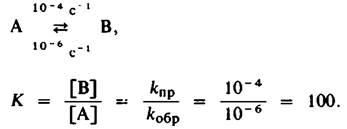
Thus, at equilibrium, the concentration of B will be 100 times higher than the concentration of A, regardless of whether the enzyme is present or not. However, in the absence of the enzyme, equilibrium is established only after several hours, whereas in the presence of the enzyme, it is reached in just a few seconds. Consequently, Enzymes accelerate the attainment of equilibrium, but do not shift it.
6.6. Enzymes Lower the Activation Energy of the Reactions They Catalyze
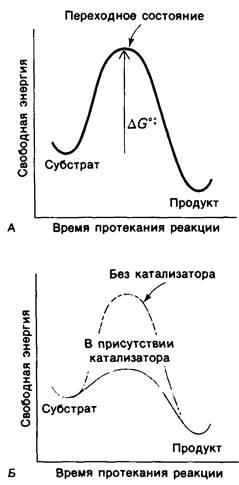
A chemical reaction A $ ightleftharpoons$ B proceeds via a Transition State with a higher energy than that of A or B. The rate of the forward reaction depends on Temperature and the difference in free energy between A and the transition state; this difference is called the standard Gibbs Free energy of activation and is denoted by
 (Fig. 6.7, A):

The reaction rate is proportional to the number of molecules whose free energy is equal to or greater than  . The fraction of such molecules increases with rising temperature.
Enzymes increase reaction rates by lowering the activation barrier  . When a substrate interacts with an enzyme, the reaction proceeds via a new pathway characterized by a lower transition-state energy than that of the uncatalyzed reaction (Fig. 6.7, B).
Fig. 6.7. A. Definition of the free energy of activation  . B. An enzyme accelerates a reaction by lowering
6.7. The First Step in Enzymatic Catalysis is the Formation of an Enzyme-Substrate Complex
The formation or Cleavage of chemical bonds by any enzyme is preceded by The formation of an enzyme-substrate (ES) complex. In this process, the substrate binds to a specific region on the enzyme known as the Active Site. Most enzymes exhibit high selectivity toward substrate binding. In essence, the catalytic Specificity of enzymes depends primarily on the Specificity of the binding process. Furthermore, REGULATION OF ENZYMATIC Activity frequently occurs at this stage.
The existence of enzyme-substrate complexes has been demonstrated in various ways.
1. ES complexes have been directly visualized using Electron Microscopy and X-ray crystallography. Complexes of Nucleic Acids and their polymerases are visible under the Electron microscope (Fig. 6.3). X-ray crystallographic Analysis of the complex between Carboxypeptidase A and its substrate, Glycine-L-Tyrosine, has provided detailed information regarding the site and nature of substrate binding within this ES complex.
2. The formation of an ES complex frequently alters the Physical Properties of the enzyme, such as its solubility or thermostability.
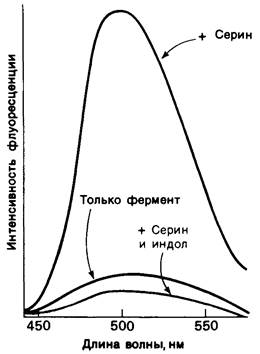
3. The spectroscopic properties of many enzymes and substrates change upon Formation of the ES complex, much like the characteristic absorption spectrum of deoxyhemoglobin changes upon oxygen binding or oxidation to the ferric form, as described previously (Fig. 3.18). These changes are particularly pronounced if the enzyme contains a colored prosthetic group. A prime illustration is Tryptophan synthase, a bacterial enzyme containing Pyridoxal phosphate as a prosthetic group. This enzyme catalyzes the synthesis of L-tryptophan from L-Serine and indole. Upon The addition of L-serine to the enzyme, the fluorescence of the pyridoxal phosphate group increases dramatically (Fig. 6.8). Subsequent addition of the second substrate, indole, quenches the fluorescence below the initial baseline. Thus, fluorescence spectroscopy makes it possible to detect the existence of enzyme-serine and enzyme-serine-indole complexes. Other spectroscopic techniques, notably nuclear magnetic Resonance (NMR) and electron paramagnetic resonance (EPR) Methods, are also successfully applied to study enzyme-substrate interactions.
Fig. 6.8. Addition of the reaction substrates, serine and indole, changes the fluorescence intensity of the pyridoxal phosphate group in the Active Site of tryptophan synthase
4. The formation of the ES complex exhibits a high degree of stereospecificity. For example, D-serine cannot serve as a substrate for tryptophan synthase. Moreover, the D-isomer does not even bind to the enzyme. This implies that the substrate-binding site has a strictly defined geometric shape.
5. ES complexes can sometimes be isolated in a pure form. If an enzyme catalyzes the reaction A + B ⇄ C, the EA complex can be isolated in certain cases. This requires the enzyme to have a sufficiently high affinity for A and the absence of B from the mixture.
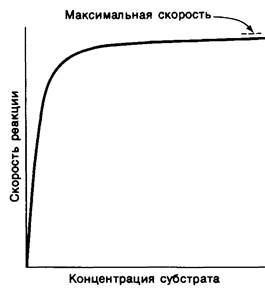
6. At a constant Enzyme Concentration, the reaction rate increases with increasing Substrate Concentration until the maximum velocity is reached
(Fig. 6.9). Such a saturation effect is not characteristic of uncatalyzed reactions. In 1913, Leonor Michaelis considered METABOLISM/2.html">THE CONCEPT OF the maximum velocity of an enzymatic reaction from the standpoint of the formation of a discrete ES complex. Michaelis concluded that the reaction rate reaches a maximum at a sufficiently high substrate concentration because, under these conditions, the substrate occupies all the catalytic sites on the enzyme. This proposition is the oldest and most general argument in favor of the existence of ES complexes.
Fig. 6.9. Enzymatic reaction rate as a function of substrate concentration
Last update: 06/08/2026
Editorial and Educational Adaptation: This material has been compiled based on the primary/original source text. The project team performed an editorial review, corrected technical inaccuracies, structured sections, and adapted the content for an educational format.
What was processed:
- elimination of formatting defects (OCR errors, structural breaks, corrupted characters);
- editorial organization of content;
- standardization of terminology in accordance with academic sources;
- verification of factual statements against the original source text.
All mentions of the author, publication year, and origin of the primary text have been preserved in accordance with the source.