Basics of Biochemistry - Filippovich, Yu. B. 1999
Hormones and Their Role in Metabolism
Other Hormones
Among non-steroid and non-Peptide HORMONES, adrenaline, thyroxine, and Prostaglandins, along with structurally similar compounds, are well known in humans and animals, whereas Auxins, Gibberellins, and Cytokinins are widely represented in the plant kingdom.
Adrenaline is a hormone synthesized in The adrenal medulla. Its existence has been known for over a century. In 1901, adrenaline was isolated in crystalline form from adrenal extracts by Takamine, Aldrich, and J. von Fürth. Two years later, F. Stolz provided definitive proof of its Structure through synthesis. Adrenaline was shown to be 1-(3,4-dihydroxyphenyl)-2-methylaminoethanol:
Class="center">
It is a colorless crystalline powder with a melting point tпл = 215—126° С. Containing an asymmetric carbon atom (marked with an asterisk), adrenaline exists as two optical isomers. Among them, the levorotatory isomer ([а]D20 = —53,5°) exhibits 15 times greater hormonal activity than the dextrorotatory one. It is precisely this isomer that is synthesized in the Adrenal Glands.
The adrenal medulla of a human, weighing 10 g, contains about 5 mg of adrenaline. In addition, adrenaline homologs have been identified: noradrenaline (0.5 mg) and isoprenaline (traces). Their formulas are given below during the Discussion of the biosynthetic pathways of these hormones.
Adrenaline and noradrenaline are also present in human Blood. Their concentrations in venous blood are 0.04 and 0.2 µg%, respectively. It is hypothesized that adrenaline and noradrenaline, bound as salts with ATP, are stored in small quantities at nerve fiber terminals and released in response to stimulation. This establishes chemical communication between the nerve terminal and a Cell, or between two Neurons.
All three substances—adrenaline, noradrenaline, and isoprenaline—exert a powerful effect on The Cardiovascular system. Furthermore, they elevate Carbohydrate METABOLISM by enhancing Glycogen breakdown in Muscles. This occurs because Muscle phosphorylase, via an adenylate cyclase-mediated action of adrenaline, transitions from the inactive form (phosphorylase b) to the active form (phosphorylase a) (see p. 334).
Thus, adrenaline performs the same function in muscles as Glucagon does in the Liver, triggering the adenylate cyclase reaction after interacting with the surface hormone receptor of the target cell (see Fig. 137).
The Biosynthesis of adrenaline and its homologs proceeds from Tyrosine According to the following pathway:

All of these reactions proceed with the participation of specific Enzymes.
Thyroxine is a hormone produced in The Thyroid Gland. The earliest information regarding THYROID HORMONES dates back to the late 19th century (F. Blum, 1896), but it was only relatively recently that E. Kendall, J. Roche, and R. Pitt-Rivers established that the direct active principle secreted by the gland into the blood consists of iodothyronines:

Scheme 13. Biosynthetic pathways of adrenaline and its homologs
By binding to a carrier protein—blood a2-globulin—they reach the Cells of body Tissues, where they exert their effects. Approximately 1 mg of thyroxine enters the bloodstream daily, which is three times the daily requirement. Further modification of iodothyronines occurs within tissues, yielding biologically more active substances that may represent the true carriers of hormonal activity.
The aforementioned compounds exhibit the following biological activities to varying degrees. Their deficiency (thyroid hypofunction) leads to slowed metabolism, weight gain, delayed growth in children, and impaired mental development. All these symptoms are commonly grouped under the term cretinism. Conversely, an excess of thyroxine and its derivatives (thyroid hyperfunction) dramatically accelerates metabolism, increases Heart rate, raises excitability, causes weight loss, and leads to exophthalmos. This entire complex of disorders is traditionally known as Graves' disease (named after the physician Graves, who detailed thyroid hyperfunction).
The MECHANISM OF ACTION of thyroid hormones has not yet been fully elucidated. However, it is clear that it involves the induction of enzyme biosynthesis, as the production levels of over 100 enzymes are altered under The Influence of L-thyroxine. There is ample reason to believe that thyroid hormone receptor Proteins are localized directly within nuclear Chromatin; by binding to them, iodothyronines alter the METABOLIC ACTIVITY OF The Nucleus. At the same time, it has been established that thyroid hormones increase adenylate cyclase activity and cAMP levels in target cells, acting through the receptors of the adenylate cyclase system (see Fig. 136).
The Biosynthesis of Thyroid hormones exhibits unique and striking features. The key reaction is the Condensation of two diiodotyrosine molecules into a tetraiodothyronine molecule. This process takes place in the thyroid gland with the participation of a specialized protein, thyroglobulin (M = 660,000; 2 x 330,000). The polypeptide chain of each of its subunits comprises approximately 2,600 amino acid residues, making it a candidate for one of the longest known natural polypeptide chains.
It has been established that iodinated tyrosine is not incorporated into the polypeptide chain of thyroglobulin during its biosynthesis. In a specialized region of the thyroid gland known as the colloid, mediated by thyroid peroxidase in the presence of endogenous H2O2, iodine atoms are incorporated into the N-terminal tyrosine residue of the thyroglobulin subunit's polypeptide chain. Subsequently, a condensation reaction takes place between free diiodotyrosine and the radical of the bound diiodotyrosine:

Alternatively, the condensation of an N-terminal monoiodotyrosine with free diiodotyrosine or monoiodotyrosine is also possible. This leads to the Synthesis of N-terminal triiodothyronine and diiodothyronine.
As a result of Hydrolysis, the N-terminal thyroxine, triiodothyronine, or diiodothyronine are cleaved and released into the gland, and subsequently into the bloodstream. As shown above, the synthesis of thyroid hormones is stimulated by thyrotropin.
Prostaglandins are compounds with a broad spectrum of hormonal activities. The initial data regarding their existence date back to 1930, although they received their name only in 1957, when S. Bergström and co-workers isolated them in crystalline form. Prostaglandins proved to be derivatives of 20-carbon polyenoic Fatty acids, from which they are synthesized in numerous Human and Animal tissues, predominantly in reproductive Organs. Depending on The structure of the cyclic portion of the molecule, natural prostaglandins are subdivided into types A, B, C, D, E, F, G, and H, while the number of double bonds in the side chains of these prostaglandin types is indicated by numerical subscripts:
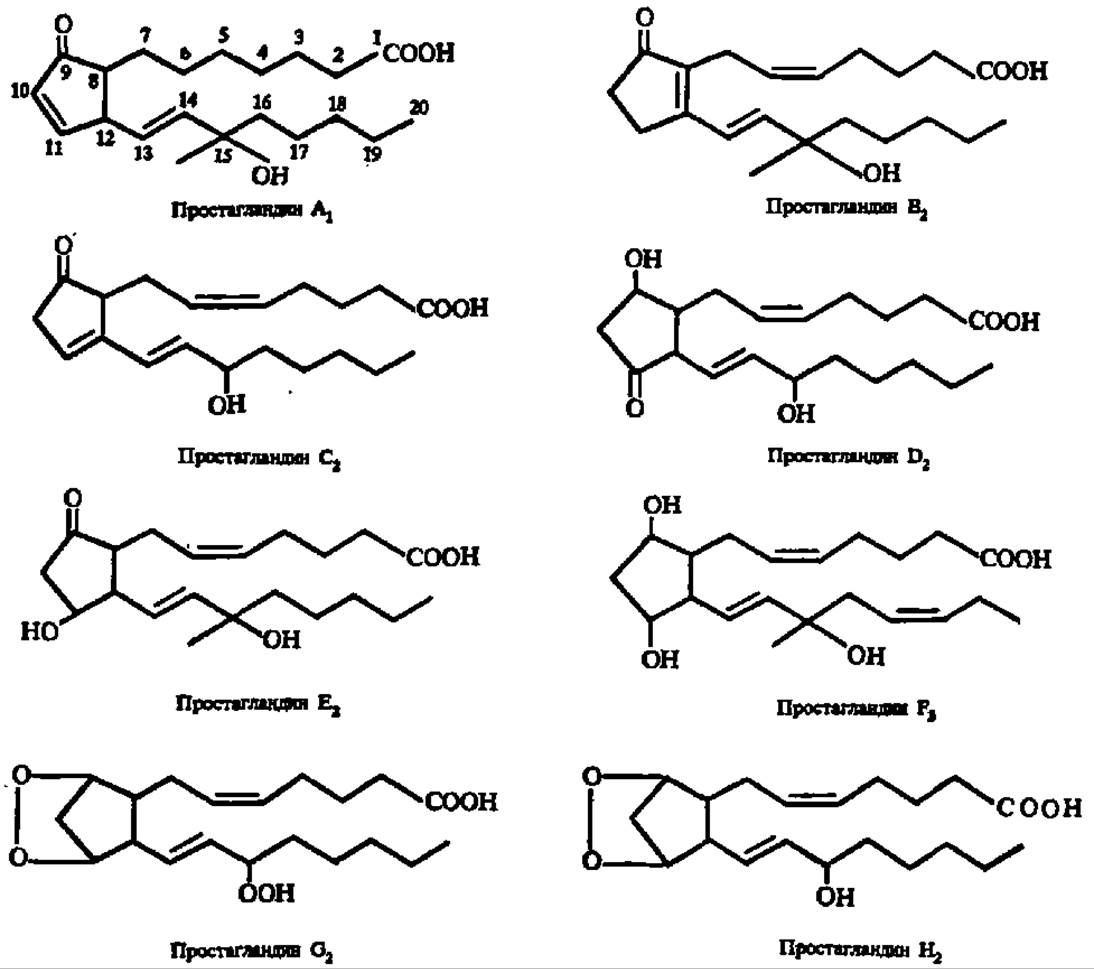
Currently, about 30 natural prostaglandins are known, and approximately 500 of their analogs have been synthesized. For their pioneering research on prostaglandins, S. Bergström (isolation), B. Samuelsson (structure elucidation), and J. Vane (synthesis of analogs) were awarded the Nobel Prize in 1982.
Prostaglandins exhibit an exceptionally wide range of physiological and pharmacological effects. Consequently, they are increasingly utilized in The Development of fundamentally novel pharmaceutical agents. This is presumably because their mechanism of action involves enhancing or attenuating the influence of numerous other hormones on fundamental aspects of metabolism at the genetic, adenylate cyclase, and other levels. A prevailing view is gradually taking shape that prostaglandins function as modulators of hormone-receptor complexes, meaning they are capable of altering their activity to mediate hormonal action.
Auxins are Plant Hormones that stimulate the growth of whole PLANTS AND THEIR individual parts. They were discovered between 1924 and 1928 by N. G. Kholodny during his research in Germany. They are present in roots, stems, and leaves. Two auxins are known, auxin a and b:
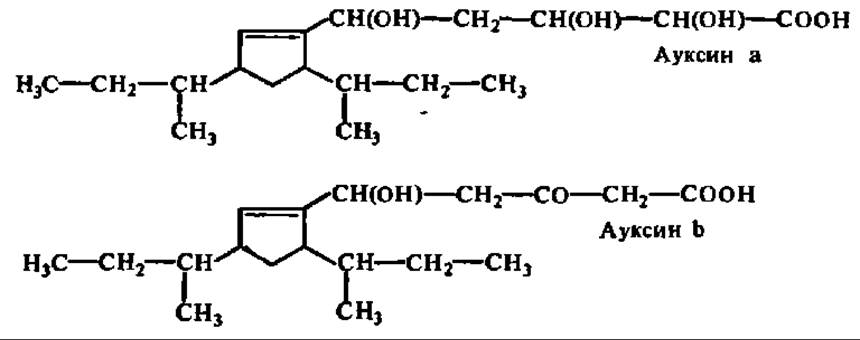
These are fat-soluble substances that accelerate cell elongation and plant growth in minute quantities.
Heteroauxin is a plant-derived hormone also synthesized by Yeasts, Molds, and Bacteria. In 1934, F. Kögl established that it is ß-indoleacetic acid:

It is particularly effective at promoting ROOT growth, which is why it is widely applied in commercial plant propagation via cuttings.
Gibberellins are hormones produced by Fungi of the genus Fusarium, isolated in the 1920s at the University of Tokyo under the direction of T. Yabuta. Several dozen gibberellins are currently known. The structural formula of one of them is shown below:

Gibberellins initiate seed germination, accelerate plant growth, stimulate the onset of flowering, and so forth.
Ethylene (CH2 = CH2). Its hormonal activity was first observed in 1901 by D. N. Nelubov (St. Petersburg University) and rediscovered in the 1920s. It accelerates fruit ripening, causes stem shortening and thickening in plants (thus preventing lodging in cereal crops), and promotes leaf and fruit abscission. At the University of Wales (UK) by M. Hall and the University of Wisconsin (USA) by T. Bleecker, the genes encoding ethylene receptors have been sequenced, and active experiments are underway to elucidate The Mechanism of action of this simplest plant hormone. It has recently been established that plants produce ethylene through The oxidation of 1-aminocyclopropane-1-carboxylic acid, mediated by the ethylene-forming enzyme (M=35 kDa, pH optimum = 7.2, t optimum = 26° C).
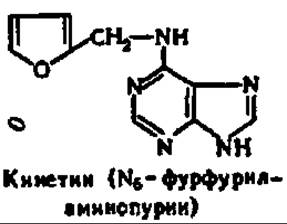
Kinetin is a hormone belonging to the cytokinin group, serendipitously discovered by University of Wisconsin assistant F. Skoog in DNA degradation products (1940–1950). It dramatically accelerates Cell Division and promotes the biosynthesis of Nucleic Acids and Proteins. Its chemical structure is as follows:
Recently, highly intensive efforts have been undertaken to elucidate the mechanism of action of plant hormones. Particularly compelling data have emerged from studies on the mechanisms of heteroauxin, gibberellin, and kinetin. It turned out that these compounds affect one of the most fundamental processes in living nature—DNA Methylation—and thereby can control Transcription, i.e., Gene Expression. Furthermore, proteins resembling animal steroid Hormone Receptors have been discovered in plant Cell Cytoplasm; under the influence of phytohormones, these proteins become involved in modulating gene transcription. This accounts for the diverse effects that these compounds exert on plant development by inducing or activating the synthesis of proteins required for specific physiological processes within the plant Organism.
Last update: 06/08/2026
Editorial and Educational Adaptation: This material has been compiled based on the primary/original source text. The project team performed an editorial review, corrected technical inaccuracies, structured sections, and adapted the content for an educational format.
What was processed:
- elimination of formatting defects (OCR errors, structural breaks, corrupted characters);
- editorial organization of content;
- standardization of terminology in accordance with academic sources;
- verification of factual statements against the original source text.
All mentions of the author, publication year, and origin of the primary text have been preserved in accordance with the source.