Plant Physiology - Musienko M. M. 2001
The influence of environmental conditions on plant growth and development. Photomorphogenesis. Phytochrome. Photoperiodism. Vernalization
Photoperiodism
The progression of Plant GROWTH AND DEVELOPMENT depends not only on light intensity and quality, but also on The ratio of light to dark periods throughout the day. The physiological reaction of plants to this daily light-dark cycle—specifically the relative duration of day and night that triggers changes in growth and development—is known as photoperiodism. It can be viewed as an adaptive mechanism enabling organisms to respond to seasonal environmental changes.
Photoperiodism was discovered in the early 1920s by American scientists W. Garner and H. Allard. While studying Maryland Mammoth tobacco and soybeans under various controlled conditions of Temperature, humidity, Nutrition, and lighting, they noticed that day length was the critical factor determining flowering for both species. The plants failed to flower when day length exceeded a certain critical threshold. Regardless of sowing dates, soybeans bloomed only when the days grew sufficiently short in autumn, whereas Maryland Mammoth tobacco plants flowered only in December when the days became even shorter, regardless of their height (Fig. 187).
Class="center">
Fig. 187. The Effect of day length on a long-day plant (Nicotiana sylvestris) and a short-day plant (Nicotiana tabacum)
W. Garner and H. Allard defined photoperiodism as the biological response to varying illumination within a 24-hour daily cycle. They demonstrated that plants such as soybeans, cotton, tobacco, millet, sorghum, rice, chrysanthemums, and asters flower when the light period lasts 8–12 hours, provided the night is sufficiently long. When cultivated in southern regions, these plants bloom much faster than in northern latitudes. Such species are classified as short-day plants.
A second group comprises plants that flower more rapidly under long days (16–20 hours). These include cereals such as oats, wheat, rye, and barley, as well as flax, lupine, and sugar beet. Such species are known as long-day plants.
Finally, There is a group of day-neutral plants—such as sunflowers, peas, and buckwheat—in which variations in day length cause no significant changes in ontogeny.
In recent years, researchers have also identified plants with mixed types of light response: long-short-day plants (which require a long day in early development followed by a short day, such as the Jerusalem artichoke) and other transitional groups.
The key difference between short-day and long-day plants is that the former bloom in autumn when the daylight hours rapidly decrease, whereas the latter flower in early summer when days are significantly longer than nights. It is worth noting that in most families—such as Asteraceae, Poaceae, Fabaceae, and Solanaceae—different species belong to distinct photoperiodic groups. Conversely, some families consist exclusively of long-day and neutral species (e.g., Brassicaceae, Caryophyllaceae, Ranunculaceae) or exclusively of short-day and neutral species (Euphorbiaceae, Amaranthaceae). The discovery of photoperiodism is of great practical importance in agriculture for obtaining multiple flower and seed crops per year, as well as for the early forcing of ornamental and vegetable plants.
Photoperiodic responses vary among species. While some plants require only a single day–night cycle to respond, others need weeks of exposure. Many species show a correlation between the number of induction cycles and The rate of flowering or the number of flowers produced. Certain plants must reach a specific degree of maturity before flowering can be induced, whereas others react to the appropriate photoperiod even at the seedling stage. Some species, as they age, will eventually flower without the appropriate photoperiod cue, though optimal exposure would have caused them to bloom much earlier.
Why do different plants require specific photoperiods for their development? It turns out there is a close correlation between a plant's photoperiodic response and its geographical origin. This was first pointed out by V.M. Lubimenko, A.I. Doroshenko, V.I. Razumov, and O.A. Shcheglova. Research revealed that short-day plants originate from tropical and subtropical regions, whereas long-day plants hail from higher latitudes. As is well known, day length at the equator is constantly 12 hours, while in temperate latitudes it reaches 16–18 hours, and in the polar regions in June it is a full 24 hours. Accordingly, short-day plants predominantly inhabit southern regions, while long-day plants inhabit the north. Thus, photoperiodism is an evolutionary adaptation of plants to specific environmental conditions.
Long-day and short-day plants likely evolved from neutral ancestors, which are phylogenetically older. When grown under long or short days, plants from different photoperiodic groups exhibit distinct morphological differences. Most long-day plants fail to form a flowering stem under short-day conditions, remaining in a rosette or tillering phase. For instance, winter crops only tiller in autumn, producing shoots and leaves without stem elongation. Shortening the day length causes such plants to adopt a low-growing, prostrate habit. Conversely, increasing day length prompts them to bolt, producing upright stems with elongated internodes. Short-day plants exhibit vigorous vegetative growth under long days, but fail to produce flowers.
Shortly after the discovery of photoperiodism, it was proven that many plants actually respond to the duration of the dark period rather than the light period. In other words, for flower bud initiation, an Organism requires a specific, uninterrupted period of darkness that is not broken by light. Therefore, so-called short-day plants are, in essence, long-night plants.
While studying the short-day plant Xanthium strumarium, K. Hamner and J. Bonner (1938) discovered that the photoperiod is perceived by the leaf blade. If all leaves are removed, flowering cannot be induced in such a plant. However, if even one-eighth of a fully developed leaf is left on the stem, a single short-day exposure triggers flowering (Fig. 188). Hamner and Bonner made a striking discovery: if the dark period is interrupted by even a minute of light, flowering does not occur, whereas interrupting the light period with darkness has absolutely no effect on flowering. Subsequent experiments with other short-day plants (Fig. 189) led M.Kh. Chailakhyan to hypothesize that specific phytohormones are synthesized in the leaves to trigger the transition to flowering. These substances were found to act locally within the SHOOT where they are synthesized, moving from the leaves to the apical Meristems of that same shoot. As a result, flower buds are initiated and the plant transitions to flowering.

Fig. 188. Induction of flowering in Xanthium strumarium by photoperiod duration: K — flower, B — vegetative shoot
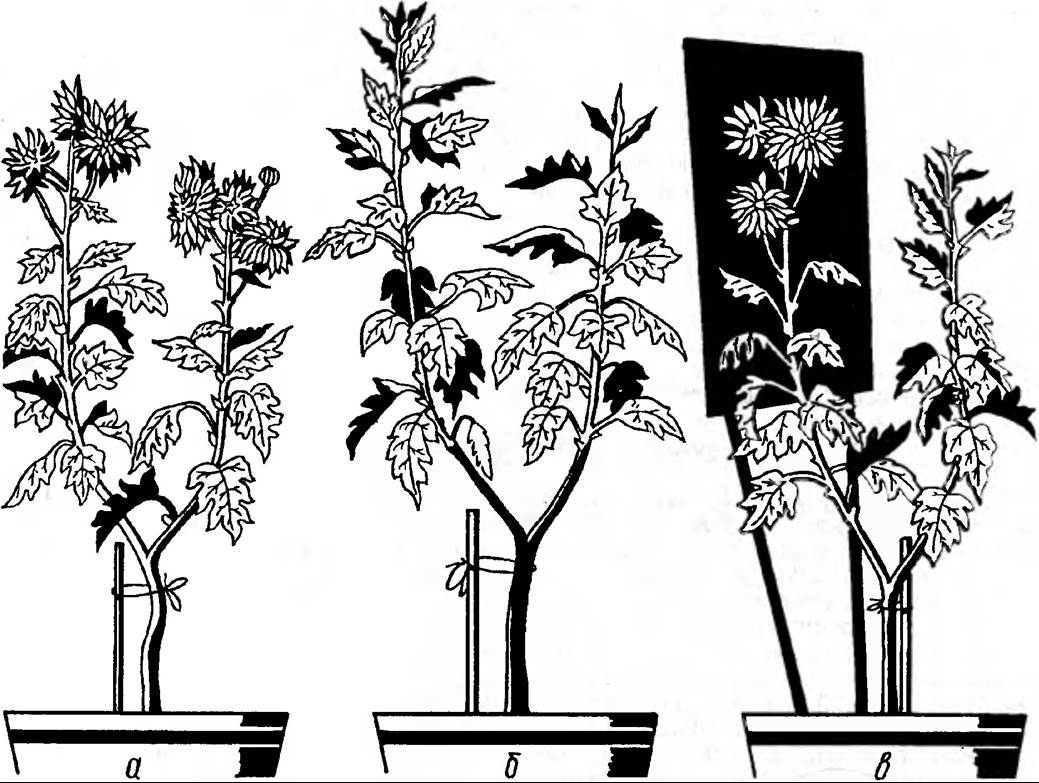
Fig. 189. The Role of leaves in the photoperiodic response of the short-day plant chrysanthemum: a — plant grown under short-day conditions, b — plant grown under long-day conditions, c — left shoot of the plant kept under short days, right shoot under long days
Investigations into the interruption of the dark period in short-day plants by a flash of light demonstrated the high effectiveness of red light at a wavelength of 660 nm, with Phytochrome acting as the photoreceptor. The effect of phytochrome depends on the level of its active far-red absorbing form. The amount of Pfr varies depending on the spectral COMPOSITION OF THE light preceding the dark period, as well as the duration of the darkness. This occurs because the ratio of red to far-red energy in sunlight near the Earth's surface depends on the daytime light period itself, typically dropping just before sunset. This reduction lowers the Pfr content by the end of the day. The amount of far-red absorbing phytochrome continues to decrease through the night due to its dark reversion Pfr → Pr. At sunrise, the Pfr level rises again.
It is important to note that the transformation Pr → Pfr triggers a response only during specific Phases of the organism's endogenous rhythm. According to E. Bünning's hypothesis, the photoperiodic control of flowering is also regulated by endogenous rhythms corresponding to various phases of a biological clock. The mechanism by which phytochrome regulates biological rhythms is thought to involve cyclic fluctuations in Cell membrane permeability and transport properties throughout the cycle. In turn, the mutual conversion Pr <=> Pfr influences this rhythmicity by inducing rapid Structural and functional changes in membranes.
Long-day plants also measure the duration of the dark period.
The phenomenon of plant dormancy is also closely linked to photoperiodism. The onset of bud dormancy in most temperate-zone plants is triggered by a response to decreasing day length. This environmental cue is perceived by the leaves, leading to an accumulation of Abscisic acid, which is then transported to the meristems to inhibit growth. Furthermore, short autumn days induce leaf abscission in deciduous trees. Winter bud dormancy can be broken only by exposure to cold—a chilling stimulus that can also be artificially replaced by gibberellin. Characteristically, aside from buds and
seeds, the photoperiod also controls the dormancy state of storage Organs. For instance, short days induce tuber formation in potatoes, whereas long days promote bulb formation in onions.
Thus, normal plant development is ensured only if the organism receives the required photoperiod not throughout its entire life, but rather during a specific, relatively short stage of its life cycle. V.M. Lubimenko termed this phenomenon photoperiodic induction.
Last update: 07/08/2026
Editorial and Educational Adaptation: This material has been compiled based on the primary/original source text. The project team performed an editorial review, corrected technical inaccuracies, structured sections, and adapted the content for an educational format.
What was processed:
- elimination of formatting defects (OCR errors, structural breaks, corrupted characters);
- editorial organization of content;
- standardization of terminology in accordance with academic sources;
- verification of factual statements against the original source text.
All mentions of the author, publication year, and origin of the primary text have been preserved in accordance with the source.