Plant Physiology - Musienko M. M. 2001
The impact of environmental conditions on plant growth and development. Photomorphogenesis. Phytochrome. Photoperiodism. Vernalization.
Light regulation of plant growth and development
The Influence of External conditions on Plant GROWTH AND DEVELOPMENT is driven by a variety of factors, among which we can distinguish: climatic (Water, light, heat, atmospheric gas composition, etc.); edaphic (soil Structure and its chemical composition); and biotic (various microorganisms, plants, and animals). All of these factors act in concert; their effects are intimately interrelated and mutually dependent. In the preceding chapters, we examined the roles of water, soil, and mineral and aerial Nutrition in the vital activity of plant organisms. Therefore, in this chapter, we will focus on such crucial environmental factors as light and Temperature.
Many growth processes—such as growth rate, growth direction, and developmental milestones including flowering, fruiting, leaf fall, transition to dormancy, and senescence—depend on and are regulated by light. In these cases, however, the primary role belongs not to light intensity, but rather to the duration of the light and dark periods. After all, besides powering Photosynthesis, light performs signaling and regulatory Functions. A green plant is not merely a solar-powered energy unit; the very structure of this mechanism is partially determined by the quantity and quality of the light energy it absorbs.
The Role of light is best demonstrated by growing a plant in total darkness;
Class="center">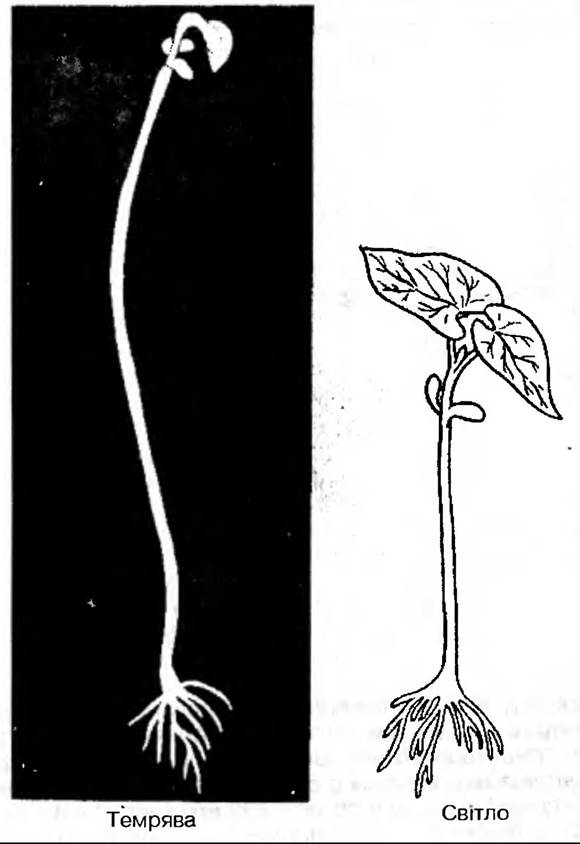
Such plants fail to accumulate chlorophyll; their internodes become elongated and thin, while their leaves remain small and underdeveloped. Instead of the chloroplast membrane system, etioplasts are formed within them. These plants lack sufficient supporting Tissues and are therefore prone to breaking and lodging. Plants grown in the dark are referred to as etiolated, and the phenomenon itself as etiolation. Natural etiolation also has a positive adaptive value, as it enables a plant to maximize upward growth using minimal carbon reserves that cannot be replenished without photosynthesis. If an etiolated seedling fails to reach the light and begin photosynthesizing, it is doomed to perish once its stored nutrient reserves are exhausted.
Even negligible doses of absorbed solar quanta exert a significant impact on a dark-grown seedling: they alter the growth rate and orientation of leaves and stems, pubescence, pigmentation, and more.
The transition to flowering and fruiting depends entirely on illumination. Finally, leaf abscission, the onset of dormancy, and The phenomenon of Aging are all consequences of previously absorbed light signals and other stimuli. The entire spectrum of processes associated with METABOLISM/18.html">The Influence of light on Plant Growth and differentiation is termed photomorphogenesis. Through photomorphogenesis, guided by its genotype, a plant acquires a form optimized for specific environmental conditions. In other words, photomorphogenesis represents normal plant growth and development. Notably, Photosynthetic Pigments do not play the leading role in these processes; instead, The primary function is performed by phycobilin and Phytochrome pigments, alongside certain others, potentially flavoprotein pigments.
Phytochrome
The mechanism by which light affects morphogenetic reactions remains insufficiently studied. During photomorphogenesis, a light signal initiates the expression of a new genetic program—The Development of a green plant. Photoreceptors, namely phytochrome and cryptochrome, induce all responses of photomorphogenesis. The phytochrome content in a plant is extremely low; consequently, it is unsurprising that the energy required to saturate the corresponding photoprocesses is several orders of magnitude lower than that required for photosynthesis. The products of these light reactions do not regulate plant growth stoichiometrically, unlike CARBOHYDRATES in photosynthesis. Rather, they influence parameters such as membrane permeability, Gene Expression, and enzyme activity. Thus, by way of comparison, whereas photosynthesis requires 8–10 quanta to evolve a single mole of oxygen, the same number of quanta absorbed by the phytochrome system can entirely determine the growth parameters of an entire stem or the onset of the reproductive phase.
Phytochrome is a water-soluble chromoprotein whose chromophore is an open-chain tetrapyrrole linked to the apoprotein via a thioether bond:
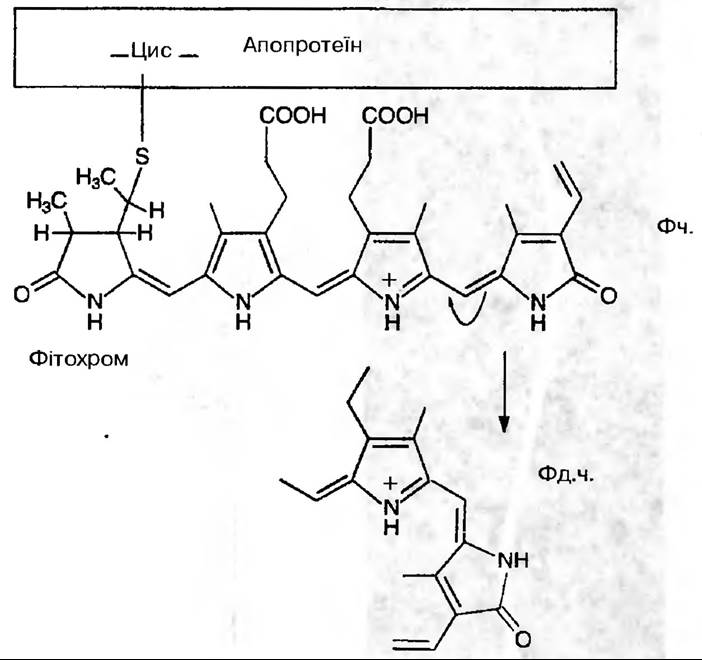
This biliprotein pigment is presumably localized within plant membranes and can readily alter its conformation and light-absorption maxima under the influence of light. Phytochrome exists in two interconvertible forms designated as Pr (red-absorbing phytochrome, with a maximum Absorption in the region of 660 nm) and Pfr (far-red-absorbing phytochrome, absorbing far-red rays in the region of 730 nm) (Fig. 186).
Phytochrome is synthesized in the Pr form, which is physiologically inactive. Upon exposure to red light, the majority of it converts into the Pfr form, which is physiologically active. The Pfr form is quite labile, and in darkness, it gradually reverts back to Pr (Pr -> Pfr → Pr). Thus, phytochrome functions as a biological switch. In all cases, The Effect of a red light pulse in restoring a high level of Pfr can be reversed by a brief exposure to far-red light, which converts Pfr back into Pr.
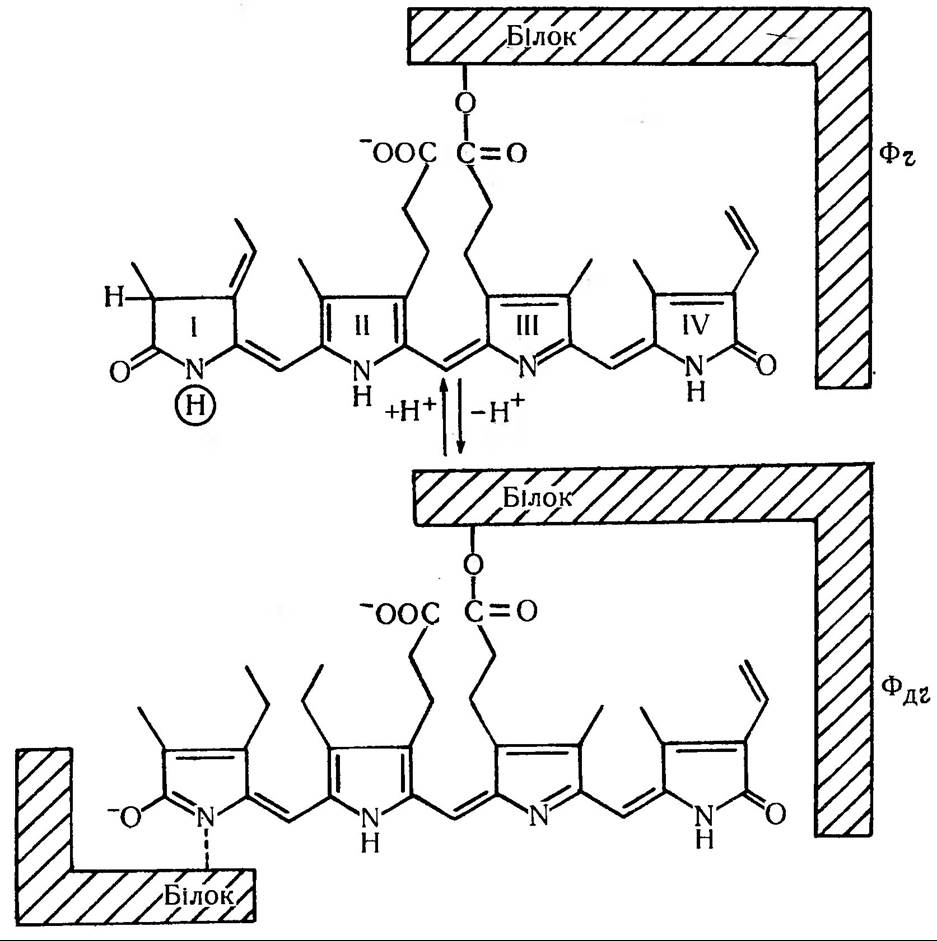
Fig. 186. Interconversion of the two phytochrome forms
Sunlight contains roughly equal proportions of red and far-red rays; therefore, under natural visible light, The ratio of the two phytochrome forms in a plant Organism remains relatively balanced. Phytochrome-mediated reactions depend on the concentration of the far-red-absorbing form. Typically, these reactions reach saturation when 50% of the phytochrome is in the Pfr state and continue as long as an adequate supply remains available.
The phytochrome molecule consists of two parts: a relatively small light-absorbing chromophore and a much larger colorless protein. The chromophore is similar to phycobilins and represents an open-chain tetrapyrrole. Upon Light absorption by phytochrome, the conformation of the chromophore group changes depending on the wavelength of the absorbed rays, which in turn triggers Conformational Changes in the protein component. The protein component is composed of 4 subunits with a Molecular Weight of 240,000.
The Pr → Pfr conversion induced by a brief pulse of red light affects plant biochemical reactions over several hours into the subsequent dark period. Such striking persistence of the effect of a very short irradiation is explained by the fact that Pfr, being the active form of phytochrome, is relatively stable in the dark. In some experiments, Pfr activity in growing tissues was detected even 72 hours after red light irradiation. Unlike phytochrome, the activated forms of other pigments are rather unstable; for instance, an excited chlorophyll molecule has a lifespan of merely a few milliseconds.
The gradual decline of Pfr levels in darkness following red light exposure is driven by two processes: reversion and destruction:

In some tissues, Pfr slowly converts back to Pr in the dark, whereas in others, it undergoes degradation. In certain cases, both processes occur simultaneously. Phytochrome destruction and reversion are temperature-dependent (high temperatures accelerate the process). It is hypothesized that G-Proteins participate in activating the expression of phytochrome-regulated genes. Specifically, Plasma Membranes from etiolated oat seedlings have been found to exhibit a reversible GTP-binding activity regulated by red and far-red light. This activity is also modulated by blue light.
How does phytochrome work? Phytochrome is present in plant Cells in extremely small amounts, yet minute quantities of absorbed energy trigger such diverse physiological responses. Therefore, it is highly probable that the primary photon absorption must be coupled to the cellular response through some Amplification mechanism. Such a mechanism could involve the Control of Gene Expression, enzyme activity, alterations in membrane properties, or Changes in the levels of substances such as phytohormones, which in turn influence various physiological processes at low concentrations. While all these processes are plausible under certain conditions, regulation of Membrane Functions should be considered the primary amplification mechanism.
Ontogenetic reactions, such as the onset of flowering, seed germination, and de-etiolation, are inextricably linked to plant Cell activity and radical changes in their chemistry, structure, and functions. These changes, in turn, depend on shifts in The activity of numerous Enzymes as well as their de novo synthesis. Because enzymes are proteins whose synthesis is governed by Translation and Transcription, the state of phytochrome must affect one or both of these processes simultaneously. It may bind to nuclear Chromatin, thereby directly influencing RNA and Protein Synthesis:
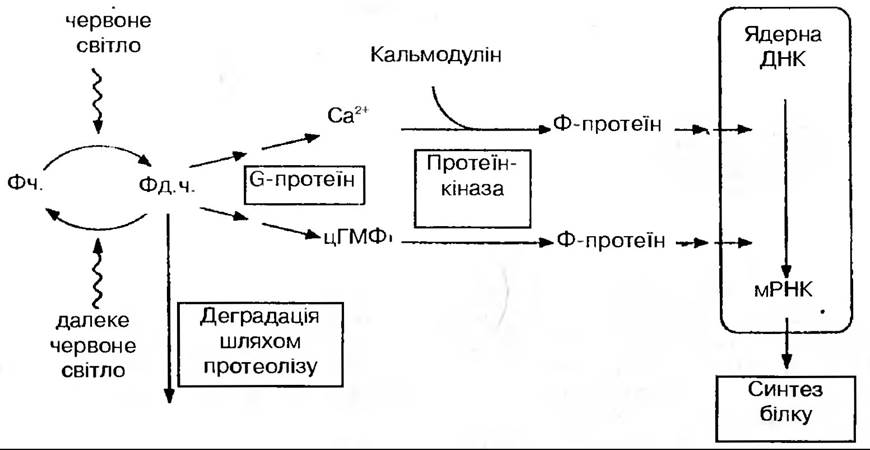
As noted previously, many physiological and morphological changes induced by phytochrome are triggered even by brief, low-fluence illuminations (1/100 of full daylight for 1 minute).
Perhaps its influence is even more subtle, acting through the alteration of intracellular ion compartmentalization and, consequently, changes in protein synthesis.
However, the control of Protein synthesis is not the only regulatory pathway of phytochromes, as the processes they regulate do not depend on PROTEIN SYNTHESIS AND occur very rapidly. As is well known, Plant HORMONES are rapidly transported throughout the plant and remain effective in minute quantities. It can be assumed that the Synthesis and degradation of phytohormones may result from the direct enzymatic action of Pfr or its effect on the activity of synthetic and hydrolytic enzymes that exist as proenzymes prior to irradiation. The binding or release of phytohormones at their sites of action and storage can occur As a result of the modification of these sites by the phytochrome Pfr.
The levels of such hormones as Gibberellins, Cytokinins, Ethylene, and auxin in the tissues of dark-grown plants change rapidly following a brief red-light irradiation, whereas the Abscisic acid level shifts under prolonged red-light exposure. Because the effect of red light on gibberellins, cytokinins, and ethylene can be reversed by far-red light, phytochrome unquestionably serves as the photoreceptor for these responses. Pfr is known to increase the levels of gibberellins and cytokinins while conversely decreasing the content of auxin and ethylene.
The rapid efficacy of its action is apparently due precisely to its impact on membrane STRUCTURE AND FUNCTIONS. The hypothesis that phytochrome acts at the membrane level is further supported by the direct demonstration of phytochrome incorporation into and functioning within artificial lipid membranes. Irradiation of such membranes with red and far-red light induces significant changes in their physical properties (for instance, electrical resistance). This indicates that conformational changes in the phytochrome chromophore can simultaneously alter Membrane Structure. Other, more delayed effects (such as gene activation) may also be influenced by these primary manifestations of phytochrome action.
Thus, based on the association of phytochrome with the membrane, several possible mechanisms of its action can be distinguished:
·regulation of Active Transport of ions and molecules across the membrane (possibly via changes in ATPase activity);
·Regulation of the activity of membrane-bound phytohormones;
·influence on the activity of membrane-bound proteins.
It should be borne in mind that not all phytochrome-controlled responses are localized within the same cell. In some cases, irradiation of one part of a plant affects the development of Organs located at a certain distance—for example, photoperiodic induction of flowering, tuber formation, or transition to dormancy. Therefore, any hypothesis concerning The Mechanism of phytochrome action must explain not only local but also spatially distant responses.
Finally, some photomorphogenetic reactions require significantly more light energy and are triggered primarily by blue or far-red light. For instance, the transition to flowering or anthocyanin accumulation can be regulated by phytochrome or another pigment absorbing blue wavelengths. It is possible that blue light is absorbed by a different pigment, such as a flavoprotein.
Recently, the view has been expressed that phytochrome can also act as a detector sensing shading by neighboring plants. Radiation at 700 nm is almost entirely reflected or absorbed by plants, whereas far-red light (700–800 nm) is largely transmitted. This causes a critical upward shift in the Pr to Pfr ratio—meaning that more Pfr is converted in shaded plants—which triggers a rapid increase in internode elongation.
Responses to red and far-red light are also related to anthocyanin synthesis in apples and cabbage, as well as A wide variety of other plant reactions across all phases of The life cycle. As for such a complex phenomenon as Photoperiodism, alongside the mutual conversion of various phytochrome forms, it is controlled by other factors as well.
Mechanism of blue light action. Phytochrome exhibits a minor absorption peak in the violet and blue Regions of the spectrum (460–475 nm). It is known that supplementing red light with these wavelengths enhances the synthesis of Amino Acids and Proteins in plants, with blue light exerting a regulatory effect. However, in most cases, the physiological action of blue light is independent of far-red light. In such instances, blue light acts not via the phytochrome system, but through cryptochrome. Blue light frequently induces hyperpolarization of the cellular Membrane Potential and affects the functioning of redox chains localized in intracellular membranes (Endoplasmic reticulum, Golgi apparatus, Mitochondria) and The Plasma Membrane. Flavoprotein Components of the redox chains ensure the absorption of blue light, thereby influencing metabolism, primarily by controlling ion fluxes. The latter, in turn, participate in The regulatory mechanisms of growth and morphogenesis.
Thus, the final form of a green plant, shaped overall by its genes, is determined with the participation of light acting through various photoreceptors. Protochlorophyll regulates the greening process, chlorophyll dictates the general autotrophic nutrition type, and phytochrome—along with another flavoprotein-type pigment—governs diverse subtle intracellular processes. A green plant is truly a machine driven by light, existing in a state of continuous dependence on the quanta falling upon it.
Last update: 07/08/2026
Editorial and Educational Adaptation: This material has been compiled based on the primary/original source text. The project team performed an editorial review, corrected technical inaccuracies, structured sections, and adapted the content for an educational format.
What was processed:
- elimination of formatting defects (OCR errors, structural breaks, corrupted characters);
- editorial organization of content;
- standardization of terminology in accordance with academic sources;
- verification of factual statements against the original source text.
All mentions of the author, publication year, and origin of the primary text have been preserved in accordance with the source.