PLANT BIOTECHNOLOGY AND BIOSAFETY - A. P. Yermishin - 2015
CHAPTER 8. APPLICATION OF IN VITRO PLANT CELL AND TISSUE CULTURE METHODS TO OVERCOME INTERSPECIFIC REPRODUCTIVE BARRIERS
The breeding of any crop can only be effective if the initial breeding material exhibits a sufficiently high level of genetic Variability. Many agricultural crops are characterized by a very narrow genetic base, which significantly impedes The Development of new cultivars. The most effective approach to expanding the genetic base of breeding material is its Hybridization with wild and primitive cultivated relatives (distant hybridization). Plant breeding has embraced two main directions for utilizing distant hybridization: expanding the genetic base of a given cultivated species (enhancing allele diversity) and introgressing specific valuable genes into the breeding material.
To achieve the first of these goals, the most promising candidates are species cultivated by indigenous populations within the centers of Water/144.html">Origin of the crop (primitive cultivated species). As a rule, they cross relatively easily with the cultivated species. The resulting hybrids are intercrossed or backcrossed with the cultivated species to produce breeding material with broadened allelic diversity, the utilization of which enhances the efficiency of breeding for yield and ecological stability.
To introgress specific genes from wild species into breeding material, interspecific hybrids involving the cultivated species are first produced, followed by a series of backcrosses with the cultivated species. This ensures that only a minor fraction of the introduced genetic material from the wild relative remains in the breeding pool—specifically, the fraction associated with the expression of valuable traits lacking in the cultivated species, such as resistance genes to biotic and abiotic environmental factors, or product quality traits.
Many cultivated species possess a wide range of wild relatives of significant interest for breeding. Some of these can be directly crossed with cultivated forms. However, in many cases, such crosses encounter major obstacles caused by natural interspecific barriers. The primary factors responsible for species isolation are categorized as follows: 1) external ecological barriers: the physical Separation of species populations in space and time (mismatch of flowering periods) resulting from adaptation to specific ecological niches; 2) genomic differences between species; 3) differences in ploidy level; and 4) internal barriers that impede hybridization (pre- and postzygotic reproductive barriers).
The first of these barriers are relatively easy to overcome by synchronizing the flowering of the crossed species in a single Location. Significant genomic differences between species make the introgression of valuable genes from one species to another nearly-impossible due to disruptions in Gene recombination during the Meiosis of interspecific hybrids. It is relatively straightforward to combine valuable traits from two species with substantial genomic differences into a single genotype by producing amphidiploid interspecific hybrids (G. D. Karpechenko, 1935). In such hybrids, the parental genomes are represented in a diploid state, which enables normal homologous chromosome conjugation during meiosis. However, this method is primarily applicable to hybrids between cultivated species (e.g., triticale, a hybrid between wheat and rye).
Ploidy differences between crossed species can cause cross-incompatibility (see postzygotic reproductive barriers below) or the sterility of interspecific hybrids, even when the parental species share similar genomes. In many cases, this problem can be readily resolved by increasing or decreasing the ploidy of one of the species (e.g., obtaining hybrids between autotetraploid cultivated potato and diploid wild or primitive cultivated potato species, see Section 7.12).
Reproductive interspecific barriers associated with pre- or postzygotic (postgametic) incompatibility present a particular challenge. Specialized techniques, including in vitro Cell and protoplast culture Methods, have been developed to overcome them.
8.1. Pre- and Postzygotic (Postgametic) Interspecific Incompatibility
Prezygotic barriers may manifest as the failure of pollen to germinate on the stigma, germination that fails to produce a pollen tube penetrating the pistil Tissues, or penetration followed by the inhibition of pollen tube growth to varying degrees and in different Regions of the style or Ovary. These barriers occur in both intraspecific and interspecific crosses.
In intraspecific crosses, prezygotic incompatibility manifests as self-incompatibility. For instance, the majority of diploid potato species are self-incompatible; that is, self-pollination fails to set seeds due to the persistent inhibition and arrest of pollen tube growth in the upper third of the pistil style (Fig. 8.1).
Class="center">Fig. 8.1. Prezygotic incompatibility in interspecific potato hybridization: monitoring of pollen tube growth in pistils via Fluorescence Microscopy using aniline blue staining; left: compatible combination (A large number of pollen tubes have penetrated the ovary); right: incompatible combination (inhibition of pollen tube growth in the upper third of the pistil)
(after R. Eijlander, 1998)

Many crops (most notably Solanaceae) feature a single-locus gametophytic self-incompatibility system. Its core mechanism relies on the presence of a so-called S-locus within the species genome, which can be represented by different alleles in a given genotype. When the S-allele of the pollen matches one or both S-alleles of the diploid pistil—which occurs, for example, during self-pollination—pollen tube growth is inhibited and halted. Thus, incompatibility in this case depends on the genotypes of both the male gametophyte and the maternal sporophyte (specifically, whether the gametophyte carries an S-gene allele present in the maternal pistil).
Plants may also exhibit sporophytic self-incompatibility, which depends on the sporophytes of both the maternal parent and the pollinator. In this case, information regarding the pollinator sporophyte is carried by the pollen coat. Sporophytic self-incompatibility is characteristic of Brassicaceae.
From an evolutionary perspective, The Emergence of the self-incompatibility mechanism was of paramount importance, as it helps prevent the appearance of organisms that are demonstrably uncompetitive in the environment (due to the transition of semi-lethal recessive genes into a homozygous state).
According to current models of gametophytic self-incompatibility, the S-locus comprises two primary components: the pistil and pollen components. The genes within them encode products expressed in the pistils and pollen tubes, respectively. The outcome of hybridization is determined by the interaction between the products of the pistil and pollen Components of the S-locus. The products of the pistil component are Glycoproteins with Ribonuclease activity (S-RNases). S-RNases are present in pistils regardless of pollination, and their ribonuclease activity is non-specific. S-RNases can freely diffuse into the Cytoplasm of pollen tubes and halt their growth by acting as Translation inhibitors (A. Clarke, E. Newbigin, 1993). This unique barrier can be breached only by pollen tubes containing specific products capable of deactivating the corresponding RNases. Candidate products for the pollen component of the S-locus include SLF Proteins (F-box Proteins of the S-locus), which are believed to recognize corresponding S-RNases and trigger their degradation pathway (N. Eckardt, 2004).
The correlation in species behavior during interspecific crosses and self-pollination has led to the Conclusion that gametophytic self-incompatibility and interspecific incompatibility share a common mechanism, or at least share overlapping mechanistic elements. In particular, the gametophytic self-incompatibility model described above can explain interspecific incompatibility mechanisms in potatoes, provided one assumes that the interaction between the pollen and pistil components of the S-locus is species-specific: the deactivation of the corresponding pistil RNases can occur only through SLF proteins from the same or a closely related species. For instance, dihaploids of S. tuberosum are known to cross successfully with many South American diploid potato species that are evolutionarily close to them. Consequently, potential variations in the pollen component of the S-locus in these species do not impair the ability of its products to deactivate the pistil RNases of other South American species during interspecific hybridization. Mexican diploid potato species represent the evolutionarily oldest group of tuber-bearing Solanum species. Evidently, due to divergence between these species and South American potatoes, differences in their S-loci are so substantial that the interaction between pollen and pistil components during hybridization between these species groups is disrupted, resulting in pre-incompatibility barriers (see A. Yermishin, 2001).
Postzygotic (postgametic) barriers are defined as those arising after the penetration of pollen tubes into the ovary and following Fertilization. Most frequently, postgametic incompatibility manifests as aberrant endosperm development in the hybrid seed, leading to early embryo abortion. In seed plants, the endosperm is a crucial seed Structure that nourishes the developing embryo from the moment the zygote forms. The endosperm is the product of double fertilization, formed when one of the sperm Cells fuses with the diploid central cell of the female gametophyte.
Postgametic incompatibility is primarily characteristic of interploidal crosses (i.e., between parental forms with differing ploidy levels). However, in many cases of interspecific hybridization, crosses between species with different ploidy levels succeed, whereas crosses between those with identical ploidy levels fail. For instance, allotetraploid potato species of the series Acaulia and Longipedicillata do not cross with tetraploid cultivars of the cultivated potato S. tuberosum, yet they readily cross with S. tuberosum dihaploids and most diploid wild species from South America, forming triploid hybrids.
To account for these deviations from the general rule, the Endosperm Balance Number (EBN) hypothesis was proposed (S. Johnston et al., 1980). According to this hypothesis, each species is assigned a specific EBN—reflecting its "effective ploidy"—based on its behavior in interperspecific crosses. The EBN ratio of the female and male parents in the endosperm must be 2:1 for the hybrid endosperm, and consequently the seed, to develop normally. In other words, for successful hybridization, the EBN values of the parental forms must match.
In most cases, a species' EBN corresponds to its actual ploidy level, though discrepancies can occur. For example, allotetraploid potato species have an effective ploidy of 2 EBN, tetraploid cultivated potato cultivars and the hexaploid S. demissum have 4 EBN, and most South American diploid potato species possess 2 EBN. Conversely, certain South American diploids, the majority of Mexican diploid species, and non-tuber-bearing diploid potato species have 1 EBN (see table). Analogous systems have also been described in alfalfa, cotton, oats, wheat, and tomatoes.
Classification of Solanum species according to their ploidy and EBN (after J. Hermsen, 1994)
Ploidy |
EBN |
Solanum species* |
2х |
1 |
blb, brd, cap, chn, clr, cph, cmm, crc, etb, frn, jam, lgl, mrf, pld, pnt, trf, amphimonoploids of allotetraploid species |
2х |
2 |
chc, chm, ifd, tar, sect. Megistacroloba and Tuberosa, with the exception of chn, dihaploids of natural and artificial autotetraploids |
4х |
2 |
All allotetraploids: acl, agf, col, fen, hjt, opl, plt, pta, scr, sto, tuq; all doubled 2х, 1 EBN species |
4х |
4 |
tbr subsp. tbr and adg; all doubled 2х, 2 EBN species (autotetraploids) |
6х |
4 |
Sect. Demissa; acl subsp. albicans |
* International Abbreviations are used to designate species names, for example: blb - S. bulbocastanum, acl - S. acaule, tbr - S. tuberosum (see www.ars-grin.gov/nr6).
Increasing ploidy through mitotic or meiotic chromosome doubling in one of the parents to comply with the EBN rule makes it possible to obtain viable seeds with normally developed endosperm between species with different effective ploidy.
8.2. In vitro Pollination to Overcome Interspecific Incompatibility
In vitro pollination is primarily used to overcome prezygotic incompatibility in interspecific and intraspecific crosses. This method was first successfully applied by Indian researchers (K. Kanta et al., 1962) to obtain self-pollinated progeny in the self-incompatible poppy Papaver somniferum. Later, it was used to obtain self-pollinated lines of various self-incompatible species, as well as hybrids between different species of cabbage, tobacco, petunia, and other representatives of various taxonomic groups (see M. Zenkteler, 1992; S. Bhojwani, M. Razdan, 1996).
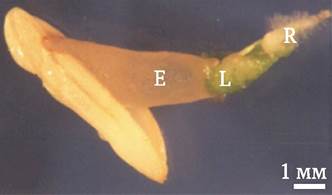
The method involves exposing the ovule(s) by removing the Tissues of the pistil and ovary, applying pollen to them, and culturing the fertilized ovules on a nutrient medium until mature seeds are formed or plant regenerants are obtained from the ovules (Fig. 8.2). Ovaries or ovules are generally cultured on a relatively simple Nitsch nutrient medium (J. Nitsch, 1951) supplemented with 5% sucrose. In many cases, The addition of various growth regulators (Auxins, Cytokinins), as well as coconut milk, Yeast extract, and various Amino Acids, had a beneficial effect on seed development.
Fig. 8.2. Germination of a sunflower Helianthus annuus L. ovule 21 days after in vitro pollination: E — endosperm; L — leaf; R — ROOT (after M. Popielarska, 2005)
Several variations of the method have been proposed: pollination and cultivation of isolated ovaries, ovules attached to the Placenta, and ovules without the placenta. Similar to In vitro fertilization in animals, researchers succeeded in isolating and fusing individual female and male Gametes in vitro and regenerating plants from the fusion products (E. Kranz, H. Lörz, 1993). A chemical gamete fusion method (using CaCl2) was developed, which provided a high frequency (about 80%) of fusion, predominantly between female and male gametes (J. Faure et al., 1994). At the same time, polyspermy (fertilization of egg cells by multiple sperms) was absent, making it unnecessary to use Selection systems for fusion products that are mandatory in somatic hybridization (see below).
Fertilized ovary culture has also proved to be a highly effective technique for obtaining interspecific and even intergeneric hybrids in combinations that were previously unsuccessful due to postgamous incompatibility (embryo death at early developmental stages due to endosperm incompatibility, early fruit drop). Using this method, valuable interspecific hybrids of cotton, clover, and sunflower have been obtained.
When using in vitro pollination or fertilized ovary culture in interspecific hybridization, it is not always possible to obtain mature, filled seeds containing viable embryos. However, these technologies make it possible to prevent the premature death of hybrid embryos and "grow" them to a size and stage where they can be extracted from cultured ovules and placed on a nutrient medium to produce plant regenerants. The embryo culture method also has independent significance for eliminating the consequences of postgamous interspecific incompatibility.
8.3. Application of Embryo Culture to Overcome the Consequences of Postgamous Interspecific Incompatibility
F. Laibach (1925, 1929) was the first to demonstrate the potential of isolated embryo culture for overcoming interspecific reproductive barriers. Using this method, he managed to obtain interspecific hybrids of flax Linum perenne × L. austriacum from shriveled, non-viable seeds. Currently, this method is widely used in breeding for interspecific hybridization of rice, beans, tomatoes, potatoes, lilies, sweet clover, and other crops. It is also used to obtain haploids via pollination with haploid-inducer pollen or irradiated pollen (see Section 7.8), to break seed dormancy, and for other purposes.
The in vitro zygotic embryo culture technique (referred to in English-language literature as "embryo rescue") is relatively simple. Embryos are excised from hybrid seeds under sterile conditions, placed on a nutrient medium, and cultured in the light to induce Plant Regeneration. Standard cell culture media, such as Murashige and Skoog medium, Gamborg's B-5 medium, etc., are used as nutrient media. The sucrose concentration is 2–3% for relatively mature embryos and can be higher (up to 10%) for immature ones. As a rule, media without growth regulators are used, though their addition is occasionally necessary. The efficiency of embryo culture can also be enhanced by adding various biological fluids to the medium: yeast extract, casein hydrolysate, coconut milk, plant extracts, as well as Amino Acids and Vitamins.
Plant regeneration efficiency in embryo culture largely depends on the explant size and the developmental stage of the embryo: the larger the explant and the more mature the embryo, the higher the probability of regenerating a plant from it. However, in interspecific crosses, hybrid embryos frequently perish at the earliest Stages of development due to endosperm incompatibility, underdeveloped endosperm, or premature berry drop. To prevent or delay these adverse phenomena, methodological approaches such as treating fruit pods with growth regulators (auxins) or culturing fertilized ovaries are employed (see Section 8.2). For culturing tiny embryos at early developmental stages, enriched nutrient media are used, along with callus induction followed by plant regeneration (B. Thomas, D. Pratt, 1981). It should be noted that the regeneration capacity of cereal callus cultures derived from immature zygotic embryos is significantly higher than that of cultures derived from mature embryos.
8.4. Production of Interspecific Hybrids via Protoplast Fusion for Introgression of Valuable Genes into Breeding Material
The Cell and tissue culture methods described earlier in this chapter help improve the efficiency of producing hybrids between phylogenetically distant plant species through sexual crosses. However, in many cases, their application fails to overcome existing interspecific reproductive barriers. Somatic hybridization via protoplast fusion opens up new possibilities in this field.
The first protoplast fusion technique, based on The Use of sodium nitrate, was developed in E. Cocking’s laboratory at the University of Nottingham (J. Power et al., 1970; P. Evans, E. Cocking, 1975). Using this technique, somatic hybrid plants between different tobacco species (Nicotiana glauca + N. langsdorffii) were obtained in the USA in 1972 (P. Carlson et al., 1972). Currently, somatic hybridization technology has been refined for many economically important plant species. A large number of valuable somatic hybrids have been produced, serving as the basis for developing new varieties.
Somatic hybridization technology includes the following stages: obtaining protoplast Suspensions from two plant species whose hybrids are to be isolated; preparing a mixed suspension of protoplasts from both species and applying experimental treatments (chemical or electrical) to induce protoplast fusion; selecting fusion products, obtaining callus cultures from them, regenerating somatic hybrid plants, and confirming their hybridity (Fig. 8.3).
Fig. 8.3. Production of interspecific pasture grass hybrids via protoplast fusion: a — protoplast fusion; b — division of fused cells after 4 days of cultivation; c — multicellular structure formed after 4 weeks of cultivation; d — callus cell colonies (four weeks of cultivation after protoplast fusion); e, f — plant regeneration from callus after 8–10 and 12 weeks from THE START OF fused cell cultivation, respectively; g — plant regenerant formed 16 weeks after protoplast fusion (www.phytowelt.com)

8.4.1. Protoplast Fusion Methods
Isolated protoplasts generally carry a like (negative) electrical charge. Therefore, to bring them into close proximity and achieve fusion between protoplasts of different species, specific substances (fusogens, from the English "fusion") are added to the nutrient medium containing the protoplast suspension, or the suspension is exposed to an electric current.
As noted above, NaNO3 was used as the first fusogen (J. Power et al., 1970). Later, less toxic and more effective treatments were proposed. The following protoplast fusion systems have become the most widespread: a high concentration of Ca2+ ions in the medium (about 50 mM) and high pH (9–11) at a Temperature of 37 °C (W. Keller, G. Melchers, 1973); the addition of polyethylene glycol (PEG) to the medium (K. Kao, M. Michayluk, 1974; A. Wallin et al., 1974); and a combination of PEG + high Ca2+ ion concentration and high pH. Polyethylene glycol with a Molecular Weight of 1500–6000 at a concentration of 15–45% is used for protoplast fusion, with a Treatment duration of 15–20 minutes. Its application ensures a high frequency of protoplast fusion (exceeding 30%) across a large number of plant species.
It is hypothesized that long PEG molecules can create molecular bridges between the surfaces of adjacent protoplasts, inducing adhesion (sticking together), which is enhanced in the presence of Ca2+ ions due to the neutralization of the negative charge of the protoplast membranes. Protoplast fusion occurs during the subsequent washing of the suspension to remove fusogens, which causes osmotic Shock and the redistribution of electrical charges across the large surface area of closely contacting protoplast membranes. Initially, small cytoplasmic bridges form between contacting protoplasts at the sites of membrane rupture. These gradually widen, ultimately forming spherical hybrid protoplasts (heterokaryocytes). Cytoplasmic mixing within them is completed within 3–10 hours. During heterokaryocyte division (at the prophase-metaphase stage of mitosis), the genetic material of the nuclei merges, resulting in The formation of two hybrid nuclei after the first mitosis.
The method of plant protoplast electrofusion was first proposed by U. Zimmermann and P. Scheurich (1981). Building on this development, The production of the automated "Zimmermann Electrofusion System" was launched in the USA. Like similar instruments, it demonstrated high efficiency in obtaining A wide variety of somatic hybrids. Electrofusion is carried out in a specialized chamber of the device equipped with two electrodes, with a distance of 0.2–0.5 mm between them (Fig. 8.4). High-voltage pulses (sine wave; peak-to-peak distance 5–10 V; frequency 500 kHz; voltage from 200 V to 350 V, pulse duration ~50 ms) are passed through the nutrient medium containing a suspension of protoplasts from two species. The electric field parameters and the duration of its action are selected experimentally in each case. Under the Influence of the current, aggregates of 2–3 protoplasts or chains of 5–6 protoplasts form between the electrodes. At this point, single direct current pulses are applied to the electrodes, leading to pore formation in the tightly compressed protoplast membranes. As a result, the cytoplasm of the contacting protoplasts mixes, and hybrid protoplasts are formed. The underlying mechanism of fusion is based on the differential effects of direct and alternating electric current on the Plasmalemma: the direct electric field compresses the membranes, leading to their local destruction, whereas the alternating field induces lateral diffusion of Membrane Proteins, creating glycoprotein-free lipid domains where opposing membranes can establish contact.
Fig. 8.4. Eppendorf equipment for protoplast electrofusion (multiporator, protoplast electrofusion chamber, inverted Microscope); the lower inset shows the external view of the protoplast electrofusion chamber (www.eshopeppendorfna.com)

It is believed that the protoplast electrofusion method is more efficient than the chemical one. It provides a high fusion frequency of 10–50% (compared to 10–30% for chemical fusion). The duration of the Procedure is only about 15 minutes, and the protoplasts are not exposed to toxic substances, which has a positive effect on the viability of heterokaryocytes. However, it should be kept in mind that protoplast electrofusion devices are quite expensive. Practice shows that, as a rule, both methods are equivalent in terms of efficiency.
8.4.2. Selection of Protoplast Fusion Products
Following the fusion of protoplasts from two plant species in a mixed suspension, heterokaryocytes (products of protoplast fusion between different species), homokaryocytes (products of protoplast fusion from the same species), and unfused protoplasts can be detected. In principle, all of them are capable of regenerating cell walls and resuming division. This poses The Challenge of isolating hybrid cells from the total mass in order to regenerate somatic hybrids from them.
Since existing methods provide a high frequency of protoplast fusion, a large number of regenerated plants can be obtained, allowing hybrid selection to be performed at the whole-Organism level. This can be done based on the external CHARACTERISTICS OF THE plants, especially in cases where the parental species differ significantly in Morphology or when one or both parents possess dominant marker traits. Protein (isozyme) or DNA markers can also be used for selection. However, in many cases, hybrids are difficult to distinguish from parental forms, particularly at Cytology/cytology/16.html">Early stages of plant development, and the frequency of hybrid regeneration can be very low. Therefore, it is recommended to carry out their selection at THE CELLULAR LEVEL using the following approaches (Yu. Gleba, K. Sytnik, 1984).
Mechanical isolation. The Essence of this method is the use of morphologically distinct types of parental protoplasts, such as protoplasts from callus cells and leaf mesophyll. After fusion, hybrid protoplasts are identified visually under a microscope, isolated using a micropipette, and transferred with a micromanipulator into a separate droplet of enriched nutrient medium. Despite requiring special equipment and microtechnique skills, the method is quite efficient for plant species in which single-cell culture techniques have been established (see Section 3.7). One variation of the heterokaryon mechanical isolation method involves vital staining of parental protoplasts with different fluorescent Dyes (Fig. 8.5).
Fig. 8.5. Vital staining of protoplasts with fluorescent dyes to simplify the visual selection of fusion products: (a) ginger protoplasts stained with fluorescein diacetate (FDA), fluorescing yellow-green under 490 nm light; (b) ginger protoplasts stained with Rhodamine B, fluorescing red under 595 nm light; (c) heterokaryons exhibiting combined yellow-green/red fluorescence under 490 nm and 595 nm light (after Q. Guan et al., 2010)

Genetic complementation. For plant somatic hybridization, genetic complementation is most frequently used involving chlorophyll-deficient mutants, which are often specially generated for this purpose. G. Melchers and G. Labib (1974) were the first to propose using chlorophyll mutants for the selection of somatic hybrids obtained via protoplast fusion.
Chlorophyll Mutations are among the most common in higher plants. They are relatively simple to induce using mutagens such as NMU and EMS (V. Sidorov, 1990). The resulting variegated forms are de-chimerized using cell culture (obtaining regenerated plants via leaf mesophyll protoplast culture is considered the most effective). Chlorophyll-deficient mutants are unviable in the natural environment, but they are easily maintained under in vitro conditions. If protoplasts of mutants homozygous for different recessive genes are fused, the resulting somatic hybrids will exhibit a wild-type (normal) phenotype due to heterozygosity at these loci. Fusion products can acquire a green color as early as during callus cultivation in the light. Green plants are regenerated from such callus (Fig. 8.6).
Fig. 8.6. The use of genetic complementation based on chlorophyll deficiency genes for the selection of tobacco somatic hybrids: (a) chlorophyll formation in cell colonies formed after the fusion of protoplasts from chlorophyll-deficient mutants of N. rustica and N. tabacum; (b) regeneration of green (hybrid) and chlorophyll-deficient (non-hybrid) shoots from callus; (c) a somatic hybrid regenerated plant with well-developed green leaves, stem, and roots (after G. Douglas et al., 1981)

In addition to mutants whose chlorophyll deficiency is caused by recessive nuclear genes, mutations controlled by the plastome (extranuclear genes) as well as nuclear mutations with incomplete dominance have also found application. A drawback of this method is that the hybrid selection stage is postponed until the regenerated plant stage. The use of auxotrophic mutants allows somatic hybrid selection to be performed at the cellular level (V. Sidorov, 1990).
Physiological complementation. This method is based on the ability of hybrid cells to divide and undergo morphogenesis under culture conditions where parental cells are unable to do so. Here, the inability of parental cell cultures to grow and undergo morphogenesis is not associated with any specific mutation, but rather represents their normal physiological response to cultivation conditions. One variation of physiological complementation was employed by P. Carlson et al. (1972) when obtaining the first somatic interspecific tobacco hybrids. It was known that sexual hybrids between N. glauca and N. langsdorfii have a tendency toward tumor formation, and hybrid cells under in vitro conditions are capable of growing on a hormone-free nutrient medium. The hormone independence of hybrid cells formed The basis of this selection method. Following induced fusion of leaf mesophyll protoplasts from both tobacco species, the cells were subsequently transferred to a phytohormone-free nutrient medium, and colonies capable of growing under these conditions were selected.
An approach based on physiological complementation, applicable not only to the aforementioned species combination, was proposed by E. Cocking (1974). The essence of the method is that parental forms with significantly different requirements for cultivation conditions are used for somatic hybridization (conditions suitable for one parent are unacceptable for the other). After protoplast fusion, the mixed cell suspension is first placed in a nutrient medium where cells of one parent are eliminated due to their inability to grow, and then transferred to conditions that similarly eliminate the Cells of the other parent.
Inactivation of protoplasts from one of the parents prior to fusion using ionizing radiation (X-rays, γ-rays at doses of 50–300 Gy) or biochemical poisons (monoiodoacetate, N-ethylmaleimide, diethyl pyrocarbonate, fluorodinitrobenzene) irreversibly suppresses cellular METABOLISM (L. Menczel et al., 1981, 1982, 1983). In hybrid cells, the capacity for division and morphogenesis in in vitro culture is restored.
Physical enrichment involves the separation of protoplasts after fusion using density gradient centrifugation. Fusion products of protoplasts from two parental forms possess an intermediate density value compared to the parental forms. Thanks to this, they can be isolated as a separate fraction. Physical enrichment also helps improve the efficiency of other selection methods, such as genetic complementation.
8.4.3. Symmetric and Asymmetric Somatic Hybrids, Cybrids. Confirmation of Hybridity in Regenerated Plants Obtained After Protoplast Fusion
As a result of protoplast fusion between two plant species, somatic hybrids can be obtained in which the genomes of both parental species are fully represented. Such hybrids are termed symmetric. When obtaining somatic hybrids through the fusion of systematically distant species, it is not uncommon for selective elimination of Chromosomes from one of the parents to occur during Cell Division. As a result, the regenerated plants completely retain The Genome of only one species, along with individual chromosomes from the second species. Such hybrids are called asymmetric. A situation is also possible where the nuclear genetic material of one of the parents is completely absent in the resulting regenerated plants. At the same time, they may contain the plastid and Mitochondrial DNA of both parents or of the parent whose chromosomes were lost. Such hybrids are termed cybrids (cytoplasmic hybrids).
Asymmetric hybrids can also form during the somatic hybridization of relatively closely related species—for example, in the event of the fusion of two protoplasts from one parental species and one protoplast from the second parental species. There is a technology for the deliberate production of asymmetric hybrids through the fusion of intact protoplasts of one species (the recipient, most often a cultivated species) and protoplasts of another species (the donor, usually a wild species) whose genome has been heavily fragmented using special treatments. The goal of creating such hybrids is to fully preserve the genome of the cultivated parent while transferring only specific valuable breeding-related nuclear genes from the wild species, thereby eliminating numerous undesirable genes. This technology also makes it possible to obtain cybrids carrying valuable cytoplasmic GENES OF THE donor species, such as cytoplasmic male sterility genes associated with transferred Mitochondria.
To fragment the genome of the donor species, protoplasts are subjected to intense ionizing radiation (X-rays, γ-rays at doses of 50–300 Gy) or ultraviolet light irradiation. The technique of micronuclei- or microprotoplasts-mediated chromosome transfer (MMCT), originally developed for partial genome transfer in mammalian somatic cell hybridization, is also employed. Micronuclei and microprotoplasts are obtained using antimitotic herbicides (e.g., oryzalin, chlorpropham) or colchicine, which exert an inhibitory effect on the microtubules of the cell division spindle. Toxin-treated cells are arrested at the metaphase stage, chromosomes remain scattered in the cytoplasm and subsequently decondense into micronuclei. Microprotoplasts are obtained from cells containing micronuclei; they are fractionated using ultracentrifugation and filtration through filters with varying pore sizes. Metabolic inhibitors such as iodoacetate, iodoacetamide, and rhodamine 6G have also found application in obtaining asymmetric hybrids by inhibiting protoplast division through the irreversible inactivation of the cytoplasm. The fusion of recipient protoplasts treated with metabolic inhibitors and irradiated donor protoplasts allows the restoration of division in the resulting heterokaryons or cybrids.
The technology for creating asymmetric somatic hybrids has not become widespread due to the emergence of more predictable Introduction/32.html">Genetic Engineering METHODS. However, interest in it has been revived owing to The complexity of regulatory barriers associated with the practical introduction of genetically modified organisms, as well as negative public attitudes toward GMOs (L. Shankar et al., 2013).
The obtained somatic hybrids must be thoroughly investigated. First of all, their hybridity must be confirmed. To this end, approaches such as the STUDY OF MORPHOLOGICAL traits (particularly relevant if the parental species differ significantly in morphology), evaluation of the breeding value of the hybrids (whether breeding-valuable genes were successfully transferred from wild species), and isozyme analysis (demonstrating the presence of species-specific isoforms of certain Enzymes from both parental species) are employed. Recently, various DNA markers have been used to confirm the hybridity of regenerated plants, including species-specific markers for individual chromosomes and genes of the parental species.
Modern cytogenetic techniques can be highly informative. In particular, genomic in situ hybridization (GISH) makes it possible to apply distinct fluorescent labeling to chromosomes belonging to the genomes of parental species. As a result, it becomes feasible not only to evaluate the representation of parental genomes in somatic hybrids but also to trace The Fate of specific chromosomes—such as those from the wild parent—during hybrid derivation and propagation, as well as upon backcrossing with the cultivated parent (Fig. 8.7). Cytogenetic Methods are especially effective when combined with DNA markers for chromosomes and genes.
Fig. 8.7. Application of the GISH method for differential staining of parental chromosomes in an interspecific potato somatic hybrid (BC2 clone of the somatic hybrid S. tuberosum + S. etuberosum; 2n = 51; 39 chromosomes of cultivated potato and 12 chromosomes of S. etuberosum) (adapted from T. Gavrilenko et al., 2003)

8.4.4. Challenges of Backcrossing Somatic Hybrids with the Cultivated Parent and Ways to Solve Them
Although the literature discusses the vast potential of somatic hybridization via protoplast fusion for addressing various fundamental and applied problems, the primary practical interest lies in utilizing this technology to introduce valuable gene pools from wild crop relatives—which are highly refractory to sexual hybridization—into breeding programs. The greatest success has been achieved using somatic hybridization in the breeding of such an important agricultural crop as potato. Through this technology, hybrids have been obtained between cultivated potato and phylogenetically distant species, such as the non-tuber-bearing S. brevidens (palustre), S. etuberosum, 1 EBN diploid wild species S. bulbocastanum, S. pinnatisectum, S. tarnii, S. cardiofilum, S. polyadenium, S. circaeifolium, and S. commersonii, which carry valuable genes for resistance to Viruses, nematodes, late blight, bacterial diseases, and frost (G. Yakovleva, 2012).
However, obtaining somatic hybrids is merely the first step toward introgressing the wild-species gene pool into breeding material, since primary hybrids require subsequent breeding refinement through backcrossing with the cultivated species. In many cases, backcrossing somatic hybrids with cultivars for further integration into the breeding process is severely hindered. Let us examine the main difficulties associated with backcrossing somatic hybrids, using potato as an example, alongside approaches to overcome them.
Somatic hybrids between cultivated potato and the non-tuber-bearing species S. brevidens (palustre) and S. etuberosum are essentially allopolyploids in which, due to significant genomic differences between the parental species, pairing occurs predominantly between homologous chromosomes. Consequently, the introgression of valuable wild-species genes into breeding material via meiotic recombination is severely restricted. In backcrosses of such hybrids with cultivated potato, the chromosomes of the wild parent remain univalent, causing them to be inherited at random. As a result, after just two or three backcrosses, at best only isolated chromosomes of the wild parent are retained in the breeding material. Therefore, it is believed that the introgression of valuable genes from non-tuber-bearing species into cultivated potato is primarily feasible by obtaining trisomic lines (possessing the cultivated potato genome plus individual extra wild-species chromosomes), tetrasomic lines (possessing an extra pair of wild-species chromosomes), or chromosome-substitution lines (where one of a pair of cultivated potato homologous chromosomes is replaced by a pair of wild-species homologous chromosomes). Maintaining such lines via vegetative propagation is straightforward. However, when introducing them into hybridization for breeding purposes, the transmission of wild-species chromosomes to progeny must be continuously monitored.
Somatic hybrids between cultivated potato and wild species with homologous genomes in most cases harbor pre- and postzygotic interspecific incompatibility factors characteristic of the parental species. For instance, tetraploid somatic hybrids between dihaploids of S. tuberosum and S. pinnatisectum or S. bulbocastanum failed to cross with cultivated potato cultivars. This is primarily because the pollen tube growth of S. tuberosum is inhibited within the pistils of somatic hybrids (prezygotic incompatibility). Based on the hypothesis describing The Mechanism of prezygotic interspecific incompatibility action (A. Ermishin et al., 2006), when somatic hybrids are used as the maternal parent, backcrossing cannot be successful because S-RNases—which are products of the S-genes of both parental species—are present in the pistils of such hybrids. The S-RNases of the wild species cannot be deactivated by the S-RNase inhibitory factors present in the pollen tubes of S. tuberosum, leading to the triggering of the incompatibility reaction.
Difficulties in utilizing such somatic hybrids in breeding may also stem from postzygotic barriers, as they apparently possess an Endosperm Balance Number (EBN) different from 4 (the EBN of cultivated potato), which can be one of the reasons for backcrossing failures with potato cultivars. Pentaploid and hexaploid hybrids, which contain an increased number of S. tuberosum genomes compared to the wild species, are backcrossed with S. tuberosum more easily. This is primarily explained by the fact that the EBN of such somatic hybrids is closer to that of cultivated potato than in the case of tetraploid somatic hybrids. Increasing the dosage of cultivated potato genomes in such somatic hybrids should also weaken the prezygotic barriers caused by the presence of pistillar RNases, which are the products of the wild parent's S-genes.
However, the efficiency of introgressing valuable wild-species gene pools into potato breeding material using highly polyploid somatic hybrids has several drawbacks. A fairly long time is required to reduce the ploidy level of the breeding material down to the tetraploid level. Selection for commercially valuable traits is carried out among polyploid and aneuploid breeding material, which is characterized by complex segregation. In this regard, utilizing tetraploid somatic hybrids in breeding and shifting the material to the diploid level appears more promising.
To bypass or overcome the prezygotic factors of interspecific incompatibility that persist in somatic hybrids, A number of approaches have been proposed by the Potato Genetics Laboratory at the Institute of Genetics and Cytology of the National Academy of Sciences of Belarus (A. Ermishin et al., 2006, 2008) (Fig. 8.8).
Fig. 8.8. Segregation at the S-locus during meiosis of tetraploid somatic hybrids S. pinnatisectum + S. tuberosum (pnt + tbr). Gametes (pollen grains) homozygous for the cultivated parent's S-genes (StbrStbr) are capable of pollinating S. tuberosum maternal plants. Accordingly, somatic hybrid dihaploids that are S.tbrS.tbr homozygotes can be crossed with S. tuberosum dihaploids
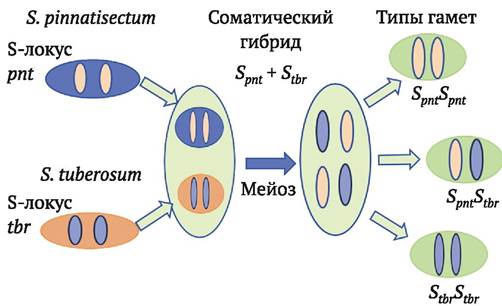
Approach 1. Using primary somatic hybrids as pollinators in crosses with potato cultivars. The pollen population will inevitably contain genotypes lacking the wild-species S-genes and thus capable of growing within S. tuberosum pistils.
Approach 2. Reducing the ploidy of somatic hybrids (obtaining dihaploids using S. phureja haplo-producers). It is assumed that homozygotes for S. tuberosum S-genes will segregate among the dihaploids, and these will be compatible as maternal parents in crosses with cultivated potato dihaploids.
Approach 3. Obtaining dihaploids or doubled dihaploids via anther culture of somatic hybrids. This approach is proposed for S. tuberosum + S. bulbocastanum somatic hybrids, which do not cross directly with S. phureja due to strict prezygotic incompatibility.
Crosses using somatic hybrids as pollinators (the first approach) generally yield successful results. This approach has been implemented, in particular, by A. Carrasco et al. (2002) with S. tuberosum + S. pinnatisectum (4x) hybrids. However, its potential is limited by the male sterility typical of somatic hybrids, which arises from meiotic disruptions during microspore formation.
The second approach was successfully implemented in the Potato Genetics Laboratory of the Institute of Genetics and Cytology, NAS of Belarus, while working with S. tuberosum + S. pinnatisectum (4x) hybrids (A. Ermishin et al., 2006). By pollinating these hybrids with pollen from the S. phureja haplo-producer IvP35, 10 dihaploids were obtained. All of them successfully set berries when pollinated with a pollen mixture from fertile S. tuberosum dihaploids, and the berries contained mature, viable seeds. Thus, the resulting forms readily crossed with S. tuberosum dihaploids; i.e., both pre- and postzygotic interspecific barriers characteristic of the initial species were absent between them.
For S. tuberosum + S. bulbocastanum (4x) somatic hybrids, which are incompatible with S. phureja, the third of the aforementioned approaches was used
(A. Ermishin et al., 2008). To obtain homozygotes for the cultivated parent's S-genes, regenerated plants (androclones) were produced via anther culture of S. tuberosum + S. bulbocastanum somatic hybrids. Ploidy analysis revealed that all of them were tetraploids (doubled dihaploids), meaning that the anther culture technique employed does not allow for the recovery of hybrid dihaploids. To reduce the ploidy of the androclones, pollination with the S. phureja haplo-producer IvP35 was employed. The results of hybridizing somatic hybrid androclones with S. phureja, as well as data from pollen tube growth analysis upon pollinating androclones with a pollen mixture from potato cultivars, indicate that some of them are highly compatible with the pollen of the pollinators used, thereby demonstrating the feasibility of overcoming prezygotic reproductive barriers.
Nevertheless, androclones whose pistils supported normal pollen tube growth of cultivated potato failed to set viable seeds when pollinated with a pollen mixture from potato cultivars. This is evidently because the effective ploidy (EBN) of the androclones, much like that of the original somatic hybrids, deviates from 4, which leads to impaired endosperm development in the hybrid seeds. Only reducing the ploidy level of the androclones made it possible to overcome these postzygotic barriers. Among the selected diploid seedlings derived from pollinating androclones with the IvP35 haplo-producer, one proved sufficiently viable and exhibited satisfactory flowering intensity. It crossed readily with S. tuberosum dihaploids, producing well-filled seeds with high germination rates. This indicates that the resulting somatic hybrid dihaploid is homozygous for the cultivated potato S-genes and has an effective ploidy (EBN) equal to 2.
As we can see, reducing the ploidy of such somatic hybrids (presumed to have an EBN of 3) makes it possible to obtain forms that cross normally with potato dihaploids (EBN of 2). Apparently, the meiosis of somatic hybrids or their androclones results in the formation of gametes with varying EBN (EBN segregation). Hybridization with a haplo-producer ensures the selection of gametes with an EBN of 2, enabling the recovery of well-filled somatic hybrid dihaploid seeds.
An interesting approach to incorporating potato somatic hybrids into breeding was proposed by V.-M. Rokka (1998). From interspecific somatic hybrids that are difficult to backcross with cultivated potato, haploids (somatohaploids) are produced via anther culture and subsequently used as one of the parents in somatic hybridization with cultivated potato dihaploids. This yields secondary somatic hybrids whose genomes are dominated by the cultivated parent's chromosomes. This approach was implemented in generating somatic hybrids involving such wild potato species as the non-tuber-bearing S. brevidens and the allotetraploid S. acaule. In principle, the procedure of "saturating" the hybrid genome with S. tuberosum genetic material using this technology can be carried out over multiple cycles. However, as we can observe, it is technically quite complex. In the case of hybrids with species such as S. brevidens, it remains uncertain which of the wild-species chromosomes will be retained in the somatic hybrids (see the beginning of this section).
Conclusion
The most effective method for broadening the genetic base of breeding material is its hybridization with wild and primitive cultivated relatives (distant hybridization). In many cases, however, crosses between cultivated and wild species are associated with significant problems caused by natural interspecific barriers. The most substantial barriers include genomic differences between species, ploidy differences, and hybridization-preventing barriers (pre- and postzygotic reproductive barriers). Special techniques have been developed to overcome them, including those based on in vitro cell and protoplast culture methods.
In vitro pollination is used primarily to overcome pre-zygotic incompatibility in interspecific and intraspecific crosses. The method involves: exposing the ovule or ovules by removing the tissues of the pistil and ovary, applying pollen to them, and culturing the fertilized ovules on a nutrient medium until mature seeds are formed. Several variations of the method have been proposed: pollination and cultivation of isolated ovaries, ovules attached to the placenta, and ovules without the placenta. Similar to in vitro fertilization in animals, researchers have succeeded in isolating and fusing individual female and male gametes in vitro and regenerating plants from the fusion products (E. Kranz, H. Lorz, 1993). A method of chemical gamete fusion was developed (using CaCl2), which ensured a high frequency (about 80%) of fusion, predominantly of female gametes with male ones (J. Faure et al., 1994). Ovary culture has proven to be a highly effective technique for obtaining interspecific and even intergeneric hybrids in combinations that were previously unsuccessful due to post-gamotophytic incompatibility (embryo abortion at early stages of development caused by incompatibility with the endosperm, and early fruit drop). Using this method, valuable interspecific hybrids of cotton, clover, and sunflower have been obtained.
In vitro culture of zygotic embryos ("embryo rescue") helps prevent their death due to nutritional disorders, such as an underdeveloped endosperm in a hybrid seed. This method is widely used in breeding for interspecific hybridization of rice, beans, tomatoes, potatoes, lilies, sweet clover, and other crops. This technique is also employed to produce haploids by pollinating with pollen from haploid Inducers or irradiated pollen (see Section 7.8), to break seed dormancy, and for other purposes.
Embryos are excised under sterile conditions from hybrid seeds, placed on a nutrient medium, and cultured in the light to achieve plant regeneration. The efficiency of plant regeneration largely depends on the explant size and the developmental stage of the embryo: the larger the explant and the more mature the embryo, the higher the probability of regenerating a plant from it. For culturing small embryos at early stages of development, enriched nutrient media are used, and callus is sometimes induced from them, from which plants are subsequently regenerated.
The application of somatic hybridization methods via protoplast fusion opens up new possibilities in distant hybridization. The technology of somatic hybridization includes the following steps: obtaining protoplast suspensions of two plant species whose hybrids are to be isolated; preparing a mixed suspension of protoplasts from both species and applying experimental treatments (chemical or electrical) to induce protoplast fusion; selecting the fusion products; establishing a callus culture from them; and regenerating plants from somatic hybrids, followed by confirming their hybrid nature.
Isolated protoplasts are generally identically (negatively) charged particles. Therefore, to bring them into close proximity so that fusion of different species' protoplasts can occur, specific substances (fusogens) are added to the nutrient medium containing the protoplast suspension, or the suspension is exposed to an electric current. The most widely used protoplast fusion systems include: a high concentration of Ca2+ ions in the medium (about 50 mM) and high pH (9–11) at a temperature of 37 °C; the addition of polyethylene glycol (PEG) to the medium; and a combination of PEG + high Ca2+ concentration and high pH.
Protoplast electrofusion is carried out in a specialized chamber of a device equipped with two electrodes. High-voltage pulses are passed through the nutrient medium containing the suspension of protoplasts from two species. The parameters of the electric field and the duration of its action are determined experimentally in each case. Under The Influence of the current, aggregates of 2–3 protoplasts or chains of 5–6 protoplasts form between the electrodes. At this point, single direct-current pulses are applied to the electrodes, causing pores to form in the heavily compressed membranes of the protoplasts. As a result, the cytoplasm of the contacting protoplasts mixes, forming hybrid protoplasts.
Since existing methods provide a high frequency of protoplast fusion, a large number of regenerated plants can be obtained, allowing selection of hybrids at the organismal level. However, in many cases, hybrids are difficult to distinguish from the parental forms; therefore, selection at the cellular level is recommended, using the following approaches.
Mechanical isolation: morphologically distinct types of parental protoplasts are used, such as protoplasts from callus cells and leaf mesophyll. Following fusion, hybrid protoplasts are identified visually under a microscope, isolated with a micro pipette, and transferred using a micromanipulator into a separate droplet of enriched nutrient medium.
Genetic complementation: if protoplasts of mutants homozygous for different recessive genes are fused, the resulting somatic hybrids will exhibit a wild-type (normal) phenotype due to heterozygosity at these loci. Hybrid selection is performed at the cellular level or among regenerated plants. For plant somatic hybridization, genetic complementation involving chlorophyll-deficient mutants—often specifically generated for this purpose—as well as auxotrophic mutants, is most frequently utilized.
Physiological complementation is based on the ability of hybrid cells to divide and undergo morphogenesis under culture conditions where the parental cells, or cells of one of the parental species, are unable to do so. In this case, the inability of the parental cell cultures to grow and undergo morphogenesis is not related to any specific mutation, but rather represents their normal physiological response to the cultivation conditions.
Inactivation of the protoplasts of one parent prior to fusion using ionizing radiation or biochemical poisons that irreversibly suppress cellular metabolism. In hybrid cells, the capacity for division and morphogenesis in in vitro culture is restored.
Physical enrichment involves the separation of protoplasts after fusion using density gradient centrifugation. Physical enrichment increases the efficiency of other selection methods, such as genetic complementation.
As a result of fusing protoplasts from two plant species, various types of somatic hybrids can be produced: those containing the complete genomes of both parental species (symmetric hybrids); those retaining the complete genome of only one species along with individual chromosomes from the second species (asymmetric hybrids); or cybrids (cytoplasmic hybrids), which contain the nuclear genome of one parent and the plastid and mitochondrial DNA of both parents or of the parent whose chromosomes were lost. The resulting somatic hybrids must undergo comprehensive analysis, including morphological evaluation, assessment of breeding value, isozyme and various DNA marker analyses, as well as cytogenetic techniques such as genomic in situ hybridization (GISH).
Obtaining somatic hybrids is only the first step in introgressing the gene pool of wild species into breeding material, as primary hybrids require subsequent breeding refinement through backcrossing with the cultivated species. In many cases, backcrossing somatic hybrids is extremely difficult. Somatic hybrids may be allopolyploids in which, due to significant genomic differences between the parental species, conjugation occurs primarily between homologous chromosomes. The introgression of valuable genes from a wild species into a cultivated one using such hybrids is mainly feasible through the production of trisomic, tetrasomic, or individual chromosome-substitution lines.
In most cases, somatic hybrids carry pre- and post-zygotic interspecific incompatibility factors (pre- and post-zygotic interspecific barriers) characteristic of the parental species. Increasing the dosage of the cultivated parent's genome in such somatic hybrids helps weaken these barriers, enabling the recovery of backcross progeny upon crossing with the cultivated species. However, introgressing valuable wild gene pools into breeding material using highly polyploid somatic hybrids requires a fairly long time to reduce the ploidy level of the breeding material down to that of the cultivated species. Selection for agronomic traits is carried out among polyploid and aneuploid breeding material, which is typically characterized by complex segregation. To bypass or overcome the interspecific incompatibility factors persisting in somatic hybrids, several approaches are proposed to induce segregation for these factors: using somatic hybrids as pollinators in crosses with the cultivated species (where feasible), and reducing their ploidy using haploid inducers or anther culture.
1. Name the main factors ensuring species isolation that hinder interspecific hybridization.
2. What mechanisms underlie pre-zygotic self-incompatibility and interspecific incompatibility?
3. What is effective ploidy (endosperm balance number), and what is its role in plant interspecific hybridization?
4. What does the in vitro pollination technique consist of, and for what purposes is it used in plant breeding?
5. Describe the technique of immature embryo culture. Give Examples of its application in breeding and genetic research.
6. Name the main protoplast fusion methods used to produce somatic hybrids.
7. What methods of selecting protoplast fusion products are applied in somatic hybridization?
8. What are asymmetric somatic interspecific hybrids and cybrids? How can they be obtained?
9. What factors may complicate the incorporation of somatic interspecific hybrids into breeding programs?
10. State the approaches used to increase the efficiency of backcrossing somatic hybrids with the cultivated parental species.
Last update: 11/08/2026
Editorial and Educational Adaptation: This material has been compiled based on the primary/original source text. The project team performed an editorial review, corrected technical inaccuracies, structured sections, and adapted the content for an educational format.
What was processed:
- elimination of formatting defects (OCR errors, structural breaks, corrupted characters);
- editorial organization of content;
- standardization of terminology in accordance with academic sources;
- verification of factual statements against the original source text.
All mentions of the author, publication year, and origin of the primary text have been preserved in accordance with the source.