Protein Chemistry - Part 2 - Selected Topics in Special Protein Chemistry - Ashmarin, I. P. 1968
Plasma proteins
Proteins of the blood coagulation and anticoagulation systems
The Blood Coagulation and anticoagulation systems are vital protective mechanisms of the Organism. Preventing intravascular blood clotting and arresting Hemorrhage upon vascular injury ensure the constancy of circulating blood volume and the normal Blood supply to Organs and Tissues.
Both processes are regulated by a complex network of enzymatic reactions in which Plasma Proteins play a crucial role. During blood clotting, one of the plasma components, fibrinogen, is converted into an insoluble protein—fibrin, and the resulting meshwork of fibrin fibers seals the injured vessel, preventing blood loss. Simplified, the processes of blood coagulation and its Prevention can be represented by the following scheme.
Substances involved in the blood-clotting process are conventionally called «clotting factors». All of them, except for calcium (factor IV), are proteins. They are usually designated by Roman numerals (I—XII).
Blood circulating within the organism does not clot because most components involved in its coagulation remain in an inactive state. Activation of the coagulation system is triggered by vascular wall injury. Lipoproteins released from damaged tissues and specialized Blood Cells—platelets—along with factors XII, XI, IX, VIII, and VII (X, V) contained in serum and tissues, form a complex system of substances known as thromboplastin (factor III). This factor is essential for converting plasma prothrombin (factor II) into the active enzyme Thrombin, which participates in the polymerization of fibrinogen. Thrombin acts on fibrinogen (factor I), facilitating its conversion first into fibrin monomer and subsequently into fibrin polymer, which forms a blood clot. Among the numerous Components of the coagulation system, two proteins that play a primary role in clotting—prothrombin and fibrinogen—deserve a more detailed examination.
Class="center">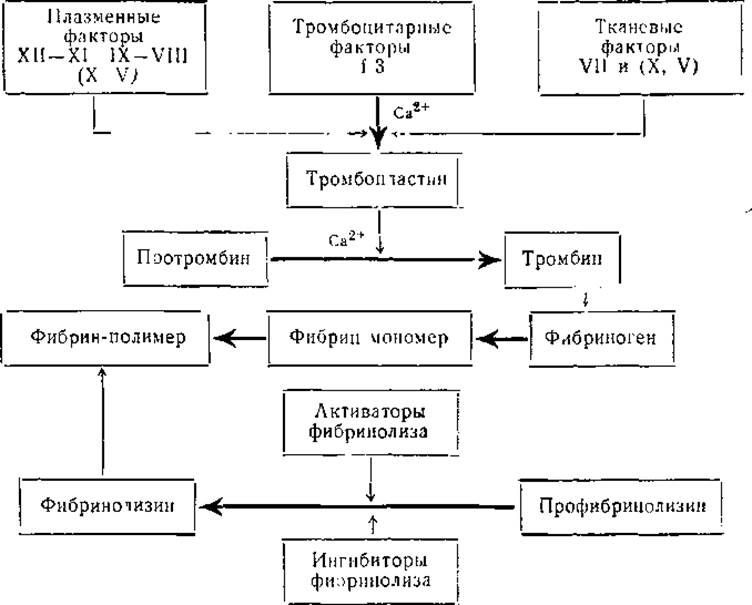
Note. Thick arrows indicate direct substance transitions; thin arrows indicate factors driving enzyme system activation and substance transitions.
Prothrombin is one of the plasma Glycoproteins with a Molecular Weight of 63,000–67,000 and an isoelectric point of 4.2. Its concentration in the blood ranges from 10 to 50 mg%. Under the action of thromboplastin in the presence of Calcium Ions, prothrombin is converted into a low-molecular-weight protein, thrombin, with a molecular weight of 14,000, which has The ability to selectively cleave Arginine-containing peptide groups from fibrinogen.
It is interesting to note that thrombin has virtually no effect on other native proteins, yet specifically cleaves only the arginine—Glycine bonds in the fibrinogen molecule, thereby Setting the Stage for The conversion of fibrinogen into fibrin monomer—a protein capable of subsequent polymerization.
Fibrinogen is a high-molecular-weight protein with a molecular weight of 330,000, whose Structure was determined in 1959 by Hall and Slatter. Its concentration in the blood is 300–400 mg%. Fibrinogen has an elongated, filamentous structure, with small globular regions at the ends and in the middle of the molecule. The conversion of fibrinogen into fibrin by the action of thrombin is accompanied by the Cleavage of two fragments, the so-called fibrinopeptides (molecular weight 4,000–8,000), located at the N-terminal region of the fibrinogen polypeptide chain. The fibrin monomer carries a small negative charge, which facilitates its easy polymerization and The formation of high-molecular-weight aggregates (molecular weight 5,000,000).
Under physiological conditions—within the vascular bed—blood does not clot due to the absence of active thromboplastin and the presence of the anticoagulation system. The anticoagulation system includes substances that inhibit clotting and prevent the transition of the coagulation system into an active state.
The primary role in preventing spontaneous blood coagulation is played by heparin, fibrinolysin (plasmin) and its activator, as well as substances that inhibit the action of thrombin and antihemophilic globulin. Among the protein components of this system, fibrinolysin and its precursor, profibrinolytic factor (profibrinolysin), warrant a closer look. Profibrinolysin is constantly present in the blood in low concentrations. This poorly soluble protein with a molecular weight of 143,000 is converted by activators into fibrinolysin—an enzyme with pronounced proteolytic and especially fibrinolytic activity. The Physiological Role of fibrinolysin is to dissolve fibrin clots formed within the vascular bed and prevent vascular thrombosis.
***
Advances in The Study of blood proteins have made it possible to develop A number of new Methods for diagnosing and treating many diseases. At the same time, numerous problems still require further investigation. These include studying the Structure of Blood proteins, the Physiological Role of certain proteins that make up the a1-, a2-, and β-globulin fractions, elucidating the relationship between their Structure and function, and developing novel approaches for the preparative isolation of proteins used as therapeutic agents.
Last update: 06/08/2026
Editorial and Educational Adaptation: This material has been compiled based on the primary/original source text. The project team performed an editorial review, corrected technical inaccuracies, structured sections, and adapted the content for an educational format.
What was processed:
- elimination of formatting defects (OCR errors, structural breaks, corrupted characters);
- editorial organization of content;
- standardization of terminology in accordance with academic sources;
- verification of factual statements against the original source text.
All mentions of the author, publication year, and origin of the primary text have been preserved in accordance with the source.