IMMUNOLOGY - Roitt I. - Mir 2000
Chapter 1. General Overview of the Immune System
CELLS OF THE IMMUNE SYSTEM
A wide variety of Cells and their secreted soluble products participate in the Immune Response. Leukocytes always play a central role, but other cells (such as tissue cells) also contribute by sending signals to lymphocytes and responding to cytokines released by T cells and macrophages. Fig. 1.4 lists the principal cells and molecules involved in the body's immunological reactions.
Class="center">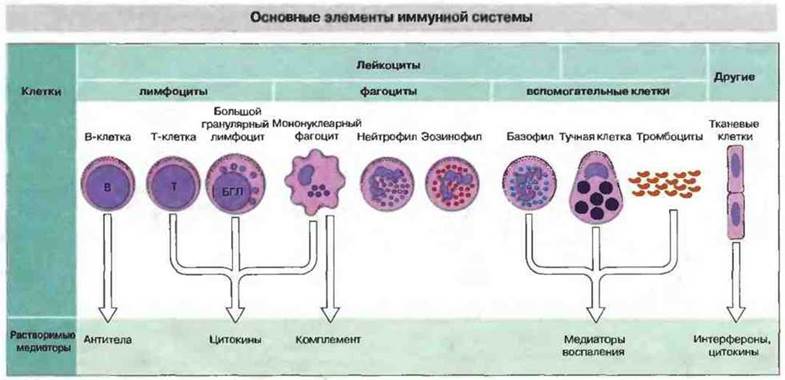
Fig. 1.4. The Main Components of The Immune System, indicating the cellular origin of soluble mediators of the immune response. Complement components are synthesized predominantly by Liver cells and, to some extent, by mononuclear phagocytes.
Each Cell type produces and secretes a strictly defined set of cytokines or inflammatory mediators. In addition, There are two types of dendritic cells that play a crucial role in antigen presentation to lymphocytes.
Phagocytes engulf Antigens and pathogens and destroy them
Mononuclear phagocytes. The most important group of long-lived, phagocytic cells is the mononuclear phagocyte system. Originating from Bone Marrow stem cells, these cells function to capture particles, including infectious agents, by engulfing and destroying them. To perform this function, phagocytes are strategically located in body Tissues where such particles are likely to enter. For example, Kupffer cells line the Blood sinusoidal capillaries of the liver, and synovial A-cells line the joint cavities (Fig. 1.5). Mononuclear phagocytes circulating in the blood are called monocytes. From the blood, they migrate into tissues, where they differentiate into tissue macrophages capable of presenting antigens to T lymphocytes very efficiently. However, interdigitating dendritic cells are the most important for antigen presentation to resting T cells (see Chapter 2).
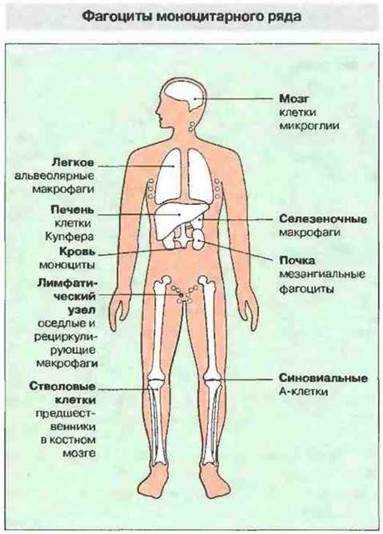
Fig. 1.5. Phagocytic cells found in many Organs originate from blood monocytes produced by the bone marrow. Monocytes leave the bloodstream and become macrophages in tissues. Local phagocytic cells of various tissues, previously classified within the reticuloendothelial system, also appear to belong to the monocyte Lineage.
Polymorphonuclear neutrophils. The second major group of phagocytic cells consists of polymorphonuclear neutrophil granulocytes, frequently referred to simply as neutrophils or PMNs (polymorphonuclear neutrophils). Neutrophils comprise the majority of Blood Leukocytes and originate from the same early precursor cells as monocytes and macrophages. Like monocytes, neutrophils migrate into tissues in response to specific stimuli, but unlike monocytes, they are short-lived cells that engulf foreign material, destroy it, and subsequently die.
Lymphocytes are represented by two major populations - B cells and T cells, which are responsible for specific antigen recognition
Specific immunological recognition of pathogens is entirely the function of lymphocytes, which is why they initiate adaptive immune responses. All lymphocytes originate from bone marrow stem cells, but T lymphocytes subsequently develop in the Thymus, whereas B lymphocytes continue their development in the Cytology/practical/86.html">Red bone marrow (in adult mammals).
B cells. Each B cell is genetically programmed to synthesize a surface receptor specific for one particular antigen. Upon encountering and recognizing this antigen, B cells proliferate and differentiate into plasma cells, which synthesize and secrete large quantities of these receptor molecules, known as Antibodies, in soluble form. Antibodies are large Glycoproteins found in the blood and tissue fluid. Because they are identical to the original receptor molecules, they interact with the antigen that initially activated the B cells.
T cells. There are several T-cell subpopulations with distinct Functions. Some interact with B cells, helping them to proliferate, mature, and produce antibodies. Others interact with mononuclear phagocytes, aiding in the destruction of microorganisms localized within them. Both of these T-cell subpopulations are termed helper T cells (Th). A third T-cell subpopulation destroys host cells infected with Viruses or other intracellularly replicating pathogens. This type of T-cell activity is termed cytotoxicity, and the cells themselves are designated cytotoxic T lymphocytes (Tc). As a rule, antigen recognition by T cells occurs only if the antigen is presented On the surface of other cells in association (complex) with MHC molecules. Recognition involves the antigen-specific T-cell receptor (TCR), which is functionally and structurally similar to the surface Ig molecule that serves as the antigen-binding receptor on B cells. T lymphocytes exert their effects on other cells either by releasing soluble Proteins—cytokines—that transmit signals to other cells, or through direct cell-to-cell contact. The Main Functions of lymphocytes are shown in Fig. 1.6.

Fig. 1.6. B cells produce antibodies, and helper T (Th) cells produce cytokines that regulate the immune response. Antigen-presenting cells (APCs) and B cells performing the same function participate in stimulating Th cells to synthesize cytokines. Activated macrophages acquire The ability to destroy microbes they have engulfed. Cytotoxic T lymphocytes (Tc) and large granular lymphocytes (LGLs) can recognize and destroy the body's own target cells.
Cytotoxic cells recognize and destroy infected host cells
Several Cells of the immune system possess cytotoxicity directed against other host cells. The most important of these are likely the Tc cells.
Large granular lymphocytes (LGLs). Like T cells, this lymphocyte population is capable of recognizing changes on The Cell surface that occur during malignant transformation or viral infection. Large granular lymphocytes attack such target cells; moreover, unlike cytotoxic T lymphocytes, they very efficiently recognize cells whose surface lacks MHC molecules entirely or has partially lost them. Previously, the cytotoxic action of LGLs was considered to be The activity of natural killer (NK) cells. Macrophages and LGLs also recognize and destroy certain target cells (or pathogens) if their surface is coated with specific bound antibodies.
Eosinophilic polymorphonuclear granulocytes, or eosinophils. A specialized population of leukocytes capable of attacking large extracellular parasitic organisms, such as schistosomes.
All types of cytotoxic cells attack their targets by releasing the contents of intracellular granules and other non-granule-stored molecules in their vicinity.
Accessory cells regulate inflammation
A number of other cells of the immune system participate in the inflammatory response, the primary purpose of which is to recruit leukocytes and SOLUBLE IMMUNE MEDIATORS to the site of infection (see below).
Basophilic segmented granulocytes and mast cells. These cells are packed with granules containing various mediators that, upon release, trigger inflammation in the surrounding tissue. The release of these mediators occurs when basophils and mast cells are activated. These cells can also synthesize and secrete a number of mediators that regulate the immune response. Mast cells reside in all tissues near Blood Vessels and affect vascular wall cells through certain of their mediators. Basophils are functionally similar to mast cells, but unlike them, they circulate in the blood.
Blood Platelets (thrombocytes). When activated during Blood Coagulation or under METABOLISM/18.html">The Influence of antigen-antibody complexes, these cells also release inflammatory mediators.
Last update: 13/08/2026
Editorial and Educational Adaptation: This material has been compiled based on the primary/original source text. The project team performed an editorial review, corrected technical inaccuracies, structured sections, and adapted the content for an educational format.
What was processed:
- elimination of formatting defects (OCR errors, structural breaks, corrupted characters);
- editorial organization of content;
- standardization of terminology in accordance with academic sources;
- verification of factual statements against the original source text.
All mentions of the author, publication year, and origin of the primary text have been preserved in accordance with the source.