MODERN BOTANY - P. RAVEN - 1990
SECTION VI. REGULATION AND GROWTH RESPONSES
CHAPTER 25. EXTERNAL FACTORS AND PLANT GROWTH
Living organisms must adapt to their surrounding environmental conditions. Many animals, being mobile, can modify their environment to some extent—moving through space in search of food, courting mates, seeking shelter, and even building it during inclement weather. Plants, in contrast, become stationary with The Emergence of their first ROOT. Nevertheless, they are capable of responding to various environmental changes and adapting to them. This is primarily driven by changes in growth patterns.
A growth response that causes a plant organ to curve toward or away from an external stimulus that determines the direction of movement is called a tropism. If the movement is directed toward the stimulus, it is referred to as positive tropism; if in the opposite direction, as negative tropism.
Perhaps the most familiar interaction between PLANTS AND THEIR environment is the bending of growing SHOOT tips toward light (see Fig. 24-2). This growth response, termed phototropism, is caused by the action of auxin (IAA), which induces Cell elongation on the shaded side of the shoot tip. What role does light play here? Three Answers are possible: light (1) decreases the sensitivity of Cells on the illuminated side to auxin, (2) destroys auxin, or (3) promotes the lateral redistribution of auxin to the shaded side of the growing shoot tip.
To test these hypotheses, Winslow Briggs and his coworkers conducted a series of experiments based on earlier work by F. Went (see Fig. 24-3). The researchers established that the total amount of IAA produced in the shoot tip is the same in both light and darkness. However, following light exposure, The amount of hormone moving down from the shaded side is greater than from the illuminated side. If the tip is split and a barrier in the form of a thin Glass slide is placed between the two halves, the difference in IAA distribution disappears. In other words, Briggs clearly demonstrated that auxin (or possibly its precursor) migrates from the illuminated side to the shaded side and that shoot bending is a response to its unequal distribution. Experiments using 14C-labeled IAA conclusively proved that it is specifically the auxin that migrates.
It was further observed that the lateral transport of this hormone in the shoot tip is most effectively stimulated by light with wavelengths between 400 and 500 nm, meaning that a blue-light-absorbing pigment acts as a mediator in this response. The Structure of the blue-light photoreceptor (which also mediates many other responses in plants and Fungi) has not yet been definitively established, but available data indicate it is a yellow-pigmented flavin. According to a widely known hypothesis that has not yet been definitively proven, blue light triggers a chemical reduction of flavin, thereby enhancing electron Transport Across the Plasma Membrane and establishing a pH gradient.
Another well-known tropism is gravitropism (or geotropism), a response to gravity that is clearly manifested in seedlings. If a seedling is placed horizontally, its root bends downward (positive geotropism), while its shoot grows upward (negative geotropism). Originally, this phenomenon was explained by the asymmetric redistribution of auxin to the lower side of the organ via downward polar lateral Transport of Molecules. Under such conditions, the lower side of the shoot should grow upward (Fig. 25-1). In the root, the upper side would elongate faster than the lower side, causing it to bend downward. Once each part of the plant assumes a vertical position, the lateral Asymmetry in auxin concentration disappears, and growth continues in a vertical direction.
Class="center">Fig. 25-1. Gravitropic response in a shoot of a young tomato plant (Lycopersicon esculentum). A. The potted plant was laid on its side and kept stationary. B. The potted plant was inverted and placed upside down on a ring stand. Stems, originally straight, curved and grew upward. If a potted plant is laid horizontally and rotated slowly along the stem axis, no bending (gravitropic response) occurs: the plant continues to grow horizontally. Can you explain the differences in growth between the horizontally rotated plant and the plants shown here?

The validity of this hypothesis as applied to gravitropism is currently open to question. Although the existence of lateral IAA transport toward the lower side of corn (Zea) and oat (Avena) coleoptiles and its asymmetric distribution in these plants have been demonstrated, much remains unclear regarding dicot shoots. Furthermore, it has not been conclusively established that the asymmetric distribution of IAA in corn and oat coleoptiles alone is sufficient to cause A change in growth rate.
The problem of asymmetry in the distribution of growth regulators in roots is less studied. It is now established that IAA, Cytokinins, Gibberellins, and ABA are present in roots, although their physiological roles remain unclear. Growth-inhibiting substances have also been found in roots, and at least one of these is produced in the root cap. There is evidence that the root cap inhibitor may be linked to the positive gravitropism of the primary root.
There is ample evidence that gravity perception is associated with the sedimentation of amyloplasts (starch-containing Plastids) in specialized Cells of the shoot and root. Such cells are present throughout the shoot, often forming part of the vascular bundle sheaths. In roots, they are localized in the root cap, particularly in its central part (the columella) (Fig. 25-2). When a root is placed horizontally, the plastids, which previously rested against the transverse cell walls in vertically growing roots, migrate downward and settle near The Cell walls that were originally oriented vertically (Fig. 25-3). Within a few hours, the root bends downward, and the plastids return to their initial position, accumulating along the transverse walls. The question of how the movement of these gravity receptors (statoliths) leads to The formation of hormonal gradients still requires a convincing explanation. It has recently been suggested that calcium, which regulates hormone transport, plays a key role in coupling gravisensing and gravitropism in roots. As known, Calcium Ions are found in the amyloplasts of columella cells.
Fig. 25-2. A. Micrograph of a median Cytology/practical/54.html">Longitudinal section of the root cap of a primary bean root (Phaseolus vulgaris). Arrows indicate amyloplasts (starch-containing plastids) clustered near the transverse walls of the central root cap cells. B. Electron micrograph of root cap parenchymal cells similar to those shown on the left. Here too, amyloplasts (arrows) sediment at the base of each cell near the transverse walls.

Fig. 25-3. Diagram showing how amyloplasts (starch-containing plastids) in root cap parenchymal cells respond to gravity. A. In the root cap of a vertically growing root, amyloplasts typically sediment near the transverse walls. When the same root is placed horizontally (B, C), the amyloplasts drop and settle against walls that are normally vertical but are now parallel to the soil surface. The movement of statoliths plays an essential role in establishing the gradients of growth substances that ensure the vertical growth of the root.

A less understood, though widespread, tropism is thigmotropism (from the Greek thigma, Touch)—a response to physical contact with a solid object. One of the most common Examples of thigmotropism is demonstrated by tendrils, which in some plants are modified leaves and in others modified stems (see Ch. 22). Tendrils coil around any object they touch (Fig. 25-4), enabling the plant to anchor itself to a support and climb upward. The response can be rapid; a tendril can wrap around a support one or more times in less than an hour. The cells in contact with the support shorten slightly, while the cells on the opposite side elongate. Evidence suggests that auxin is involved in this response.
Fig. 25-4. Tendrils of Smilax. Coiling is caused by differential growth rates of cells on the inner and outer sides of the tendril.

Research conducted by M. Jaffe at Wake Forest University in North Carolina revealed that tendrils of young pea plants (Pisum sativum) can store sensory information and subsequently retrieve it to respond accordingly. For example, if tendrils are kept in the dark for three days and then stimulated, they will not coil until they are re-exposed to light. Furthermore, they can be left in the dark for two hours after stimulation, but when subsequently returned to light, they coil immediately; that is, although sensory information was retained during the dark period, the motor function could not be executed under those conditions. Why this is so remains unclear. It has been suggested, however, that ATP (which is apparently required for coiling) may be depleted during the dark period and replenished only upon illumination through Photosynthesis; alternatively, a coiling inhibitor may accumulate in the dark and rapidly disappear upon exposure to light.
Circadian Rhythms
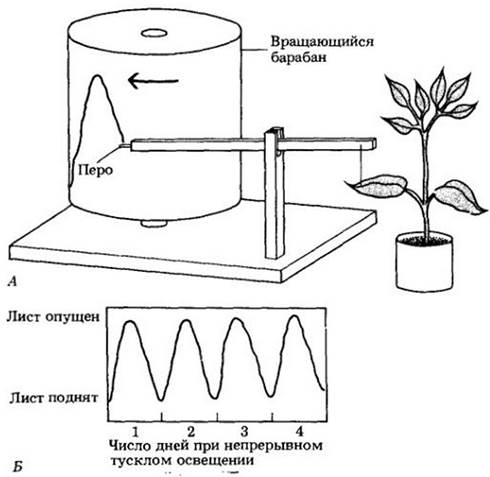
It is common knowledge that certain plants open their flowers in the morning and close them at dusk, spreading their leaves in sunlight and drooping them at night (Fig. 25-5). As early as 1729, the French researcher Jean-Jacques d'Ortous de Mairan observed that these daily movements persist even when plants are kept under continuous dim light (Fig. 25-6). Subsequent studies have shown that processes lacking such obvious external manifestations, such as photosynthesis, auxin production, and Cell Division rates, also exhibit regular daily rhythms that persist under constant environmental conditions. These regular, approximately 24-hour (daily) cycles are called circadian rhythms, from the Latin words circa ("approximately") and dies ("day"). Circadian rhythms, found in almost all eukaryotes, appear to be absent in Bacteria. Why this is so remains unknown.
Fig. 25-5. Leaves of the wood sorrel (Oxalis) during the day (A) and at night (B). One hypothesis suggests that leaf folding protects them from absorbing moonlight on clear nights, thereby preventing unwanted photoperiodic reactions. Another hypothesis, proposed by Darwin a century ago, is that folding protects leaves from cooling at night.
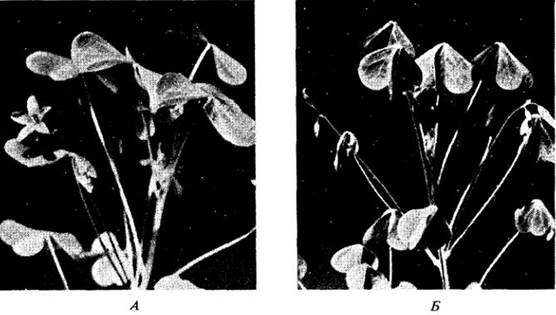
Fig. 25-6. In many plants, leaves are positioned perpendicular to the stem and sunrays during the day and parallel to the stem at night. These "Sleep" movements can be recorded on a rotating drum using a finely tuned pen and lever system attached to the leaf by a thin thread (A). In many plants, such as the common bean (Phaseolus vulgaris) shown here, leaves continue these movements for several days even under continuous dim light. C. A tracing of this circadian rhythm, demonstrating its persistence under continuous dim light conditions.
Are Rhythms Endogenous?
Are circadian rhythms regulated endogenously—that is, by internal mechanisms—or are they triggered by external factors? For years, biologists debated whether these rhythms are established by environmental factors such as cosmic rays, the Earth's magnetic field, or its rotation. Two key observations address this question: first, the observed rhythms are circadian (i.e., their period is approximately 24 hours); second, there are slight individual variations among organisms in this regard.
Attempts to resolve this recurring debate have prompted numerous experiments under diverse conditions. Organisms have been placed in salt mines, taken on ships to the South Pole, flown across much of the globe in airplanes, and, more recently, launched into near-Earth Orbit aboard satellites. Although a distinct minority still maintains that circadian rhythms are influenced by elusive geophysical factors, most researchers now agree that they are endogenous, meaning they are regulated by internal factors. This internal timing mechanism is referred to as the Organism's biological clock.
Setting the Clock
Under constant environmental conditions, the period of a circadian rhythm is free-running, meaning its natural duration (typically 21–27 hours) does not need to be reset for each cycle. In other words, a circadian rhythm behaves as a self-sustaining oscillator. Although the rhythm originates within the organisms themselves, the environment acts as a synchronizing agent, or zeitgeber (time-giver). Indeed, it ensures that the circadian rhythm keeps pace with the 24-hour light-dark cycle. If a plant's circadian rhythm period were longer or shorter than 24 hours, the rhythm would soon fall out of step with the day-night cycle. Consequently, if flowering (which typically occurs during the light period) were governed solely by such a rhythm, it would occur at a different time each day, eventually spilling into the dark period. Therefore, the plant must be resynchronized, or entrained, to a 24-hour daily cycle.
Entrainment is the process whereby the periodic repetition of light and darkness, or some other external cycle, synchronizes a circadian rhythm with the cyclicity of the external factor. Light-dark cycles and Temperature cycles are considered the primary entraining factors (Fig. 25-7).
Fig. 25-7. A. Micrograph of the dinoflagellate Gonyaulax polyedra, a unicellular marine alga. B. In G. polyedra, three different Functions are governed by distinct circadian rhythms: Bioluminescence, which peaks in the middle of the night (colored curve); photosynthesis, which peaks in the middle of the day (black curve); and cell division (not captured), which occurs in the pre-dawn hours. When Gonyaulax is cultured under continuous dim light, these three functions continue to exhibit their characteristic rhythms for days and even weeks after multiple cell divisions have passed. C. The bioluminescence rhythm in Gonyaulax, like most circadian rhythms, can be shifted by altering lighting cycles. For instance, if researchers expose algal cultures to alternating 6-hour periods of light and darkness, the rhythmic function adopts the same cyclicity (left). If the cultures are then returned to continuous dim light, the organisms revert to their original rhythm with a period of approximately 24 hours.

Another intriguing feature is that circadian rhythms do not automatically speed up as temperature rises. One might expect an acceleration because biochemical processes (and the internal biological clock undoubtedly has a biochemical basis) generally proceed faster at higher temperatures than at lower ones. While some clocks run slightly faster with increasing temperature, others run slower, and many remain largely unchanged. Thus, they must possess a compensatory mechanism—a feedback system allowing them to adapt to temperature fluctuations. Such a temperature-compensation system is exceptionally beneficial to plants.
Recent evidence suggests that cell membranes may hold the key to the biological clock. Although the exact mechanism remains unclear, it is likely that core Membrane Functions are involved, such as regulating The transport of ions into and out of cells and subcellular compartments, as well as governing METABOLISM/26.html">Energy Metabolism at the level of energy-transducing chloroplast and mitochondrial membranes.
Certain biological rhythms regulate interactions between organisms. For example, some plants secrete nectar at specific times of day. As a result, bees, equipped with their own biological clocks, learn to visit the flowers precisely at those times, thereby obtaining maximum rewards for themselves while ensuring cross-pollination for the plants.
However, for most organisms, using biological clocks for such specialized purposes is likely of secondary importance. Primarily, physiological clocks enable plants or animals to respond to seasonal changes by accurately measuring shifting day lengths. Thus, environmental Variability triggers adaptive responses that regulate growth, reproduction, and other vital processes.
Sixty-five years ago, a mutant tobacco plant (Nicotiana tabacum) appeared in a field near Washington, D.C. The new plants grew over 3 meters tall and possessed unusually large leaves. As the appropriate season arrived, normal plants flowered, while the Maryland Mammoth specimens (as this variety came to be called) simply continued to grow larger. Two U.S. Department of Agriculture researchers, W. Garner and H. Allard, placed cuttings of Maryland Mammoth in a greenhouse, protecting them from frost. The cuttings flowered in December, though they reached a height of only 1.5 meters—half the size of the parent plants. New plants grown from their seeds also failed to flower until nearly winter.
1Translated from English. — Ed. note.
As it happened, Garner and Allard were simultaneously experimenting with a soybean variety (Glycine max) called Biloxi. The agronomists aimed to obtain yields at different times by sowing seeds at two-week intervals from early May to late June. However, these experiments yielded unexpected results: regardless of when the seeds were planted, all plants flowered at the exact same time—in September.
The researchers began cultivating Maryland Mammoth tobacco and Biloxi soybeans under a wide range of controlled conditions involving temperature, humidity, Nutrition, and light. Their experiments revealed that the critical factor for both species was day length. Neither plant flowered if the photoperiod exceeded a certain critical number of hours. Thus, soybeans flowered only when the days became sufficiently short—in September—regardless of planting date, whereas Maryland Mammoth failed to flower until December, when the days grew even shorter, regardless of how tall the plants had grown.
Garner and Allard termed this phenomenon photoperiodism. Photoperiodism is a biological response to changes in illumination occurring within a 24-hour daily cycle. Although THE CONCEPT OF photoperiodism was established through The Study of plants, it has since been confirmed in other areas of biology, such as research into the mating behavior of the codling moth, spruce budworm, aphids, pink bollworm, fish, birds, and mammals.
Long-Day and Short-Day Plants
Garner and Allard conducted experiments confirming their discovery across numerous plant species. Consequently, they were able to answer many questions that had long puzzled professional botanists and amateur gardeners alike. Why, for instance, is ragweed (Ambrosia) absent in northern Maine? Answer: because it begins to flowering when day length drops to 14.5 hours or less. Meanwhile, long summer days in northern Maine do not shorten to 14.5 hours until August, by which time ragweed seeds cannot mature before the frosts arrive. Question: why doesn't spinach (Spinacea oleracea) grow in the tropics? Answer: because it requires at least 14 hours of daily illumination for a minimum of two weeks to flower—conditions uncharacteristic of tropical regions.
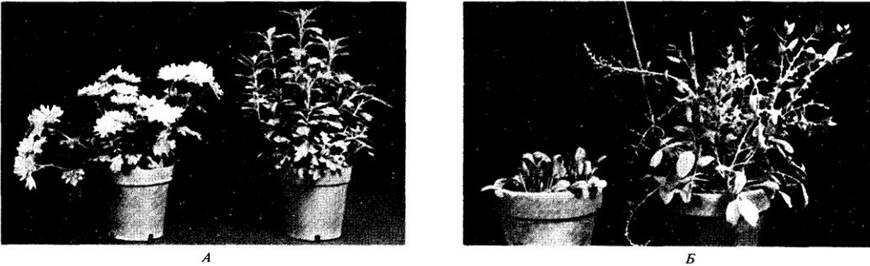
Researchers discovered that all plants can be divided into three main groups: short-day, long-day, and day-neutral. The former flower in early spring or autumn and require day lengths shorter than a specific critical threshold. For example, the common cocklebur (Xanthium strumarium) is induced to flower by a photoperiod of 16 hours or less (Figs. 25-8 and 25-9). Other short-day plants include certain chrysanthemum varieties (Fig. 25-10, A), poinsettias, strawberries, and primroses.
Fig. 25-8. The relative length of day and night determines the timing of plant flowering. The four curves illustrate annual changes in day length across four North American cities located at different latitudes. Colored horizontal lines represent the effective photoperiods of three distinct short-day plants. The common cocklebur, for instance, flowers when the daylight duration is 16 hours or less. In Miami, it can flower quite early, whereas in Winnipeg, buds appear only in early August—so late that frost may kill the plants before seeds can mature.

Fig. 25-9. Short-day plants flower when the daylight period falls below a critical threshold. Common cocklebur (Xanthium strumarium) blooms when the photoperiod is under 16 hours. Henbane (Hyoscyamus niger) requires about 10 hours of light or more to flower (depending on temperature). However, if the dark period is interrupted by a flash of light, henbane will flower even under short-day conditions. A light "pulse" during the dark period has the opposite effect on short-day plants, inhibiting flowering. The top diagrams show the duration of light and dark periods over a 24-hour cycle.

Long-day plants bloom primarily in summer and require a day length exceeding a specific critical threshold. Examples include spinach, certain potato varieties, specific wheat cultivars, lettuce, and henbane (Hyoscyamus niger) (Figs. 25-9 and 25-10, B).
Fig. 25-10. Representatives of short-day and long-day plants, each grown under short-day (left) or long-day (right) conditions. A. Chrysanthemum is a short-day plant. B. Spinach (Spinacia oleracea) is a long-day plant. Note that the plants grown under long-day conditions have taller stems than those grown under short-day conditions.
Both cocklebur and spinach will flower with a 14-hour day length, yet only the latter is a long-day plant. As mentioned previously, what matters is not the absolute length of the photoperiod, but whether it is longer or shorter than a critical value. Day-neutral plants flower regardless of day length; examples include cucumber, sunflower, tobacco, rice, corn, and garden pea.
Among individual plant species distributed widely from north to south, different photoperiodic ecotypes adapted to local conditions are frequently observed. For instance, in many prairie grasses ranging from southern Canada to Texas, northern ecotypes flower earlier than southern ones when grown together under identical conditions. Various populations are exceptionally well adapted to the photoperiodic regime of their habitat.
Photoperiodic responses can be remarkably precise. For example, at 22.5°C, the long-day henbane will flower if the photoperiod is 10 hours and 20 minutes (Fig. 25-9), whereas it will fail to bloom under a 10-hour photoperiod at the same temperature. Furthermore, environmental conditions also influence photoperiodic responses. For instance, at 28.5°C, henbane requires at least 11.5 hours of light to flower, whereas at 15.5°C it needs only 8.5 hours.
The response can vary significantly among different species. Some plants require only a single exposure to a day-night cycle, while others (such as spinach) need several weeks of exposure. Many plants exhibit a correlation between the number of induction cycles and The rate of flowering or the number of flowers formed. Certain species must reach a specific degree of maturity to induce flowering, whereas others respond to the appropriate photoperiod as early as the seedling stage. Over time, A number of species will eventually flower as they age even without exposure to the appropriate photoperiod, although proper exposure would cause them to bloom much earlier.
Measuring the Dark Period
In 1938, two other researchers, Karl Hamner and James Bonner, investigated photoperiodism using the cocklebur as an experimental subject. As noted earlier, the cocklebur is a short-day plant requiring no more than 16 hours of light in a 24-hour cycle to flower. This plant is particularly convenient for experimental purposes because, under laboratory conditions, even a single short-day cycle induces flowering two weeks later, even if the plant is immediately returned to long-day conditions. The cocklebur also tolerates rough Surgical Treatment; for example, it will survive even if all its leaves are removed. Hamner and Bonner demonstrated that the photoperiod in cocklebur is perceived by the leaf blade. A defoliated plant cannot be induced to flower. However, if at least one-eighth of a fully developed leaf is left on the stem, a single short-day exposure can trigger flowering. During these experiments, conducted under various experimental conditions, Hamner and Bonner made a decisive and completely unexpected discovery. If the dark period is interrupted by light from a 25 W bulb for as little as one minute, flowering does not occur. Conversely, interrupting the light period with darkness has no effect on flowering. Corresponding experiments with other short-day plants showed that they, too, require periods of continuous darkness rather than continuous light.
At the same time, whether the night period is interrupted in the middle or not is crucial. If a short-day plant such as cocklebur is illuminated for 8 hours and then placed in extended darkness, it transitions from a state of increasing sensitivity to a light break (lasting about 8 hours) to a state where the light break becomes progressively less significant. Indeed, a one-minute light exposure after 16 hours of darkness stimulates flowering. According to the hypothesis of German plant physiologist Erwin Bünning, photoperiodic control of flowering is regulated by an endogenous rhythm, with rhythm phases differing depending on whether light exerts a stimulatory (photophilic phase) or inhibitory (scotophilic phase) effect. Consequently, changes in sensitivity correspond to different Phases of the biological clock. Experiments involving the so-called light break provide some of the strongest evidence for Bünning's hypothesis.
Based on the discovery by Garner and Allard, commercial chrysanthemum growers concluded that they could delay the flowering of short-day plants by extending daylight using artificial illumination. Building on Hamner and Bonner's new experiments, they began delaying flowering by turning on lights for a short period in the middle of the night.
What about long-day plants? They also measure the duration of the dark period. A long-day plant will flower when kept in the laboratory under 16 hours of light and 8 hours of darkness; it will also flower when given 8 hours of light and 16 hours of darkness, provided the dark period is interrupted, even briefly, by light.
Chemical Basis of Photoperiodism
The next major breakthrough in studying plant photoperiodic responses was achieved by a team of scientists at the USDA Agricultural Research Station in Beltsville, Maryland. This line of research evolved from earlier studies on lettuce seeds (Lactuca sativa). These seeds germinate only when exposed to light—a requirement characteristic of many small seeds that need loose soil and shallow planting for germination. Earlier work on the light requirements of germinating lettuce seeds showed that red light stimulates germination, whereas slightly longer wavelengths (far-red light) inhibit germination even more effectively than complete darkness.
Hamner and Bonner found that if the dark period was interrupted by a single flash of light from an ordinary incandescent bulb, cocklebur failed to flower. Building on this, the Beltsville researchers initiated experiments with various wavelengths of light, varying the intensity and duration of the flash. They discovered that red light with a wavelength around 660 nm (orange-red) is the most effective at preventing flowering in cocklebur and other short-day plants. They also demonstrated that such light is the most effective at promoting flowering in long-day plants.
The Beltsville group discovered that when a flash of red light is immediately followed by a flash of far-red light, lettuce seeds do not germinate. Red light at 660 nm, which is most effective for inducing seed germination, also triggered flowering. Furthermore, they found that the light most effective at counteracting red light has a wavelength of 730 nm. Alternating flashes of red and far-red light can be repeated indefinitely; the number of flashes does not matter, but The Nature of the final flash is critical. If the series of flashes ends with a red flash, most seeds germinate; if it ends with a far-red flash, most seeds remain dormant (Fig. 25-11).
Fig. 25-11. Light and lettuce seed germination. A. Seeds exposed briefly to red light. B. Seeds exposed to red light followed by far-red light. C. Seeds exposed sequentially to red, far-red, and red light. D. Seeds exposed sequentially to red, far-red, red, and far-red light. In each case, seed germination depended entirely on the final wavelength in the sequence: red light promoted germination, whereas far-red light inhibited it.

Far-red light tested on short-day and long-day plants showed the same "off" effect. When administered alone during the dark period, far-red light was ineffective. However, a flash of far-red light directly following a red light flash negated the red light's effect.
Discovery of Phytochrome
Plants contain a pigment that exists in two interconvertible forms: Pr (the form that absorbs red light) and Pfr (the form that absorbs far-red light). When a Pr molecule absorbs a photon of red light at a wavelength of 660 nm, it converts within milliseconds into Pfr; when a Pfr molecule absorbs a photon of far-red light at 730 nm, it rapidly converts back into the Pr form. These reactions are termed photoconversions. The Pfr form is biologically active (i.e., it drives responses such as seed germination), whereas the Pr form is inactive. Thus, the pigment molecule functions as a "biological switch," directing the course of a reaction one way or the other depending on its active state.
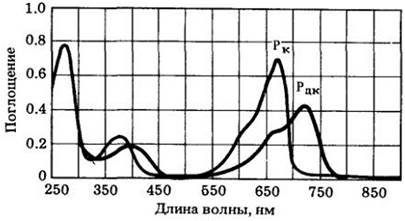
From this perspective, it is easy to interpret the results of lettuce seed germination experiments. Since Pr absorbs red light more efficiently (Fig. 25-12), exposure to this wavelength converts the majority of the molecules into the Pfr form, thereby inducing germination. Subsequent far-red light, absorbed by the Pfr form, forces essentially all the molecules to revert to the initial state, thus nullifying The Effect of the red light.
Fig. 25-12. Absorption spectra of the two phytochrome forms, Pr and Pfr. This difference in absorption spectra enabled the Isolation of the pigment.
What can be said about flowering under a natural day–night cycle? Since white light contains a range of wavelengths (both red and far-red), both forms of the pigment are simultaneously exposed to enough photons for their photoconversion into opposite forms. Within a few minutes in the light, photoequilibrium is established—meaning the forward (Pr -> Pfr) and reverse (Pfr -> Pr) reactions are balanced. At this point in time, under daylight, a constant ratio of phytochromes (about 60% Pfr and 40% Pr) is maintained in The plant cell as long as the light exposure continues.
If a plant is placed in darkness at the end of the photoperiod, the level of Pfr steadily decreases over several hours. If a high level of Pfr is restored by a brief red-light flash in the middle of the dark period (see Fig. 25-9), it will delay flowering in short-day (so-called "long-night") plants that would otherwise flower, and promote flowering in long-day (so-called "short-night") plants that would otherwise remain vegetative. In either case, the effect of the red pulse in restoring a high Pfr level can be reversed by a brief subsequent exposure to far-red light, which converts Pfr back into Pr.
In 1959, Harry Borthwick and his colleagues in Beltsville named this pigment phytochrome and provided compelling physical evidence for its existence. The basic CHARACTERISTICS OF THE pigment are schematized in Fig. 25-13. The molecule is continuously synthesized as Pr and accumulates in this form in dark-grown plants. Light triggers the photoconversion of Pr into Pfr, which induces the biological response. Pfr can be converted back to Pr either via photoconversion by absorbing far-red light or in the dark (a process termed "dark reversion," which takes from several minutes to several hours). Pfr can apparently also be degraded through proteolysis by proteases—so-called destruction—which occurs over several hours. All three alternative pathways for the removal of Pfr provide a mechanism to cancel the induced response. It should be noted, however, that the dark reversion pathway has been found only in dicots, not in monocots.
Fig. 25-13. Phytochrome is initially synthesized from Amino Acids in the Pr form (Pn denotes the precursor). Pr is converted to Pfr upon illumination with red light, which is the active form that triggers the biological response. Pfr converts back to Pr when exposed to far-red light. In the dark, Pfr either converts to Pr or is degraded (Pp denotes the breakdown product).

Isolation of Phytochrome
Compared to pigments such as chlorophyll, phytochrome is present in plants in very small amounts. Identifying phytochrome requires a spectrophotometer sensitive to extremely minute changes in Light absorption. Such an instrument was developed only seven years after the existence of phytochrome was first hypothesized; this novel device was subsequently used for the detection and isolation of the pigment.
To avoid errors caused by the presence of chlorophyll—which, like phytochrome, absorbs light at around 660 nm—dark-grown seedlings (in which chlorophyll has not yet formed) were used as the source of phytochrome. The isolated pigment had a blue color and reversibly shifted between forms upon exposure to red and far-red light, exhibiting slight, reversible color changes in response to the absorption of light at the respective wavelengths.
Phytochrome molecules have been shown to consist of two distinct parts: a chromophore (which absorbs light) and a large protein moiety (Fig. 25-14). The chromophore closely resembles phycobilin, an accessory pigment found in cyanobacteria and red Algae.
Fig. 25-14. The phytochrome chromophore (Pr form); its attachment to the protein portion of the molecule is visible.

The specific mechanism of phytochrome action has not yet been fully elucidated. However, it is clear that phytochrome regulates morphogenesis by altering Gene Transcription.
Other Phytochrome-Mediated Responses
Phytochrome has been shown to be involved in a range of other plant responses as well. The germination of many seeds, for example, takes place in the dark. In seedlings, the stem elongates rapidly, pushing the shoot (or, in most monocots, the cotyledon) up through the soil. At this stage of growth, substantial leaf development does not occur, as it could hinder shoot emergence. This type of growth is not strictly dependent on the soil; any seedling kept in the dark will become etiolated, growing long and spindly with small leaves. It will appear yellow or colorless because plastids do not turn green until the seedling is exposed to light. Such a seedling is termed etiolated (Fig. 25-15).
Fig. 25-15. Dark-grown seedlings (left) are thin and pale, featuring longer internodes and smaller leaves compared to normal seedlings (right). This suite of physical traits, known as etiolation, is crucial for seedling survival because it increases the chances of reaching the light before stored energy reserves are depleted.

When the tip of the seedling emerges above the ground, etiolated growth gives way to normal development. In dicots, the hooked hypocotyl straightens, stem elongation rate may decrease, and leaf expansion begins (see Fig. 19-2). In grasses, growth of the mesocotyl (the region of the embryonic axis between the scutellum and the coleoptile) ceases, the stem elongates, and the leaves unfold.
Bean seedlings grown in the dark and exposed to, say, five minutes of red light per day begin responding to this light by the fourth day. If the red-light treatment is followed by five minutes of far-red light, none of the typical red-light-induced developmental changes are observed (Fig. 25-16). Similarly, red-light illumination in grass seedlings signals the cessation of mesocotyl growth, an effect that can likewise be nullified by subsequent far-red light.
Fig. 25-16. All three bean plants were illuminated for 8 hours daily. The center plant was exposed to 5 minutes of growth-promoting far-red light at the beginning of each dark period. The plant on the right was exposed to 5 minutes of far-red light followed by red light, which neutralized the far-red effect. The plant on the left served as a control; its phytochrome remains predominantly in the Pfr form because the plant entered the dark period immediately after daylight exposure.

A recent paper published in England suggested yet another function for phytochrome in plants growing under natural conditions: it can act as a detector to sense shading by other plants. Radiation below 700 nm is almost entirely reflected or absorbed by plant canopies, whereas radiation between 700 and 800 nm (the far-red range) is largely transmitted. This causes a critical upward shift in The ratio of Pr to Pfr (meaning more Pfr is converted to Pr) in shaded plants, triggering a rapid increase in internode elongation rate.
Red/far-red reversible responses are also implicated in anthocyanin synthesis in apples, rutabagas, and cabbage; seed germination; chloroplast and plastid differentiation; and a vast array of other physiological responses throughout the plant's life cycle.
Phytochrome and Photoperiodism
When the existence of phytochrome was first demonstrated, the researchers who discovered it hypothesized that its behavior might explain The phenomenon of photoperiodism—that is, that reversible responses to red/far-red light could be incorporated into a time-measuring mechanism, or biological clock. According to this hypothesis, Pfr inhibits flowering in short-day plants but promotes it in long-day plants. In short-day plants, Pfr would accumulate in the light and be removed during the subsequent dark period through destruction or dark reversion. If the nights were sufficiently long, all of the
(or a critical amount of) Pfr would be removed, and flowering would no longer be inhibited. On the other hand, long-day plants require short nights, during which complete destruction of Pfr does not occur; if the night was sufficiently short, enough Pfr would remain at its end to promote flowering.
Experiments have shown, however, that Pfr disappears in many plants within three or four hours of darkness. Based on these experiments and other observations, it is now widely accepted that the phenomenon of photoperiodism, associated with time measurement, is not controlled solely by The interconversions of Pr and Pfr. A more complex explanation must be sought.
Hormonal Control of Flowering
In their early experiments with cocklebur, Hamner and Bonner demonstrated that flowering in a bud is stimulated by a leaf that "perceives" light. Apparently, some substance that exerts a decisive influence on GROWTH AND DEVELOPMENT moves from the leaf to the bud. This hypothetical substance was named the flowering hormone, or stimulus.
Experiments confirming the existence of a flowering stimulus were independently conducted in several laboratories during the 1930s. The most convincing were among the first, carried out by Soviet plant physiologist M. Kh. Chailakhyan several years before the cocklebur studies began. Using the short-day plant Chrysanthemum indicum, Chailakhyan showed that if the upper part of a plant is deprived of leaves, and the leaves remaining on its lower part are placed under short-day conditions, the plant will flower. Conversely, if the upper, leafless part of the stem is placed under short-day conditions and the lower, leafy part under long-day conditions, flowering will not occur. Based on these results, Chailakhyan suggested that a hormone is formed in the leaves, which moves to the stem apex and induces flowering. Chailakhyan named this hypothetical hormone florigen.
Further experiments showed that flowering does not occur if the leaf is removed immediately after photoinduction. However, if the leaf is left on the plant for several hours after the end of the induction cycle, subsequent leaf removal has no effect on flowering. The flowering hormone can be transmitted from a photoinduced plant to a non-induced one through grafting. Unlike auxin, which can pass through Agar or other nonliving media, florigen moves from one plant tissue to another only if anatomical connections exist between them. If a branch is ringed—that is, a annular strip of bark is removed—the movement of florigen ceases. Based on these data, it was concluded that florigen travels through the phloem, which is the pathway for the transport of most organic substances in plants.
Subsequently, Anton Lang of the California Institute of Technology showed that certain long-day plants and biennials, such as celery and cabbage, can be induced to flower by treating them with gibberellin, even when grown under non-inductive photoperiods. This discovery led Chailakhyan to modify his florigen hypothesis, proposing that florigen actually consists of two Hormones: gibberellin and a yet-unidentified antiin. According to this hypothesis, long-day plants produce antiin but not gibberellin during the non-inductive photoperiod, and gibberellin treatment at this time can induce flowering. On the other hand, short-day plants produce gibberellin but not antiin when grown under non-inductive conditions. Although the concept of a complex nature for florigen stimulated much research, it unfortunately failed to answer such crucial questions as: why short-day plants grown under non-inductive conditions do not induce flowering in grafted long-day plants that have likewise not been exposed to an inductive photoperiodic signal.
In some plants—the Biloxi soybean (Glycine max) being a case in point—leaves must be removed from the scion, otherwise it will not flower. This observation suggests that an inhibitor may be formed in the leaves of non-induced plants. Indeed, based on such evidence, some researchers have concluded that no flowering-inducing substance exists; rather, There is a substance that, unless removed, inhibits flowering. There is now strong evidence that, at least in some plants, the control of flowering involves both inhibitory and accelerating substances.
The most compelling Evidence for the existence of these substances within a single plant comes from the experimental research of Anton Lang at Michigan State University, as well as M. Kh. Chailakhyan and I. A. Frolova at the K. A. Timiryazev Institute of Plant Physiology in Moscow. These scientists chose three tobacco varieties for their studies: the day-neutral Nicotiana tabacum variety Trapezond, the short-day variety Maryland Mammoth, and the long-day species Nicotiana sylvestris. It was found that Flower Formation in day-neutral tobacco is accelerated by grafting a long-day plant onto it, provided the grafted plants are placed under long-day conditions. Similar results were obtained when short-day plants were grafted onto day-neutral plants and the scions were placed under short-day conditions. If long-day plants grafted onto day-neutral rootstocks were exposed to short days, flowering of the day-neutral rootstock was markedly inhibited (Fig. 25-17). Conversely, if short-day plants grafted onto day-neutral plants were exposed to long days, little or no delay in flowering was observed.
Fig. 25-17. Grafts of Nicotiana sylvestris (a long-day plant) onto Nicotiana tabacum var. Trapezond (a day-neutral plant). Under long-day conditions, Flower Development in the day-neutral tobacco is accelerated by grafting (plant on the left). Under short-day conditions, the day-neutral tobacco remains vegetative throughout the entire (90- to 94-day) experiment (plant on the right)

These results indicate that flower-inducing substances are formed in the leaves of long-day plants under long-day conditions, whereas flowering-inhibiting substances are formed under short-day conditions; furthermore, both types of substances can pass from the scion to the rootstock and be transported throughout the plant. In the leaves of short-day tobacco plants under long-day conditions, apparently few or no flowering-inhibiting substances are formed. Short-day plant flowering inhibitors are much less effective at delaying flowering than those produced by long-day plants.
The evidence for the existence of flowering inhibitors and stimulants is quite convincing, although all attempts to isolate these substances have so far proved unsuccessful.
Dormancy
Plants do not grow at a constant rate all year round. During unfavorable seasons, they restrict their growth or stop it altogether. This ability allows plants to survive adverse periods associated with Water scarcity or low temperatures.
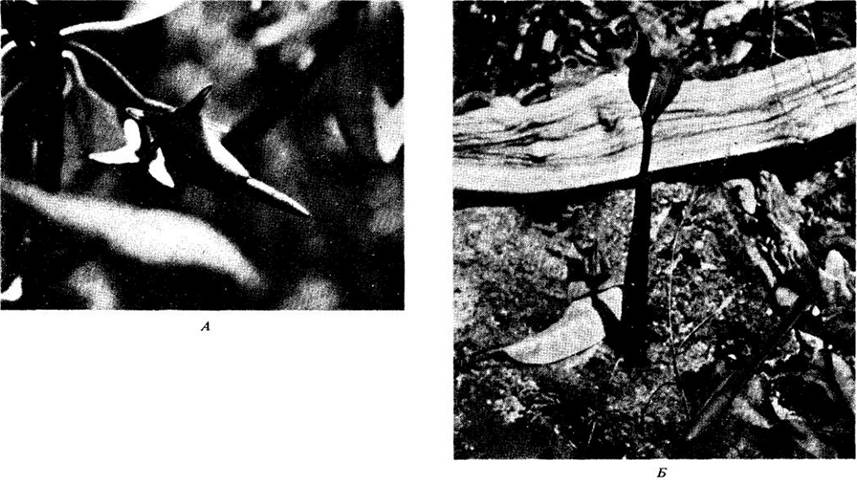
Dormancy is a specialized state of arrested growth characteristic of both seeds and buds. A seed that fails to germinate despite being adequately supplied with water and oxygen and kept under favorable temperature conditions is termed dormant. Bud dormancy is defined as the cessation of visible growth. Only specific environmental "signals," often quite precise, can "activate" a dormant bud or embryo. This adaptation is of vital importance to the plant. For example, in spring plant buds open, flowers form, and seeds germinate—yet how do plants know that spring has arrived? If warm weather alone were sufficient, then in some years during Indian summer all plants would flower, and seedlings would begin to grow only to be killed by winter frost. The same thing would happen during the warm spells that frequently interrupt the winter season. A dormant seed or bud does not respond to these seemingly favorable conditions thanks to endogenous inhibitors that must be removed or neutralized before dormancy can end. In contrast to this "reluctance" to germinate too quickly, some seeds can germinate immediately after formation. This is true, for instance, of willows (Salix) and sugar maples (Acer saccharum), whose seeds lose viability within a week if exposed to air. In mangroves (Rhizophora mangle), seeds germinate directly on the parent plant, forming heavy roots and dropping like darts to embed themselves in the mud (Fig. 25-18). In agricultural practice, seeds are specially selected for their ability to germinate rapidly under favorable conditions; such a trait would be highly dangerous for the seeds of wild species.
Fig. 25-18. A germinating seed (A) and young seedling (B) of the mangrove Rhizophora mangle. The seeds germinate while still attached to the parent plant and form a dart-like root that plunges into the mud as soon as the germinating seed drops
Seed Dormancy
Seeds of almost all plants found in regions with pronounced seasonal temperature variations require a cold period to germinate, which normally sets in with the arrival of winter. The seeds of many ornamental plants also require a period of low temperatures. If a moist seed is treated with low temperatures for several days (the average optimum being 5°C for 100 days), dormancy can be broken and the seed will germinate. This horticultural practice is called stratification. Many seeds require drying in order to germinate (although some may be in a non-dormant state prior to drying). This requirement prevents them from germinating within the moist environment of the parent fruit. Some seeds, such as lettuce, require light for germination, whereas the germination of others is inhibited by light.
Some seeds do not germinate under natural conditions until they are cracked by the action of the soil. Such cracking helps to rupture the seed coat, facilitating the uptake of water and oxygen by the seed and, in some cases, the removal of inhibitors. Hard seed coats that prevent water absorption and embryo growth are frequently found in legumes.
Seeds of certain desert plant species germinate only when sufficient rainfall occurs to leach out germination-inhibiting substances located in the seed coat. In addition, a specific amount of water—which must be stored by the plant—is necessary for seedling establishment. Mechanical disruption of the seed coat (scarification) with a knife, file, or sandpaper helps overcome "hardseededness," removes inhibitors, or restores the metabolic activity required for germination. Germination can also be induced by immersing seeds in alcohol and other fat-Solvents (to dissolve waxy substances that prevent water entry) or in concentrated acids. These techniques are widely used in horticulture.
Some seeds can remain viable in a dormant state for long periods (years, decades, and even centuries). In 1879, seeds of 20 common Michigan weed species were placed by W. J. Beal of Michigan State University in moist, well-aerated sand to determine their longevity. After 100 years, seeds of three species were still viable. Recently, viable seeds (representing seven out of 40 plant species) were discovered in the brick walls of historic buildings constructed in California and northern Mexico between 1769 and 1837. Although the resilience of these seeds is impressive, it still falls short of sacred lotus seeds (Nelumbo nucifera) found by Japanese botanists in peat deposits in Manchuria. Radiocarbon dating showed these seeds to be about 2,000 years old, yet when their seed coats were ruptured to facilitate water penetration, every single seed germinated.
In 1967, even this record was surpassed by seeds of the arctic lupine (Lupinus arcticus) from the arctic tundra. Some of these seeds, found in a frozen lemming burrow in the Yukon along with animal remains dating back at least 10,000 years, germinated within 48 hours. However, the age of the seeds themselves was not definitively established.
In recent years, researchers have shown a growing interest in the factors that enable seeds to maintain their viability. Stored seeds may experience a gradual decline in enzyme activity, which eventually leads to a complete loss of viability. What conditions can prolong seed longevity? Such questions are particularly relevant given the widespread interest in establishing seed banks to preserve the genetic traits of wild and cultivated crop varieties for use in future plant-breeding programs.
The Need for such seed banks arises from the gradual replacement of older varieties with newer ones and the eradication of the displaced varieties, largely due to habitat destruction. Furthermore, for the same reasons, many wild species face the threat of extinction, and their seeds must be preserved whenever possible (see Appendix 2 to Chapter 30).
Bud Dormancy
Bud dormancy is vital for the survival of herbaceous and woody perennials in temperate regions, which are subjected to low temperatures during the winter. Although dormant buds do not enlarge—meaning no visible growth is observed—meristematic activity has nonetheless been detected in them during various phases of dormancy.
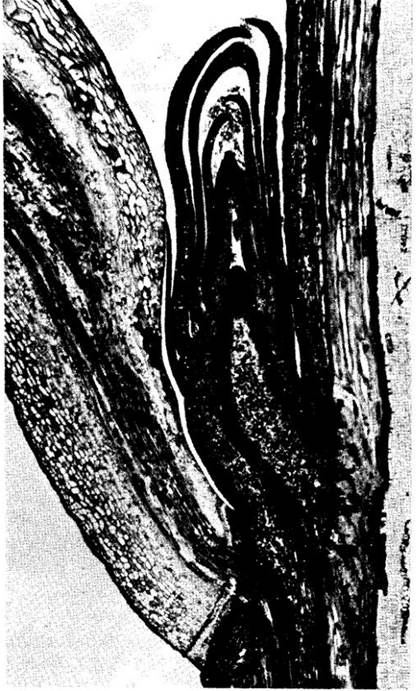
In many trees, buds enter dormancy in midsummer, long before autumn leaf fall. A dormant bud is an embryonic shoot consisting of an apical meristem, nodes and internodes (not yet elongated), rudimentary leaves or leaf primordia, with buds or bud primordia in their axils. This entire embryonic shoot is surrounded by bud scales (Fig. 25-19). Bud scales are critically important because they prevent dehydration, restrict oxygen diffusion, and insulate the bud against heat loss. In addition, growth inhibitors are known to accumulate in the bud scales, the axial PARTS OF THE buds, and the leaves within the buds. Therefore, in many respects, The Role of bud scales is analogous to that of a seed coat.
Fig. 25-19. Longitudinal section of a dormant axillary bud of maple (Acer). The bud consists of an embryonic shoot surrounded by bud scales.
As growth proceeds and eventually ceases with the transition to a dormant state, numerous physical and physiological changes begin to occur in plant Tissues to prepare the plant for winter—a process known as acclimation. Shortening day length is the primary trigger that induces buds to enter dormancy (Fig. 25-20). Typically, more inhibitors accumulate in leaves and buds under short-day conditions than under long-day conditions. Cold acclimation results in cold hardiness, which is the plant's ability to withstand severe cold and drought during the winter months.
Fig. 25-20. Relationship between day length and the plant developmental cycle in the northern temperate zone.

Both seeds and buds of many plant species require a period of cold to break dormancy. If branches of trees and shrubs are cut in the autumn and brought indoors, they will not flower; however, if such branches are left outdoors until late winter or early spring and then transferred to a warm room, they will bloom. Deciduous fruit trees, such as apple, chestnut, and peach, cannot grow in climatic zones devoid of cold winters. Similarly, The Development of bulbs (such as tulips, hyacinths, and daffodils) can be accelerated artificially—forcing them to bloom indoors in winter—provided they have been stored in a cold place. As discussed in Chapter 22, these bulbs are essentially large buds in which the leaves are modified into fleshy scales that store reserve nutrients.
Controlled-environment studies support the hypothesis that many plant species require cold to break dormancy. For instance, most peach varieties must experience 600 to 900 hours at temperatures below 4°C before they can respond to the activating effects of warmer temperatures and longer days. Some plants respond even to brief frost exposure; if a single bud of a greenhouse-grown lilac bush is chilled briefly, that lone bud will soon open. However, cold is not universally required to break dormancy. For example, potatoes, whose "eyes" are nothing more than dormant buds, require at least two months of dry storage; low temperature is not a decisive factor. In many plants, particularly trees, winter dormancy is broken via a photoperiodic response, with the dormant buds acting as the receptor Organs.
Gibberellins can sometimes break dormancy. For example, treating a peach bud with gibberellin can induce its development after the bud has been chilled for only 164 hours at temperatures below 8°C. Does this mean that under normal conditions an increase in gibberellin levels triggers the breaking of dormancy? Not necessarily. Dormancy may be determined by the balance between growth inhibitors and stimulators. Adding a growth stimulator (or removing an inhibitor, such as Abscisic acid) can shift this balance sufficiently to initiate growth.
It appears that there is no single, universal mechanism by which dormancy is induced or broken. While this significantly complicates the challenges facing plant physiologists, it aligns well with our understanding of evolution. Dormancy emerged as a useful trait for plants relatively recently, as seed plants began to spread into diverse ecological zones. It likely evolved independently across many plant groups, with each group finding its own solution.
Cold and the Flowering Response
Cold can also affect flowering. For example, if winter rye (Secale cereale) is sown in autumn, it sprouts over the winter and flowers the following summer, seven weeks after growth begins. If rye is sown in spring, it fails to flower for 14 weeks, remaining in a vegetative state for most of the growing season. In 1915, German plant physiologist Gustav Gassner discovered that regulating the temperature of germinating seeds could influence the flowering of winter rye and other cereals. He noticed that if seeds of winter varieties were kept near freezing temperatures (1°C) during germination, the winter rye would flower that same summer even when sown in late spring. This Procedure, known as vernalization, is widely used in agriculture. Even after vernalization, the plant must be exposed to a photoperiodic signal, typically by placing it under long-day conditions. Vernalized winter rye behaves as a typical long-day plant, flowering in response to long summer days. A parallel example is biennial henbane (Hyoscyamus niger). The rosette that terminates the first year of vegetative growth produces a flower stalk only if the plant is exposed to cold. Afterward, it behaves as a long-day plant, exhibiting the same photoperiodic response characteristic of annuals.
As these examples demonstrate, cold treatment in certain plants modifies the photoperiodic response. Spinach is considered a long-day plant and typically does not flower until day length exceeds 14 hours. However, if spinach seeds are subjected to cold treatment, the plant will flower even under an 8-day length. Similarly, cold treatment in the clover Trifolium subterraneum can completely eliminate its flowering dependence on day length.
In biennial henbane and most other biennial rosette-forming long-day plants, gibberellin treatment can substitute for the chilling requirement, causing the plants to rapidly bolt and flower. Gibberellin treatment of short-day plants or long-day plants that do not pass through a rosette stage has little effect on the flowering response (or may delay it). However, if gibberellin synthesis is inhibited while a plant is exposed to the appropriate inductive cycle, it will fail to flower until gibberellin levels are restored.
Movements of plants occurring in response to an external stimulus, where the direction of movement is independent of the direction of the stimulus, are called nastic movements. Perhaps the most widespread nastic movements are leaf-folding phenomena, discussed earlier under "Circadian Rhythms." Known specifically as nyctinastic movements (from Greek words meaning "night-closing"), these involve the upward and downward movement of leaves in response to daily light fluctuations, causing leaves to orient vertically in the dark and horizontally in the light. Such movements are particularly characteristic of legumes.
Most commonly, nyctinastic leaf movements result from Changes in the cell sizes of the ground parenchyma within pulvini located at the base of each leaf (or leaflet, in compound leaves). A pulvinus is a flexible cylinder with a vascular bundle running through its center. The bulk of the pulvinus consists of thin-walled parenchymatous cells surrounding the vascular tissue. These movements are driven by turgor changes and the concomitant expansion and contraction of parenchyma cells on opposite sides of the pulvinus. These turgor-driven cellular changes are mediated by the shuttle-like transport of potassium ions between the Two Sides of the pulvinus—the site housing the biological clock and the photoreceptor phytochrome.
Nastic movements triggered by touch are called thigmonastic. Such movements are characteristic of the well-known sensitive plant, Mimosa pudica, whose leaflets and sometimes entire leaves suddenly droop in response to touch (Fig. 25-21). As with nyctinastic movements, this reaction results from a sudden shift in turgor pressure within specialized cells of the pulvinus at the Base of the leaflets or leaves. Water loss from these cells is triggered by the efflux of potassium ions. The stimulation of a single leaflet is sufficient for the signal to propagate to other parts of the leaf and subsequently throughout the entire plant.
Fig. 25-21. The sensitive plant Mimosa pudica. A. Normal position of leaves and leaflets. The response to a needle touch is illustrated in B and C. This movement is driven by changes in turgor pressure within the pulvini located at the base of the leaflets, and occurs even when only a single leaflet is stimulated (C).

Evidently, two distinct mechanisms—Electrical and Chemical—are triggered when a stimulus propagates in a sensitive plant. There are varying opinions regarding the adaptive significance of thigmonastic movements for plant survival. Mimosa pudica often grows in arid regions, where it may be subjected to dry hot winds; strong winds, by swaying the leaves, can cause them to fold up, which helps conserve water. Another hypothesis is that a "wilted" plant is less attractive to numerous herbivores. Finally, it is entirely plausible that the leaf-folding effect deters herbivorous insects; there is evidence that other "insensitive" Mimosa species growing near Mimosa pudica suffer heavier insect predation.
Until recently, it was assumed that changes in turgor pressure were involved in the touch response of the insectivorous Venus flytrap (Dionaea muscipula), which enables the plant to capture its prey. However, it now appears that the rapid closing of the Venus flytrap leaves involves irreversible cell elongation, which may be initiated by the acidification of cell walls to pH 4.50 and lower. As the leaves close, the cells of the lower epidermis in the central region of each leaf elongate partially, whereas the dimensions of the upper epidermis cells undergo no significant change. Upon opening, the cells of the upper epidermis in the central part of the leaf elongate, while the lower epidermal cells remain unchanged. These changes can be prevented by neutral buffers that inhibit the acidification of cell walls to pH 4.5 – 4.74. Changes in ATP levels, measured as the leaf closes, show that about one-third of the cellular ATP disappears within the time required for the trap to snap shut (1 – 3 s). It is possible that ATP is utilized for the very rapid transport of hydrogen ions out of the cells.
Each half of the Venus flytrap leaf is equipped with three sensitive trigger hairs. If an insect lands on one of the leaves, attracted by nectar secreted on its surface, it brushes against the hairs and thereby triggers the trap-like closing mechanism of the leaf. The spiny margins interlock, the leaf halves gradually compress, and the insect is pressed against the digestive glands located on the trap surface (Fig. 25-22).
Fig. 25-22. Touch response in the Venus flytrap (Dionaea muscipula). Shown here is an unwary fly, attracted by nectar secreted on the leaf surface, before and after trap closure. Each half of the leaf bears three sensitive hairs that control the "trap." When the fly touches a single sensitive Hair twice or brushes against two hairs sequentially, it thereby causes the leaf halves to snap shut.
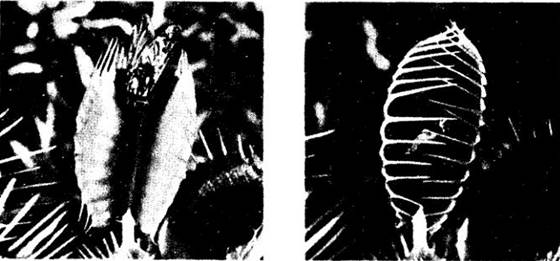
The trapping mechanism is so specialized that it can distinguish living prey from inanimate objects, such as sand grains and small plant debris accidentally falling onto the leaf; the leaf will not snap shut unless two of its hairs are stimulated in succession or a single hair is touched twice.
Heliotropism
The leaves and flowers of many plants can reorient themselves throughout the day, positioning themselves perpendicularly or parallel to the sun's rays. This phenomenon is specifically known as heliotropism (from the Greek helios, sun). Unlike stem phototropism, the movement of a heliotropic plant leaf is not the result of asymmetrical growth. In most cases, pulvini at the base of the leaves and/or leaflets are involved in the movement. Some petioles apparently possess pulvinate properties along their entire length or over a major portion of it. Common plants exhibiting leaf heliotropism include cotton, soybean, lupine, and sunflower (Fig. 25-23).
Fig. 25-23. A. Leaves of the Arizona lupine (Lupinus arizonicus) tracking the sun. This phenomenon is called heliotropism. B. Heliotropism in the sunflower.

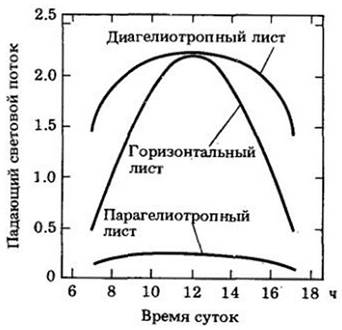
Two Types of heliotropism are distinguished. In one (diheliotropism), the leaf blades reorient so that they remain perpendicular to direct sunlight throughout the day. Such leaves intercept more quanta (Fig. 25-4) involved in photosynthesis and presumably maintain a higher photosynthetic rate throughout the day than non-tracking or paraheliotropic leaves (see below).
During dry spells, some heliotropic plants actively avoid direct sunlight by orienting their leaf blades parallel to the sun's rays (paraheliotropism). In addition to minimizing rather than maximizing solar radiation absorption (Fig. 25-24), this orientation also lowers leaf temperature and transpirational water loss, thereby aiding survival during drought periods.
Fig. 25-24. Comparison of photosynthetically active solar radiation (400 – 700 nm) incident upon diheliotropic, non-heliotropic (horizontal), and paraheliotropic leaves over the course of a day.
Every stage in a plant's life is controlled not by any single factor, but by a complex of various factors. Internal and external factors interact with one another. They may reinforce, modify, or neutralize each other. As W. Hillman of the Brookhaven National Laboratory (USA) remarked: "After all, if plants were as simple as physiologists would like them to be, physiologists would have nothing to do."
Summary
Plants possess numerous adaptations that enable them to detect and respond to environmental changes. An example of such an adaptation is phototropism, or the bending of a growing shoot toward light. The differential growth of a seedling is caused by the lateral redistribution of the Growth Hormone auxin in response to light. The photoreceptor for this response is a blue-light-absorbing pigment. Gravitropism, or geotropism, is the response of a shoot or root to gravity. The accumulation of auxin on the lower side of a horizontally oriented shoot can promote upward stem bending. The downward bending of a horizontally oriented root results partly from the asymmetric distribution of growth-inhibiting hormone substances produced in the root cap and transported to the root elongation zone. Thigmotropism is a response to physical contact with a solid object.
Circadian rhythms are cycles of physiological activity that repeat at intervals of approximately 24 h under constant environmental conditions. These rhythms are endogenous—driven not by external cues such as light-dark cycles or Earth's rotation, but controlled by an internal regulatory mechanism. This regulatory mechanism, whose chemical and physical nature remains unknown, is termed the biological clock. The biological clock enables an organism to perceive Changes in external daily cycles, such as day length variations. Consequently, phenomena such as dormancy, leaf abscission, and flowering can be synchronized with environmental conditions.
The response of organisms to changes in 24-hour light-dark cycles is known as photoperiodism, which controls the onset of flowering in many plants. Some plants flower only when day length exceeds a critical threshold; these are termed long-day plants. Other plants—short-day plants—flower only when day length is shorter than the critical value. Day-neutral plants flower regardless of photoperiod. Photoperiodic responses can be influenced by factors such as temperature and plant age. Interrupting the Dark Phase of a photoperiod with even a brief flash of light can alter the direction of the photoperiodic effect.
Phytochrome—a pigment typically present in low concentrations in higher plant tissues—is sensitive to light-dark alternations. The pigment exists in two interconvertible forms: Pr and Pfr. Pr absorbs red light at a wavelength of 660 nm and is thereby converted into Pfr; Pfr absorbs far-red light (730 nm) and reverts to Pr. In the dark, Pfr either slowly converts back to Pr or is degraded. Pfr is the physiologically active form of the pigment: it promotes flowering in long-day plants and inhibits it in short-day plants. Pfr is also responsible for the changes that occur when seedlings emerge from the soil into the light, as well as for seed germination and anthocyanin synthesis.
In both long-day and short-day plants, the photoperiod is perceived by the leaves, whereas the response is manifested in the bud. Phytochrome acts as the photoreceptor that perceives the environmental stimulus and presumably interacts in some way with the endogenous circadian rhythm to induce the formation of a flowering stimulus. Although the flowering stimulus has not yet been isolated or identified, this chemical substance, termed florigen, travels from the leaves to the bud, where it triggers flowering. Experiments have demonstrated that transport occurs via the phloem and that the Structure and function of florigen are similar in long-day, short-day, and day-neutral plants. There is strong evidence to suggest that at least in some plants, both flowering-inducing and flowering-inhibiting substances are involved in the flowering process.
The alternation of growth and dormancy periods enables plants to withstand water scarcity as well as extreme heat and cold. Dormancy is a specialized state of arrested growth in which the entire plant or structures such as seeds or buds will not resume growth without specific environmental triggers. The requirement for such a stimulus—such as chilling, dehydration, or an appropriate photoperiod—prevents tissues from breaking dormancy prematurely under favorable conditions, such as those inside a succulent parent fruit or during an unseasonable autumn warm spell (Indian summer). There appears to be no single universal mechanism across all plant groups that induces or breaks dormancy. A decrease in day length is typically the primary factor involved in the induction of bud dormancy. Cold acclimation leads to cold hardiness, the plant's capacity to endure severe winter frosts. Vernalization accelerates flowering in winter crop varieties by exposing seeds to low temperatures.
Plant Movements that occur in response to a stimulus, but whose direction is independent of the stimulus vector, are termed nastic movements. Among these are the widespread "sleep" movements—the daily raising and lowering of leaves in response to the light-dark cycle. Nastic movements triggered by touch include the snap-trap mechanism of the Venus flytrap.
The leaves and flowers of certain plants track the sun throughout the day, thereby maximizing or minimizing the absorption of solar energy.
Last update: 07/08/2026
Editorial and Educational Adaptation: This material has been compiled based on the primary/original source text. The project team performed an editorial review, corrected technical inaccuracies, structured sections, and adapted the content for an educational format.
What was processed:
- elimination of formatting defects (OCR errors, structural breaks, corrupted characters);
- editorial organization of content;
- standardization of terminology in accordance with academic sources;
- verification of factual statements against the original source text.
All mentions of the author, publication year, and origin of the primary text have been preserved in accordance with the source.