Plant Physiology - Musienko M.M. 2001
Plant Movements
Tropisms
A growth response that causes a plant organ or part to bend toward or away from an external stimulus that determines the direction of movement is called a tropism. Accordingly, tropisms can be positive or negative. In positive tropisms, the movement is directed toward the stimulus, whereas in negative tropisms, it is directed away from it. Tropisms result from the accelerated elongation of Cells on one specific side of a SHOOT, ROOT, or leaf. According to the Cholodny–Went Hormonal theory of tropisms, external stimuli induce a corresponding electropolarization of Tissues, As a result of which auxin transport—and consequently growth—becomes asymmetrical. Abscisic acid and other factors are also involved in The Mechanism of tropisms. Ultimately, tropisms serve to orient Organs in space, ensuring the most efficient utilization of nutritional factors and protection against harmful influences.
Depending on The Nature of the stimulus, distinctions are made among geo-, photo-, thigmo-, hydro-, aero-, and traumatropisms, among others.
Geotropism, or gravitropism, is a response to the force of gravity, which is clearly manifested in seedlings. If a seedling is placed horizontally, its root will bend downward (positive geotropism), and its shoot upward (negative geotropism). Gravitropic responses can also be observed in the shoots of young plants (Fig. 205).
Class="center">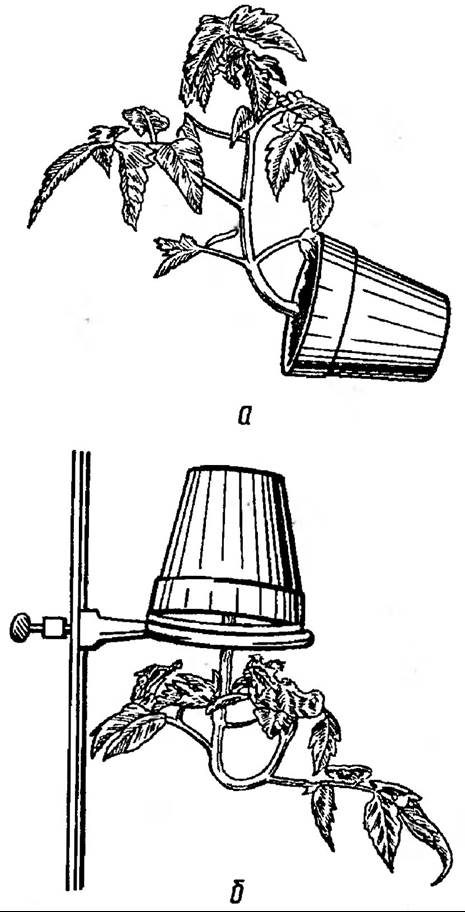
Fig. 205 Gravitropic response of a young tomato plant shoot (Lycopersicum esculentum): a — the pot with the plant was laid on its side and kept stationary; b — the pot with the plant was inverted and secured upside down on a ring stand.
Initially, this phenomenon was explained by the asymmetrical redistribution of Auxins toward the lower side of the organ via lateral polar Transport of Molecules from top to bottom. Consequently, the lower side of the shoot should grow upward, whereas in the root, the upper side would elongate faster than the lower side, causing it to bend downward.
Although the existence of lateral IAA transport and its asymmetrical distribution has been experimentally proven, there is still data that is inconsistent with this explanation.
As it turned out, gravity perception is associated with pressure exerted by statoliths—which can be amyloplasts, METABOLISM/14.html">Chloroplasts, or various inclusions—on the cellular membranes of the Plasmalemma or The Endoplasmic reticulum. In roots, The Role of statocytes (cells containing statoliths) is performed by cells in the central part of the root cap, which house amyloplasts. There is evidence suggesting that gravity perception is linked to the sedimentation of these amyloplasts.
When a root is placed horizontally, the Plastids move downward and accumulate near The Cell walls that were previously oriented vertically. After a few hours, the root bends downward, and the plastids return to their previous position along the transverse cell walls of the root. Exactly how the movement of these gravity receptors generates the corresponding hormonal gradients remains to be elucidated. It is likely that Ca44 ions play a key role in this phenomenon by regulating auxin transport.
The geotropic response is a "threshold" phenomenon, meaning that geotropic bending occurs only when the stimulus reaches a certain level. The time required for the bending to manifest is about one hour.
A fairly common type of tropism is the response to contact with a solid object, known as thigmotropism (from Gr. thigma — Touch). An example of such tropisms is the response of tendrils (modified leaves or stems), which coil around any object acting as a support. The cells that come into contact with the support contract slightly, while those on the opposite side elongate. There is evidence that auxins are involved in this response. Tendrils that fail to attach to a support undergo autonomous coiling as they age, driven by enhanced growth on the upper side.
Phototropism refers to growth movements and bending of plant organs under The Influence of unilateral illumination. The plant perceives not the direction of the light beam, but the difference in illumination (the light gradient) between the shaded and illuminated sides.
In this case, the growth response is driven by the action of indole-3-acetic acid, which induces cell elongation on the shaded side of the shoot apex. Light likely decreases the sensitivity of cells on the illuminated side to auxin, may destroy auxin, or promotes its displacement toward the shaded side of the growing shoot apex. It has been proven that blue light (400–500 nm) provides the most efficient translocation of the hormone, meaning that a pigment absorbing precisely these wavelengths acts as the mediator in this process. The complete Structure OF THE blue-light photoreceptor has not yet been elucidated, but data suggest it is a flavin pigment. One hypothesis suggests that blue light triggers a chemical reduction reaction of flavins, which enhances electron Transport Across the Plasma Membrane and establishes a specific proton gradient. All manifestations of phototropism are characterized by a dependence exclusively on short-wave light. This is charac-
teristic of shoots, oat coleoptiles, fungal sporangiophores, and others. In fern and moss protonemata, which exhibit apical growth, long-wave light is also effective, but the phototropic response in this case is mediated by the Phytochrome system.
Chemotropism refers to bending movements associated with the unilateral influence of chemical substances. Chemotropic bending is characteristic of pollen tubes and plant roots.
Hydrotropism, which is caused by an uneven distribution of moisture in the environment, also deserves attention. Hydrotropic bending occurs in the direction of higher moisture levels. Root systems are characterized by positive hydrotropism. Under conditions of sufficient moisture, hydrotropic movements do not occur.
Aerotropism is spatial orientation caused by an uneven distribution of oxygen. It is primarily characteristic of root systems.
Heliotropism. In many plants, leaves and flowers can be observed turning throughout the day, orienting themselves perpendicular or parallel to the sun's rays (sunflower, lupine, soybean). This phenomenon is called heliotropism. Unlike stem phototropism, it is not the result of asymmetrical growth. For the most part, these movements involve pulvini at the Base of the leaves. It is even possible that some petioles possess analogous pulvinar properties along their entire length or a specific portion of it. There are two types of heliotropism. The first is diaheliotropism, in which leaf blades turn during the day so that they remain perpendicular to direct sun rays at all times. The second is paraheliotropism, in which leaf blades orient themselves parallel to the sun's rays. Such movements are likely associated with photosynthetic processes and adaptation to Changes in the plant's Water regime.
Last update: 07/08/2026
Editorial and Educational Adaptation: This material has been compiled based on the primary/original source text. The project team performed an editorial review, corrected technical inaccuracies, structured sections, and adapted the content for an educational format.
What was processed:
- elimination of formatting defects (OCR errors, structural breaks, corrupted characters);
- editorial organization of content;
- standardization of terminology in accordance with academic sources;
- verification of factual statements against the original source text.
All mentions of the author, publication year, and origin of the primary text have been preserved in accordance with the source.