Plant Physiology - Musiyenko M.M. 2001
Plant Movements
Nastic Movements
Nastic movements are typical of Organs with a bilaterally symmetrical Structure. They are accompanied by uneven growth of the lower and upper PARTS OF THE organ. If rapid growth occurs on the morphologically upper side of the organ, epinasty takes place, resulting in the opening of buds and flowers. Conversely, when rapid growth occurs on the lower side, the floral envelopes close—a phenomenon known as hyponasty. In most cases, however, nastic movements are driven by turgor changes resulting from an increase or decrease in the concentration of osmotically active substances (malate, potassium ions, chloride) in specialized Cells on opposite sides of the organ.
Movements can be observed when light periodically alternates with darkness. In some plants, flowers open in the morning and close at night. A similar characteristic is typical of the leaves of certain plants (Fig. 206).
Class="center">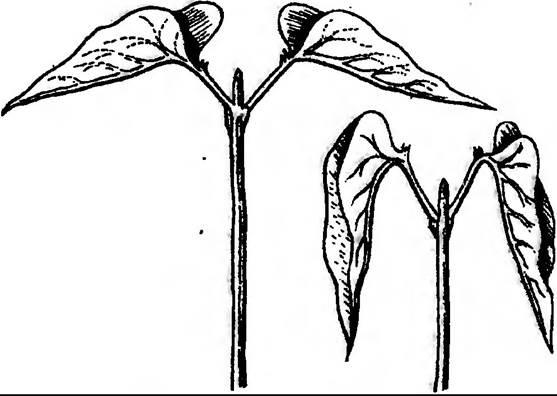
Fig. 206. Rhythmic daily movements of leaf positioning in Phaseolus multiflorus during the day (left) and at night (right)
These movements are known as the "Sleep of plants"—nyctinasty, although this does not correspond to the physiological state of the Organism and has nothing in common with The phenomenon of sleep in animals. The "sleep movements" of flowers and leaves, where they open or close in response to changes in light (photonasty) or Temperature (thermonasty), are classified as nastic because external stimuli merely trigger them, while the direction of movement depends on internal factors.
Photonastic movements occur As a result of changes in light intensity. Dandelion flowers close at night and open in the morning. The opposite phenomenon is observed in plants whose flowers open in the light and close when light intensity decreases. Such movements differ from Tropisms, which are growth-related.
The leaf blades of plants capable of photonasty are positioned horizontally during the day, whereas in the evening they change their orientation through the bending of petioles or leaf blades.
Thermonasties occur as a result of changes in ambient temperature. Such movement can be observed when flowers of tulips or crocuses are moved from the cold into conditions of 20–25°C, causing them to open.
In many plants, especially legumes (clover, mimosa), leaves and leaflets feature special structures called pulvini. These are distinct swellings at the Base of the petiole or leaflet containing large parenchymal cells. A rapid change in turgor pressure within these cells causes the pulvinus to function as a hinge, facilitating movement.
Hépotonastic movements observed in response to Touch are among the most specific movements characteristic of plants. Everyone is familiar with the sensitive plant Mimosa pudica, which is highly touch-sensitive. While this species exhibits normal sleep movements, it is also capable of reacting sharply to "Shock" stimuli—seismonasties. Stimulation of the leaflet tips causes them to fold within just a few seconds. A stronger stimulus or a longer duration of exposure can trigger not only the pairwise folding of leaflets but also the drooping of the entire petiole (Fig. 207).
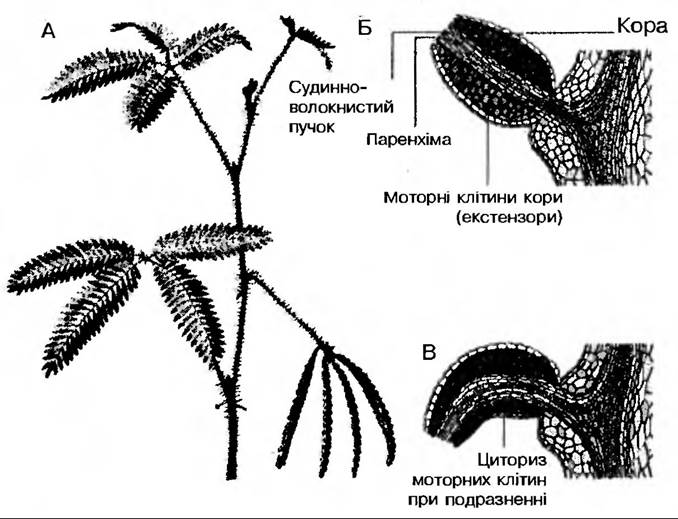
Fig. 207. Nastic movements in Mimosa pudica
It is believed that The Mechanism of seismonastic movements is driven by changes in turgor between the upper and lower halves of the pulvinus, which normally holds the leaf in an upright position. This is associated with altered ion transport in motor cells. Motor cells interact with other cortical cells and collenchyma Cells of the pulvinus. Much like guard cells, changes in ion fluxes are driven by proton pumps that extrude H+ from motor cells simultaneously with The transport of K+, Cl-, and other ions. During movement, proton pumps in the motor cells of the upper and lower parts of the pulvinus interact while functioning in opposite phases. The stimulus is thought to be transmitted by a phytohormone carried through the xylem. Signal transmission is also associated with electrical changes. It has been proven that stimulation triggers action potentials in the leaf with an amplitude of 50–100 mV, propagating along the petiole at a speed of 0.5–4 cm/s. Within 0.05–1 s after the Action Potential appears in the pulvinus, the electrical resistance of the lower motor cells decreases relative to the upper ones due to the efflux of potassium and chloride ions from these cells. The release of ions from the vacuole is accompanied by the outflow of Water into the intercellular space, leading to a loss of Cell turgor. It is also hypothesized that contractile protein systems within motor cells participate in the rapid seismonastic movements of certain plants.
In the carnivorous Venus flytrap (Dionaea muscipula), leaves borne on winged petioles snap shut rapidly when an insect touches sensitive trigger hairs on the upper surface of the leaf. It was long believed that turgor also mediated these movements; however, recent studies have shown that the rapid closure of Venus flytrap leaves is linked to irreversible cell stretching, initiated by the acidification of cell walls to pH 4.5 or lower. As the trap closes, epidermal cells in the lower central region of each leaf lobe stretch partially, whereas the dimensions of the upper epidermal cells remain virtually unchanged.
Conversely, during leaf opening, upper epidermal cells stretch while the lower ones remain unchanged. Monitoring ATP levels during leaf closure revealed that one-third of the available ATP is consumed within this brief time frame (1–3 s). It is hypothesized that ATP is utilized for rapid proton transport. There are Other forms of seismonastic responses as well. All plants that react to touch or mechanical shock also respond to electric current. The movements of mimosa leaflets can be triggered by wounding a specific leaflet or the entire plant—a phenomenon known as traumatunasty. Two distinct mechanisms (Electrical and Chemical) are invariably engaged during stimulus propagation in such plants.
Nastic Movements of the stomatal apparatus. The opening and closing of Stomata are driven by nastic turgor movements of guard cells. Stomata exhibit phyto-, hygro-, thermo-, and chemonasties. Stomatal movements are unique in that turgor changes arise from shifts in osmotic potential. These are active processes that consume ATP for intercellular ion transport, particularly of K+.
Stomata, which vary across plant species, are structured to open under high turgor and close under low turgor. The morphological foundation of stomatal movement lies in The structure of the bean-shaped guard cells. The outer walls of these cells are elastic, whereas the inner walls are thickened and inelastic. Directional movement is maintained by a specialized microstructure and the orientation of microfibrils in the inner wall. The degree of stomatal opening is a function of the turgor pressure difference between the guard cells and the adjacent epidermal cells that resist their expansion. The action spectrum of photonastic stomatal movements resembles that of Photosynthesis, although the high effectiveness of blue light suggests that pigments other than photosynthetic ones are also involved in this process.
It is possible that day-night-induced stomatal movements are driven by The conversion of starch into sugars, whereas rapid fluctuations in stomatal aperture width under various environmental factors result from the activation of ion pumps. Guard cells also respond to internal CO2 levels within the intercellular spaces (closing at approximately 0.05% CO2 and opening at lower concentrations). The specific effect of blue light and the circadian rhythm of stomatal opening are likely interconnected with fluctuations in CO2 concentration.
Last update: 07/08/2026
Editorial and Educational Adaptation: This material has been compiled based on the primary/original source text. The project team performed an editorial review, corrected technical inaccuracies, structured sections, and adapted the content for an educational format.
What was processed:
- elimination of formatting defects (OCR errors, structural breaks, corrupted characters);
- editorial organization of content;
- standardization of terminology in accordance with academic sources;
- verification of factual statements against the original source text.
All mentions of the author, publication year, and origin of the primary text have been preserved in accordance with the source.