Principles of Biochemistry, Volume 3 - A. Lehninger 1985
Selected Aspects of Human Biochemistry
Digestion, nutrient transport, and metabolic interrelationships
Blood has a very complex composition
Blood serves as the medium that interconnects the METABOLISM of various body Organs. It transports nutrients from the Small Intestine to The Liver and other Tissues, while carrying Metabolic waste products to the Kidneys for subsequent excretion from the body. Additionally, blood delivers oxygen from the Lungs to the tissues and transports CO2—formed as a final product of tissue Respiration—back to the lungs. Furthermore, Hormones functioning as chemical messengers (Ch. 25) are carried by the blood from Endocrine glands to specific target organs. The Chemical composition of Blood is exceptionally complex, as it contains a vast array of nutrients, metabolic intermediates, waste products, and inorganic ions; yet it is precisely this complexity that enables blood to coordinate metabolic interactions across different organs and integrate them into a unified system.
Class="center">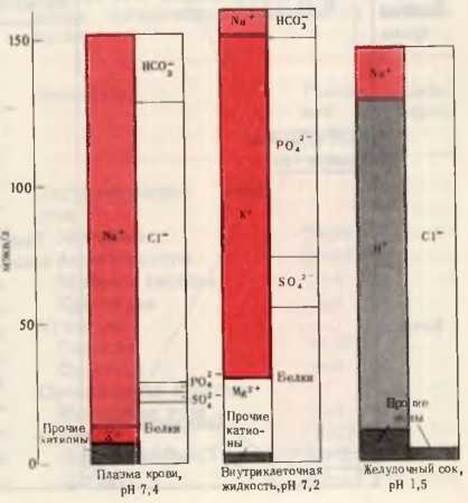
Fig. 24-19. Comparison of the Electrolyte Composition of Blood Plasma, intracellular fluid, and gastric juice. The left bar in each pair represents the cationic composition, and the right bar represents the anionic composition. Dark gray areas correspond to the sum of minor components (i.e., cations present in trace amounts). Note the stark difference in Na+ and K+ ion concentrations between blood plasma and intracellular fluid. These ion gradients are maintained by the Na+, K+-ATPase found in the Plasma Membranes of nearly all Cells in the body. Similarly, a steep H+ ion gradient exists between gastric juice and the blood plasma from which it is formed. This gradient is established by the action of an H+-translocating ATPase in the parietal Cells of the Stomach.
The total blood volume in an adult human Circulatory system is approximately 5–6 L. Nearly half of this volume consists of erythrocytes (red blood cells), with a much smaller fraction comprising leukocytes (white blood cells) and platelets (Fig. 24-20). The liquid portion of blood, plasma, is composed of 90% Water and 10% dissolved solutes. Over 70% of the dry weight of plasma consists of Plasma Proteins (Table 24-3). Approximately 20% is accounted for by organic intermediates (metabolites) transported between organs, along with metabolic end products such as urea and uric acid, which are delivered to the kidneys and excreted in the urine (Table 24-4). The remaining 10% of the plasma dry weight comprises inorganic salts. Figure 24-20 outlines the principal substances dissolved in human blood plasma.

Fig. 24-20. Composition of blood. Whole blood is separated into plasma and cellular components by centrifugation. Approximately 10% of blood plasma consists of dissolved solutes, of which about 70% are plasma proteins, roughly 10% are inorganic salts, and about 20% are low-molecular-weight Organic compounds. The primary components of each fraction are listed on the right. The quantitative COMPOSITION OF THE inorganic plasma components is shown in Fig. 24-19, plasma proteins in Table 24-3, and non-protein organic substances in Table 24-4. Blood plasma also contains Lipids at a concentration of approximately 700 mg per 100 mL, which are bound to a- and ß-globulins (Table 24-3). Blood contains numerous Other Compounds, often in trace amounts, including metabolic intermediates, hormones, Vitamins, Trace Elements, and Bile pigments. Measurements of individual plasma component concentrations play a vital role in disease Diagnosis and the monitoring of therapeutic progress.
Table 24-3. Major Plasma Protein Fractions1
Protein |
Amount, mg/100 mL |
Mol. Wt. |
Function |
Serum albumin |
3500-4500 |
66000 |
Regulation of Blood volume; fatty acid transport |
a1-Globulins |
300-600 |
40000-60000 |
Transport of lipids, thyroxine, Adrenocortical Hormones |
a2-Globulins |
400-900 |
100000-400000 |
Transport of lipids, copper |
ß-Globulins |
600-1100 |
110000-120000 |
Transport of lipids, iron, heme; immune activity (Antibodies) |
y-Globulins |
700-1500 |
150000-200000 |
Major fraction of circulating antibodies |
Fibrinogen |
3000 |
340000 |
Precursor of fibrin in blood clots |
Prothrombin |
100 |
69 000 |
Precursor of Thrombin, essential for blood clotting |
1 Total plasma protein content is 7000-7500 mg/100 mL. A wide variety of proteins are found in blood plasma; the table lists only their principal classes.
Under normal conditions, the concentrations of certain blood components may fluctuate within specific ranges depending on dietary intake and the timing of blood sampling. For instance, blood glucose concentration peaks immediately after a meal, particularly following a carbohydrate-rich diet, and may drop below average levels several hours later. Similarly, blood chylomicron levels vary during the intervals between meals.
The concentrations of individual plasma components are maintained at relatively constant levels through the action of various regulatory systems (Ch. 25).
Table 24-4. Concentrations of Major Non-Protein Organic Components of Blood Plasma
Component |
Normal Range, mg/100 mL |
|
Nitrogenous substances |
|
Urea |
20-30 |
35-65 |
|
Uric acid |
2-6 |
Creatinine |
1-2 |
Glucose |
70-90 |
Fructose |
6-8 |
|
Organic acids |
|
1-4 |
|
Lactate |
8-17 |
0,4-2,5 |
|
Citrate |
1,5-3,0 |
Lipids (fully protein-bound - a and β-globulins) |
|
Total lipids |
300-700 |
Triacylglycerols |
80-240 |
Cholesterol and its esters |
130-260 |
160-300 |
|
Last update: 06/08/2026
Editorial and Educational Adaptation: This material has been compiled based on the primary/original source text. The project team performed an editorial review, corrected technical inaccuracies, structured sections, and adapted the content for an educational format.
What was processed:
- elimination of formatting defects (OCR errors, structural breaks, corrupted characters);
- editorial organization of content;
- standardization of terminology in accordance with academic sources;
- verification of factual statements against the original source text.
All mentions of the author, publication year, and origin of the primary text have been preserved in accordance with the source.