Principles of Biochemistry Volume 3 - A. Lehninger 1985
Selected Aspects of Human Biochemistry
Digestion, nutrient transport, and metabolic interrelationships
Kidneys use ATP to perform osmotic work
Kidneys are characterized by a very high rate of respiratory METABOLISM and significant metabolic flexibility. They can utilize glucose, Ketone Bodies, free Fatty acids, and Amino Acids as cellular fuels, ultimately degrading these substrates via The Citric Acid Cycle, followed by ATP generation through Oxidative Phosphorylation. The majority of ATP energy is consumed in urine production, which occurs in two distinct stages. In The First stage, Blood Plasma is filtered through microscopic structures called glomeruli, located in the renal cortex (Fig. 24-18). All plasma components pass through the glomeruli, with the exception of Proteins and their ligands. The filtrate enters long ducts known as renal tubules, which are lined with epithelial Cells that perform ATP-dependent Active Transport of specific ions and metabolites from the tubular lumen into the surrounding capillary blood. As the plasma filtrate flows down the renal tubules, Water is reabsorbed back into the peritubular capillaries. Consequently, as the glomerular filtrate moves along the tubules, it becomes concentrated while its composition changes simultaneously. Each milliliter of finished urine entering the bladder is formed from 50–100 mL of glomerular filtrate. Vasopressin, a posterior pituitary hormone (Chapter 25), accelerates the reabsorption of water from the tubules. The composition of healthy human urine is given in Table 24-2.
Certain components, notably glucose, are normally present in urine at a lower concentration than in blood. This is because substances belonging to this group are reabsorbed from the glomerular filtrate back into the blood against a concentration gradient, driven by ATP-dependent membrane transport systems. A second group of components, which includes NH+4, K+, and phosphate ions, is present in urine at a relatively high concentration compared with blood; these components are actively transported from the blood into the renal tubules, also against a concentration gradient. Substances in the third group, including urea and creatinine—the end product of phosphocreatine breakdown—do not undergo reabsorption, and their concentration in urine increases as it flows along the renal tubules. Sodium ions (Na+) represent a special case. These ions are reabsorbed by active Transport from the glomerular filtrate into the blood in the upper section of the tubules; however, a portion of the sodium ions subsequently re-enters the urine via secondary exchange for other cations.
The transport of Na+ and K+ ions plays a particularly crucial role in the kidneys, as it is the kidneys that maintain the required concentrations of these vital cations in the body by conserving Na+ ions and excreting K+ ions. Virtually all mammalian cells contain K+ ions at a relatively high concentration and Na+ ions at a relatively low concentration. Conversely, in blood plasma and most other extracellular fluids, the concentration of Na+ ions significantly exceeds that of K+ ions (Fig. 24-19). Cell/30.html">The Plasma Membrane of most cells contains the Na+,K+-ATPase (Section 14.16), which pumps K+ ions into The Cell while simultaneously extruding Na+ ions. This energy-dependent process is coupled to the Hydrolysis of cytosolic ATP to ADP and phosphate. The Na+,K+-ATPase of renal tubular cells ensures the continuous excretion of K+ ions into the urine, while losses of Na+ ions remain minimal even under conditions of very low dietary Na+ intake (see also Chapter 26).
Class="center">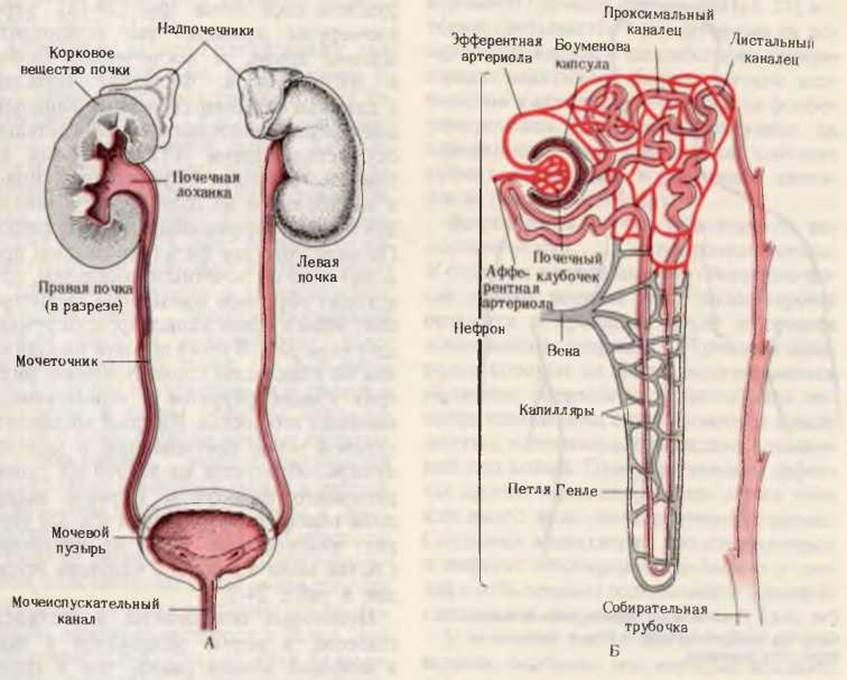
Figure 24-18. A. The kidneys contain a vast number of functional units called nephrons. Urine from individual nephrons drains into the renal pelvis and then travels via the Ureters to the Urinary Bladder. B. Schematic representation of a nephron. Blood plasma is filtered through the glomeruli. The filtrate enters Bowman's capsule and then flows down the long renal tubule, which is lined with epithelial cells. The urine within the tubule is progressively concentrated by the removal of water into the surrounding blood capillaries. Certain substances, such as glucose, are reabsorbed into the blood, whereas others are excreted into the urine; in both cases, the Transport of substances occurs against a concentration gradient. These active transport processes require a substantial expenditure of ATP by the renal tubular cells.
Table 24-2. Major Components of Human Urine1
Component |
Grams per 24 h |
Approximate Urine-to-Plasma Concentration Ratio |
Glucose |
<0.05 |
<0.05 |
Amino acids |
0.80 |
1.0 |
Ammonia |
0.80 |
100 |
Urea |
25 |
70 |
Creatinine |
1.5 |
70 |
Uric acid |
0.7 |
20 |
H+ |
pH 5-8 |
Up to 300 |
Na+ |
3.0 |
1.0 |
K+ |
1.7 |
15 |
Ca2+ |
0.2 |
5 |
Mg2+ |
0.15 |
2 |
Cl- |
6.3 |
1.5 |
HPO2-4 |
1.2 g P |
25 |
SO2-4 |
1.4 g S |
50 |
HCO-3 |
0-3 |
0-2 |
1 The volume and composition of 24-hour urine vary widely depending on fluid intake and diet. The table shows the composition of a typical 24-hour urine sample with a total volume of 1200 mL.
Owing to the action of the Na+,K+-ATPase, as well as other energy-dependent membrane transport systems for glucose and amino acids, Urine Formation proceeds in such a manner that substances whose blood concentrations need to be lowered are excreted, while those required to maintain the proper blood composition are reabsorbed from the renal tubules. These active membrane transport processes consume more than three-quarters of the ATP generated in the kidneys via oxidative phosphorylation.
Last update: 06/08/2026
Editorial and Educational Adaptation: This material has been compiled based on the primary/original source text. The project team performed an editorial review, corrected technical inaccuracies, structured sections, and adapted the content for an educational format.
What was processed:
- elimination of formatting defects (OCR errors, structural breaks, corrupted characters);
- editorial organization of content;
- standardization of terminology in accordance with academic sources;
- verification of factual statements against the original source text.
All mentions of the author, publication year, and origin of the primary text have been preserved in accordance with the source.