Genetics - A. V. Sivolob 2008
Formal Genetics: Patterns of Trait Inheritance
Crossing Over
Interference
Returning to our example in Fig. 3.12, it should be noted that the double crossover frequency of 3% given in Table 3.11 contradicts the assumption of complete independence between recombination events in adjacent chromosome regions. If such events in the intervals between the A/a and B/b loci, and the B/b and C/c loci were independent, then the frequency of double crossovers (the result of two simultaneous events in these intervals) should equal the product of the frequencies of the corresponding single crossovers (According to the product rule of probabilities): 0.18 × 0.29 = 0.052 (5.2%). Note that the total crossover frequency should be used as the frequency of single events (e.g., 0.15 + 0.03 = 0.18): what matters is the frequency with which the B/b alleles exchanged places (see Table 3.11), and it is irrelevant whether the C/c alleles returned to their "original place" As a result of a double crossover.
Thus, an exchange between loci in one region affects such an exchange in adjacent regions—a phenomenon known as interference. In our example (which is a typical situation), interference is positive, meaning crossovers in adjacent regions hinder one another. Naturally, interference becomes more pronounced as the distance between the two regions decreases. Sometimes, negative interference is also observed, where the recombination process is mutually stimulated in two or more adjacent regions. However, in reality, negative interference does not reflect an increased frequency of double crossovers, but rather results from Gene Conversion (see below).
To evaluate the agreement between the expected frequency of double crossovers $h_0$ (based on the independence of individual recombination events) and the observed frequency $h$, the coefficient of coincidence $C = h/h_0$ is used. That is, in our example, $C = 0.030/0.052 = 0.58$, and the magnitude of interference is $I = 1 - C = 0.42$.
From these estimates, it is clear that interference partially compensates for The Effect of double crossovers when determining the distance between two genes. Indeed, if two recombination events were independent and the frequency of double crossovers were 5.2%, then the crossover frequency between the A/a and C/c loci (estimated in the absence of B/b) would be $18 + 29 - 2 \times 5.2 = 36.6$ cM.
Class="center">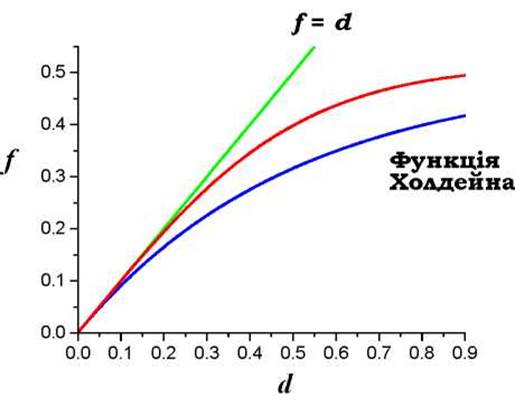
Fig. 3.13. The actual dependence of the crossover frequency between two loci $f$ on the distance $d$ (red curve) compared to two idealized dependencies
The calculated crossover frequency $f$ between two loci as a result of single and multiple crossovers, assuming the independence of individual recombination events, is described by the Haldane function (John Haldane):
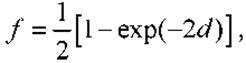
where $d$ is the physical distance between two loci in probability units (ranging from 0 to 1). At small distances, $\exp(-2d) \approx 1 - 2d$ and $f \approx d$ (the crossover frequency is directly proportional to the physical distance, which is practically valid for distances up to ~10 cM); at large distances, $f$ approaches $1/2$, which is the maximum possible crossover frequency. Due to interference, the actual dependence of frequency on physical distance occupies an intermediate position between the Haldane function and the straight line $f = d$ (Fig. 3.13).
Last update: 11/08/2026
Editorial and Educational Adaptation: This material has been compiled based on the primary/original source text. The project team performed an editorial review, corrected technical inaccuracies, structured sections, and adapted the content for an educational format.
What was processed:
- elimination of formatting defects (OCR errors, structural breaks, corrupted characters);
- editorial organization of content;
- standardization of terminology in accordance with academic sources;
- verification of factual statements against the original source text.
All mentions of the author, publication year, and origin of the primary text have been preserved in accordance with the source.