Genetics - A. V. Sivolob 2008
Formal Genetics: Patterns of Trait Inheritance
Crossing-over
Gene Conversion
The phenomenon of Gene conversion is closely linked to The process of Homologous Recombination, regardless of whether a reciprocal exchange of segments between homologous Chromosomes has taken place (see Section 1). As shown in Fig. 3.14, resulting from a conversion event where allele B is transformed into b or vice versa, a Bb heterozygote can produce Two Types of Gametes in a 3 : 1 ratio. In genetic analysis via crosses, such gametes may formally be regarded as double crossovers (cf. Fig. 3.12) characterized by negative Interference—yielding a high frequency of "double crossovers" in the absence of flanking crossover products between the A/a and C/c loci.
Class="center">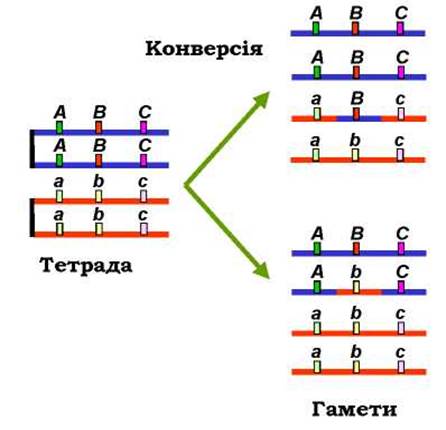
Fig. 3.14. Tetrad in prophase I of Meiosis and two Variants of the gamete set produced in the event of B/b gene conversion between two homologous chromatids
It should be noted that gene conversion provides diploid organisms with a mechanism to restore Genetic information that has been damaged by a mutation in one of the two homologous chromosomes (see also Section 5).
Last update: 11/08/2026
Editorial and Educational Adaptation: This material has been compiled based on the primary/original source text. The project team performed an editorial review, corrected technical inaccuracies, structured sections, and adapted the content for an educational format.
What was processed:
- elimination of formatting defects (OCR errors, structural breaks, corrupted characters);
- editorial organization of content;
- standardization of terminology in accordance with academic sources;
- verification of factual statements against the original source text.
All mentions of the author, publication year, and origin of the primary text have been preserved in accordance with the source.