Fundamentals of Molecular Biology - V.I. Rezyapkin 2009
Genome Rearrangements
Homologous Recombination
Homologous recombination is characteristic of All living organisms. This type of recombination (Fig. 9.2 A, B) is initiated by single-strand breaks introduced by an endonuclease enzyme. Next, strand exchange occurs between the DNA molecules, leading to The formation of a cross-shaped Structure (Fig. 9.2 C) known as the Holliday junction, named after the scientist who proposed this mechanism of recombination. Then, the crossover point migrates along the recombining DNA molecules, forming a heteroduplex (Fig. 9.2 D). This process is mediated by specific Enzymes. The size of the heteroduplex can reach several thousand Base Pairs. Subsequently, the Holliday junction can be resolved in two ways. In one mode of Cleavage, the recombining molecules exchange their flanking segments (Fig. 9.2 E, G). In the other mode of cleavage, the recombining molecules exchange the single-stranded regions that formed the heteroduplex (Fig. 9.2 F, H).
Class="center">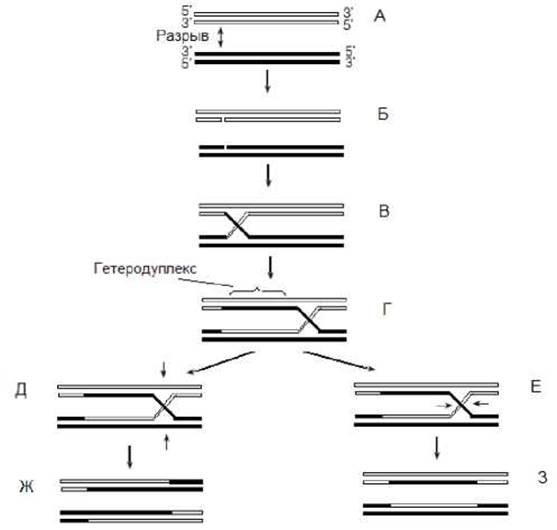
Fig. 9.2. Homologous recombination
DNA strands within a heteroduplex may not be fully complementary. Unpaired bases can be replaced with complementary ones via DNA Repair. In this case, the information encoded in one of the DNA strands is lost and replaced by the information encoded in the other strand.
This model of homologous recombination is typical of both prokaryotes and eukaryotic somatic and Germ Cells. Homologous recombination can result in: a) inversion of a DNA segment flanked by inverted repeats; b) deletion of a DNA segment flanked by direct repeats; c) unequal Crossing-over between sister chromatids, resulting in the loss of a DNA fragment in one chromatid and its duplication in the other.
The Biological Significance of homologous recombination is profound. It results in Gene reassortment, allowing organisms to continuously adapt to their environment. Genetic rearrangements driven by homologous recombination play a crucial role in the Introduction/30.html">Regulation of Gene Expression.
Last update: 12/08/2026
Editorial and Educational Adaptation: This material has been compiled based on the primary/original source text. The project team performed an editorial review, corrected technical inaccuracies, structured sections, and adapted the content for an educational format.
What was processed:
- elimination of formatting defects (OCR errors, structural breaks, corrupted characters);
- editorial organization of content;
- standardization of terminology in accordance with academic sources;
- verification of factual statements against the original source text.
All mentions of the author, publication year, and origin of the primary text have been preserved in accordance with the source.