Fundamentals of Molecular Biology - V.I. Rezyapkin 2009
Genome Rearrangements
Site-Specific Recombination
Site-specific recombination does not require extended homologous DNA regions. Instead, it requires specific short homologous DNA segments (15–30 bp) and a dedicated enzymatic machinery. This type of recombination is common in Viruses, prokaryotes, and eukaryotes. Site-specific recombination is responsible for several biological processes, including the integration of temperate phage DNA into the bacterial chromosome, the inversion of specific DNA regions within bacterial Chromosomes, and the rearrangement of DNA sequences encoding IMMUNOGLOBULINS during lymphocyte maturation in higher eukaryotes.
Integration of phage λ into the E. coli chromosome
The first site-specific recombination system to be studied in detail was the integration of phage λ into the E. coli chromosome (Fig. 9.3). This process is quite complex. Upon entering the E. coli Cell, the linear double-stranded phage DNA circularizes due to complementary single-stranded cohesive ends. The phage DNA then integrates into the bacterial chromosome at a precise, predetermined site. A phage integrated into the bacterial chromosome is referred to as a prophage. The excision of the prophage from the chromosome is also possible and proceeds via the reverse pathway. Phage integration requires a phage-encoded protein, integrase, along with a host-derived protein known as IHF (integration host factor). In addition to these Proteins, the excision of the prophage requires an extra product from one of the phage genes.
Class="center">
Fig. 9.3. Integration of phage λ into the E. coli chromosome
Site-specific recombination in phage Mu
The center of the phage Mu DNA contains a G segment approximately 3,000 bp in size, flanked by inverted repeats (about 30 bp each). Each repeat contains a site that participates in recombination. This process is mediated by a phage-encoded enzyme called invertase, which drives the inversion of the G segment (Fig. 9.4). This process is reversible. In one orientation of the G segment, The Cell transcribes genes responsible for phage adsorption and Replication in certain bacterial hosts. In the alternative orientation, METABOLISM/31.html">Transcription initiated from the same promoter drives the expression of different genes responsible for adsorption and replication in other bacterial hosts. Thus, inversion of the G segment allows phage Mu to broaden its host range.

Fig. 9.4. Site-specific inversion of the G segment in phage Mu
Site-specific recombination in Salmonella typhimurium
Salmonella typhimurium is a bacterial pathogen affecting rodents. Its flagella are composed of proteins called flagellins. Once the Bacteria enter an animal host, the host mounts an Immune Response and produces anti-flagellin Antibodies. These antibodies, acting in concert with Other components of The Immune System, can neutralize the bacteria. However, after antibodies against a specific antigen are formed in the host, some bacteria undergo flagellin Gene switching. This halts the synthesis of one flagellin and initiates The production of another, altering the antigenic Properties of the flagella. As a result, previously generated antibodies become ineffective. These Cells then rapidly multiply within the host Organism, triggering a new wave of infection.
The switching of flagellins in Salmonella typhimurium is governed by a chromosomal segment known as the H segment (993 bp). This segment undergoes periodic, reversible site-specific inversions (Fig. 9.5). The H segment is flanked by inverted repeats and contains a gene encoding the invertase responsible for its inversion, alongside two promoters, P1 and P3. Promoter P1 directs the Transcription of the H2 flagellin gene and the repressor of the H1 flagellin gene. Introduction/27.html">Translation of the resulting mRNA produces H2 flagellin and the H1 flagellin repressor, respectively. H2 flagellin forms the flagella, whereas the repressor binds to the operator of the H1 flagellin gene, blocking its expression. Promoter P3 drives the transcription of the invertase gene, and the resulting mRNA serves as a template for invertase synthesis. The invertase then catalyzes the inversion of the H segment, which relocates promoter P1 far away from the genes it previously regulated. Consequently, the H2 flagellin gene and the H1 repressor gene are no longer expressed, and neither H2 flagellin nor the H1 repressor is produced. Meanwhile, the invertase gene continues to be expressed. The absence of the repressor frees the operator of the H1 flagellin gene, allowing transcription to initiate from promoter P2; translation of this mRNA yields H1 flagellin. This is how flagellin synthesis is switched. The site-specific inversion in Salmonella typhimurium allows the bacterium to evade the host immune system.

Fig. 9.5. Site-specific inversion in Salmonella typhimurium. H1 — H1 flagellin gene, H2 — H2 flagellin gene, rH1 — H1 flagellin repressor gene, Fl H1 — H1 flagellin, Fl H2 — H2 flagellin, Rep — repressor
DNA Rearrangements in bacteria leading to the rejoining of coding sequences
The coding sequences of certain bacterial genes are interrupted by insertions consisting of specific DNA elements.
These elements possess short direct repeats at their flanks and encode a site-specific recombinase. The recombinase recognizes the direct repeats, excises the element as a circular molecule, and rejoins the separated gene segments (Fig. 9.6). The excision of the insertion occurs with absolute precision. The size of the insertion can range from 10 kb to several tens of kilobases. Through this DNA rearrangement, a functionally active gene is formed.
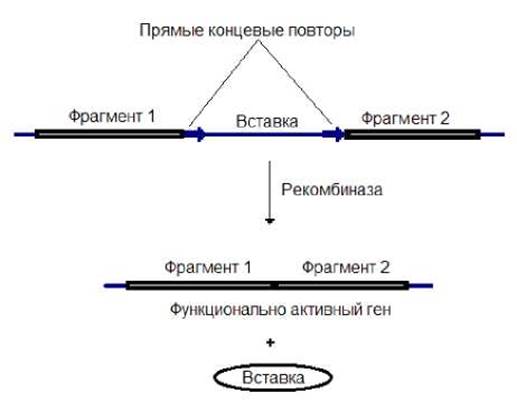
Fig. 9.6. Rejoining of gene coding sequences mediated by a recombinase
Last update: 12/08/2026
Editorial and Educational Adaptation: This material has been compiled based on the primary/original source text. The project team performed an editorial review, corrected technical inaccuracies, structured sections, and adapted the content for an educational format.
What was processed:
- elimination of formatting defects (OCR errors, structural breaks, corrupted characters);
- editorial organization of content;
- standardization of terminology in accordance with academic sources;
- verification of factual statements against the original source text.
All mentions of the author, publication year, and origin of the primary text have been preserved in accordance with the source.