Fundamentals of Molecular Biology - V.I. Rezyapkin 2009
Genome Rearrangements
Transpositions
As a result of transposition (special recombination processes), Mobile Genetic Elements relocate from one region of a DNA molecule to another or to a completely different DNA molecule. These mobile elements are found in both PROKARYOTES AND EUKARYOTES. Typically, they consist of a central region flanked by inverted or direct terminal repeats (Fig. 9.7). The central region usually contains the Gene(s) responsible for transposition. The insertion of mobile elements through transposition is generally non-specific and occurs at random DNA sites. Most mobile elements are bounded on both sides by short direct repeats of the target DNA (usually 5 or 9 bp), which are generated as a result of target DNA duplication during element transposition.
Class="center">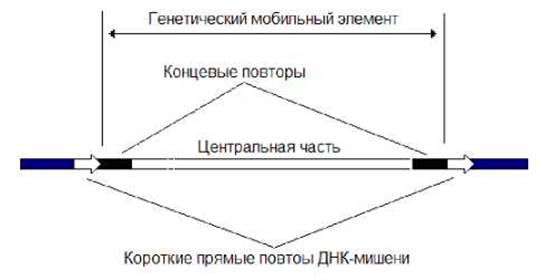
Fig. 9.7. Schematic representation of the Organization of mobile elements
The following MAIN MECHANISMS OF transposition are distinguished: replicative transposition, non-replicative transposition, and retrotransposition (the movement of retrotransposons—eukaryotic mobile elements flanked by long terminal direct repeats). In replicative transposition, the mobile element undergoes duplication (Replication). One copy remains at the original site, while the other moves to another DNA molecule (Fig. 9.8 A). In this case, the movement of the mobile element is accompanied by an increase in its copy number. During non-replicative transposition, the element is excised and integrated into a new DNA site (Fig. 9.8 B). Such transposition does not lead to an increase in the number of copies of the mobile element. Retrotransposition involves Proteins encoded within the mobile element: integrase and Reverse Transcriptase (reverotase). These are encoded within a single gene and synthesized as a single precursor, which is subsequently cleaved into individual proteins by a specific protease. The Mechanism of retrotransposition is illustrated in Fig. 9.9. Initially, METABOLISM/31.html">Transcription of the retrotransposon yields its RNA copy. This copy is then transported from The Nucleus into the Cytoplasm, where, with the participation of reverse transcriptase, it serves as a template for synthesizing a DNA copy of the mobile element. This DNA copy is subsequently imported back into the Cell Nucleus and integrated into a new DNA site by means of integrase. Thus, these mobile elements spread throughout The Genome via retrotransposition.

Fig. 9.8. Replicative (A) and non-replicative (B) transposition; ME stands for mobile element

Fig. 9.9. Retrotransposition
Transpositions differ from Homologous Recombination by the lack of Homology between the mobile element and its insertion site, and from Site-Specific Recombination by the fact that mobile element insertion occurs at random DNA sites.
Last update: 12/08/2026
Editorial and Educational Adaptation: This material has been compiled based on the primary/original source text. The project team performed an editorial review, corrected technical inaccuracies, structured sections, and adapted the content for an educational format.
What was processed:
- elimination of formatting defects (OCR errors, structural breaks, corrupted characters);
- editorial organization of content;
- standardization of terminology in accordance with academic sources;
- verification of factual statements against the original source text.
All mentions of the author, publication year, and origin of the primary text have been preserved in accordance with the source.