Fundamentals of Molecular Biology - V.I. Rezyapkin 2009
Genome Organization
Organization of the Viral Genome
Viruses (from Latin virus meaning poison) represent an acellular form of life. They consist of nucleic acid molecules enclosed within a protein coat known as a capsid. The capsid is typically built from one or more types of protein, which allows the virus to conserve space within its genome. The nucleic acid complexed with Proteins forms a Structure called a nucleocapsid. Some viruses also possess an outer lipid envelope. A complete viral particle, or virion, may contain Enzymes essential for the viral life cycle. The size of various viruses ranges from 20 to 500 nanometers or more.
As Obligate Intracellular Parasites, viruses hijack the Replication and protein-synthesis machinery of the host Cell for their own propagation. They are incapable of reproducing outside of a cell. Some viruses parasitize Eukaryotic Cells, while others infect Prokaryotic Cells; the latter are commonly referred to as Bacteriophages.
The interaction between a virus and a host cell can be divided into several distinct stages.
Stage 1: Adsorption of the virus to The Cell membrane. Successful adsorption typically requires specific receptor proteins on the cell surface, which facilitate viral attachment to the membrane and subsequent entry into the cell.
Stage 2: Penetration of the virus into the cell. At this stage, the virus delivers its genetic material inside the cell. Along with Nucleic Acids, certain viruses also introduce their own proteins into the cell, which are necessary to support their life cycle. Stage 3: Reprogramming of cellular METABOLISM. During this phase, the cell's antiviral defenses are overcome, creating favorable conditions for viral replication. Some viruses may enter a latent state (integrating into the host genome) with minimal Interference in cellular metabolism; under specific conditions, they can become active and initiate the infectious phase. Stage 4: Synthesis of viral components. This stage involves the synthesis of virus-specific proteins and the replication of the viral genome.
Stage 5: Maturation of Viral Particles and release from the cell. The newly replicated genomic nucleic acids are coated with proteins, and the assembled virions exit the cell. Viral release is often accompanied by lysis of the host cell. However, in some cases, viruses bud off from The Plasma Membrane without causing it to rupture.
Viral genomes can be composed of either DNA or RNA:
Class="center">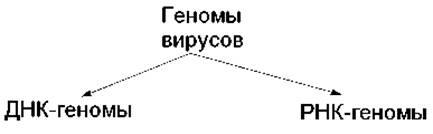
Approximately 95% of the viral genome encodes proteins. Viral proteins are generally classified into structural proteins, enzymes, and regulatory proteins. The number of genes in a viral genome ranges from a few to several hundred: phage Qβ has 4 genes, the smallpox virus has about 250 genes, and the mimivirus possesses roughly 900 genes.
About 5% of The Genome consists of regulatory sequences. These include promoters, operators, and terminators, regions that facilitate the Integration of the viral genome into the host chromosome, and sticky ends of linear viral DNAs that enable the circularization of the linear molecule. Genes encoding rRNA and tRNA are typically absent from viral genomes. However, the genome of phage T4 does contain genes encoding several tRNAs. Viral genes may also be nested within other genes or overlap with one another. Some eukaryotic viral genes can be transcribed from multiple promoters, and their genes exhibit an intron-exon Organization. Following synthesis, viral proteins occasionally undergo post-translational modifications to acquire biological activity.
Last update: 12/08/2026
Editorial and Educational Adaptation: This material has been compiled based on the primary/original source text. The project team performed an editorial review, corrected technical inaccuracies, structured sections, and adapted the content for an educational format.
What was processed:
- elimination of formatting defects (OCR errors, structural breaks, corrupted characters);
- editorial organization of content;
- standardization of terminology in accordance with academic sources;
- verification of factual statements against the original source text.
All mentions of the author, publication year, and origin of the primary text have been preserved in accordance with the source.