FUNDAMENTALS OF BIOCHEMISTRY AND MOLECULAR BIOLOGY - N. N. Skvortsova - 2016
Part I. Chemical Components of the Cell
6. LIPIDS
Lipids are a large group of low-molecular-weight substances characterized by diverse chemical structures and united by common features. Lipids are insoluble in Water (i.e., hydrophobic), yet soluble in nonpolar organic Solvents such as chloroform, benzene, and ethers. Their molecules contain higher hydrocarbon (alkyl) radicals, which impart lipophilic properties to them.
Lipids vary significantly in their chemical Structure AND Functions. Therefore, it is difficult to provide a single definition applicable to all compounds belonging to this Class.
6.1. BIOLOGICAL FUNCTIONS OF Lipids
Lipids play a crucial role in vital cellular processes, performing A wide variety of functions.
Structural. Phospholipids serve as one of the primary components of Introduction/36.html">Biological Membranes, thereby participating in Nerve Impulse transmission and The formation of intercellular contacts.
Regulatory. Triacylglycerols (fats) contain essential dietary factors—polyunsaturated Fatty acids—which act as hormone precursors. Steroid Hormones function in both PLANT AND ANIMAL organisms.
Energy storage. Fatty acids serve as an efficient energy source, both through direct utilization and as energy reserves stored in adipose tissue. The hydrocarbon radicals of fatty acids contain energy-rich CH2 groups; their oxidation yields more energy than The oxidation of CARBOHYDRATES, in which carbon atoms are already partially oxidized (-HСОН-).
Transport. Dietary fats contain Fat-soluble Vitamins and facilitate their Absorption in the body.
Protective. Fats form thermal insulation layers in animals and plants, shielding Organs and Tissues from mechanical stress. Waxes create protective coatings on plants, preventing infections and maintaining water balance.
6.2. Classification of Lipids
Several lipid classifications exist. The most widely accepted classification is based on the Structural Features of lipids (Fig. 43). Lipids are subdivided into saponifiable and nonsaponifiable groups. Nonsaponifiable lipids include cyclic sterols (such as Cholesterol) and Steroids (estradiol, testosterone, etc.).
Fig. 43. General classification of lipids

The defining criterion for further classifying saponifiable lipids is the COMPOSITION OF THE components formed during Hydrolysis. The Structural components of saponifiable lipids are linked by ester bonds, making them readily hydrolyzable in water under the action of bases or Enzymes.
Simple Lipids are esters of fatty acids with various alcohols.
Complex Lipids are also esters of fatty acids with alcohols, but they contain additional functional groups.
The structural diversity of saponifiable lipids is determined by the fatty acids that compose them.
6.3. Classification and Structural Features of Natural Fatty Acids
Over 200 fatty acids have been discovered in nature; however, approximately 70 of them are found within simple and complex lipids in Human and Animal tissues, with more than half present only in small quantities.
About 20 Fatty acids are widespread. All of them contain an even number of carbon atoms, primarily ranging from 12 to 24. Carbon atom numbering in a fatty acid molecule begins with the carbon atom of the carboxyl group. Approximately 3/4 of all fatty acids are unsaturated, meaning they contain double bonds. Fats are predominantly composed of acids with C16 and C18 chains (saturated: palmitic, stearic; unsaturated: oleic, linoleic, linolenic).
Unsaturated fatty acids in humans and animals involved in lipid formation (oleic, linoleic, linolenic) typically contain a double bond between the 9th and 10th carbon atoms (Fig. 44):
Fig. 44. Unsaturated fatty acids

Additional double bonds are more frequently located between the 11th carbon atom and the methyl end of the chain (linoleic, linolenic). In polyunsaturated fatty acids, double bonds are "isolated", meaning they are always separated by a methylene group (-СН = СН-СН2-СН = СН-). Naturally occurring unsaturated fatty acids have a cis-configuration.
Free fatty acids occur in very small amounts. They are primarily found as constituents of other lipids, bound to other lipid components via an ester bond.
The systematic name of a fatty acid is most commonly formed by adding the suffix -oic to the hydrocarbon name. Saturated acids thus end in -anoic (for example, hexadecanoic acid is the systematic name, while palmitic acid is the trivial name), whereas unsaturated acids end in -enoic (for example, octadecadienoic acid is the systematic name, and linoleic acid is the trivial name). The number and position of double bonds in unsaturated fatty acids are frequently denoted using numerical symbols: the first digit indicates the number of carbon atoms, the second indicates the number of double bonds, and the subsequent digits represent the positions of the carbon atoms closest to the carboxyl group involved in the Formation of the double bonds (Table 12).
Table 12. Nomenclature of fatty acids
No. |
Trivial name |
Systematic name |
Abbreviated name |
1 |
Butyric |
Butanoic |
С4:0 |
2 |
Caproic |
Pentanoic |
С5:0 |
3 |
Caprylic |
Octanoic |
С7:0 |
4 |
Capric |
Decanoic |
С10:0 |
5 |
Lauric |
Dodecanoic |
С12:0 |
6 |
Myristic |
Tetradecanoic |
С14:0 |
7 |
Palmitic |
Hexadecanoic |
С16:0 |
8 |
Stearic |
Octadecanoic |
С18:0 |
9 |
Palmitoleic |
Hexadecenoic |
С16:1(9) |
10 |
Oleic |
Octadecenoic |
С18:1 (9) |
11 |
Linoleic |
Octadecadienoic |
С18:2 (9,12) |
12 |
Linolenic |
Octadecatrienoic |
С18:3 (9,12,15) |
13 |
Arachidonic |
Eicosatetraenoic |
С20:4 (5,8,11,14) |
14 |
Timnodonic |
Eicosapentaenoic |
С20:5 (5,8,11,14, 17) |
15 |
Clupanodonic |
Docosapentaenoic |
С22:5 (7,10,13,16,19) |
16 |
Cervonic |
Docosahexaenoic |
С22:6 (4,7,10,13,16,19) |
17 |
Erucic |
Docosenoic |
С22:1 (13) |
The dietary fatty acids most frequently present are linoleic acid, which has two double bonds (omega-6) (see Fig. 44), and linolenic acid, which has three double bonds (omega-3):

The locant indicates THE POSITION OF the double bond closest to the methyl group (omega group) of the hydrocarbon radical. These acids cannot be synthesized by the body and are therefore essential nutritional factors. An insufficient intake of Essential Fatty Acids, let alone their complete absence, leads to a broad spectrum of physiological disorders known as essential fatty acid deficiency syndrome.
A special role in the body is played by 20-carbon (eicosanoid) PUFAs, which serve as precursors to a whole group of biologically active compounds known as local hormones, or Eicosanoids. Arachidonic acid is the precursor for one group of these hormones—Prostaglandins—which regulate the physiological Functions of the Cells in which they are produced.

Scientific research has proven that omega-3 fatty acids are required for normal Brain function, as they rapidly provide the energy needed to transmit impulses carrying signals from Cell to Cell. This enhances cognitive abilities, helps retain information in memory, and allows for its faster retrieval when needed.
Researchers classify fatty acids not only by their degree of saturation, but also by chain length.
Short-chain fatty acids are always saturated. Butanoic acid (C4) is found predominantly in cow's milk fat, while capric acid (C6) is found mainly in goat's milk fat. These fatty acids possess antimicrobial properties, meaning they protect us against Viruses, Fungi, and pathogenic Bacteria in the gastrointestinal tract. They are not affected by Bile salts and are absorbed directly for a quick source of energy.
Medium-chain fatty acids (C8–C12) are found mainly in milk fat and tropical oils. Similar to short-chain fatty acids, these fats exhibit antimicrobial properties and are easily absorbed to provide a rapid energy boost.
Long-chain fatty acids (C14–C18) can be saturated, monounsaturated, or polyunsaturated (see Table 12). Stearic acid is found primarily in beef and mutton fat. Oleic acid is the main component of olive oil. Palmitoleic acid occurs exclusively in animal fats and exhibits strong antimicrobial properties. Linoleic and linolenic acids are found in many vegetable oils, such as linseed (55%), sea buckthorn (32%), hemp (20%), and soybean (5%) oil.
The body is unable to produce linoleic and linolenic acids, which is why they are termed "essential". The body obtains these acids from dietary vegetable oils. Unpaired electrons at the double bonds result in high chemical reactivity, particularly in omega-3 linolenic acid. Polyunsaturated fats should not be heated or used for frying, as they are highly susceptible to rancidity.
Very long-chain fatty acids (C20–C24) are typically highly polyunsaturated, containing four, five, or six double bonds. The most important very long-chain fatty acids are listed in Table 12. All of them, with the exception of docosahexaenoic acid, are involved in the synthesis of prostaglandins. Docosahexaenoic acid and arachidonic acid play a crucial role in the functioning of The Nervous system.
6.4. Structure and PHYSICOCHEMICAL PROPERTIES OF Individual Lipid Groups
6.4.1. Acylglycerols
Acylglycerols (neutral lipids, fats) are esters formed by the trihydric alcohol glycerol and Higher Fatty Acids.
If all three hydroxyl groups of glycerol are esterified with fatty acids (the acyl radicals R1, R2, and R3 may be identical or different), such a compound is called a triglyceride (triacylglycerol); if two are esterified, a diglyceride (diacylglycerol); and finally, if only one group is esterified, a monoglyceride (monoacylglycerol):

Plant and animal fats consist mainly of triglycerides, but under the action of natural enzymes (lipases), they are hydrolyzed into mono- and diglycerides as well as free fatty acids.
The fatty acids in triglycerides can be saturated or unsaturated. The most common fatty acids are palmitic, stearic, and oleic acids. If all three acyl radicals belong to the same fatty acid, such triglycerides are called simple; if they belong to different fatty acids, they are called mixed. The names of mixed triglycerides are formed based on their constituent fatty acids, with numbers 1, 2, and 3 indicating the attachment of the fatty acid residues to the respective alcohol groups in the glycerol molecule. The names of the fatty acid radicals are listed starting from the first (top) carbon atom of the glycerol backbone, for example, palmitoyl-linolenoyl-oleoylglycerol.
In the Spatial Structure of a triglyceride, the terminal "glycerol" carbon atoms become non-equivalent if their hydroxyl groups are acylated with different fatty acids:

Natural fat molecules contain various fatty acids: typically, positions 1 and 3 are occupied by more saturated fatty acids, while position 2 contains a polyunsaturated fatty acid.
Fatty acids determine the physicochemical properties of fats. The melting point of fats increases with the number and chain length of saturated fatty acid residues. Conversely, the higher the content of unsaturated fatty acids or short-chain acids, the lower the melting point. Animal fats (lard) generally contain a significant amount of saturated fatty acids (palmitic, stearic, etc.), which makes them solid at room Temperature (Table 13).
Table 13. Composition and melting point of certain dietary fats
Fats |
Melting point, °C |
Saturated acids, % |
Unsaturated fatty acids, % |
||||
18:1 |
18:2 |
18:3 |
20:4 |
20:5 |
|||
Milk fat |
+(28-33) |
52-70 |
27-40 |
3-5 |
<1 |
tr.* |
- |
Pork fat (lard) |
+(36-46) |
37-45 |
37-50 |
8-10 |
1 |
tr.* |
- |
Beef fat |
+(44-51) |
53-60 |
42-43 |
3-5 |
<1 |
- |
- |
Mutton fat |
+(46-55) |
55-65 |
36-43 |
3 |
0 |
- |
- |
Fish oil |
-(2-7) |
16-20 |
20-22 |
2 |
3 |
3 |
6-8 |
Oils |
|||||||
Sunflower oil |
-(16-19) |
10-12 |
21-34 |
51-68 |
2 |
- |
- |
Olive oil |
(0-6) |
10-19 |
64-85 |
4-14 |
<1 |
- |
- |
Corn oil |
-(10-20) |
10-14 |
38-40 |
43-47 |
<3 |
- |
- |
*Acids present in small amounts.
Fats containing predominantly saturated acids are solid (beef and mutton tallow), whereas those containing a high proportion of unsaturated acids are liquid. Liquid fats or oils are typically of plant origin. For instance, in hemp oil, 95% of all fatty acids are accounted for by oleic, linoleic, and linolenic acids, with only 5% represented by stearic and palmitic acids.
Among dietary animal fats, mutton tallow is the most saturated and practically lacks essential fatty acids. Valuable dietary fats include fish oil and vegetable oils, which are rich in essential fatty acids. Fish do not synthesize omega-3 and omega-6 polyunsaturated fatty acids endogenously either; they obtain them through their diet (Algae, plankton).
The chemical properties of fats are manifested in their ability to undergo saponification, rancidification, drying, and hydrogenation. Glycerides are capable of participating in all Chemical Reactions characteristic of esters.
Of primary importance is the saponification reaction, which results in the Cleavage of triglycerides into glycerol and fatty acids. Fat saponification can occur via Enzymatic hydrolysis or under the action of acids or alkalis.
Rancidification of fats is most commonly associated with the Oxidation of Unsaturated fatty acids by atmospheric oxygen, which can add across double bonds to form peroxides.
When spread in a thin layer, liquid fats behave differently in air: some remain liquid without changes, while others undergo oxidation and gradually transform into a transparent, resin-like, elastic film known as linoxin, which is insoluble in organic solvents. Oils that do not form a film are called non-drying oils. The principal constituents of such oils are oleic acid glycerides (containing a single double bond). Oils that form a tough film are called drying oils. Their main constituents are linolenic acid glycerides (containing three double bonds). Oils that form soft films are termed semi-drying oils. Their primary constituents are linoleic acid glycerides (containing two double bonds). The ability of certain oils to dry is widely utilized in the paint and varnish industry. Conversely, non-drying oils are of interest in medicine because they are used for parenteral administration of drugs.
In addition to halogens, hydrogen readily adds across the double bonds. As a result of this hydrogenation, unsaturated fatty acids are converted into saturated ones, and the fats acquire a solid consistency. The hydrogenation reaction is widely employed to produce solid fats from vegetable oils. These include food fats (margarine, hydrogenated fat/salomas) and fats used in pharmacy (bases for ointments and suppositories) and cosmetics.
Fat numbers (fat constants) are used to identify fats and determine their quality.
Saponification value is the number of milligrams of potassium hydroxide (KOH) required to saponify 1 g of fat. It depends on the Molecular Weight of the fatty acids making up the fat molecule: the higher the molecular weight, the lower the saponification value.
Iodine value is an index characterizing the degree of unsaturation of the fatty acids comprising the fat. It is expressed as the percentage of iodine equivalent to the halogen that adds to 100 g of fat. The iodine value is widely used to identify the type of fat, assess its drying capacity, and calculate The amount of hydrogen required for its hydrogenation.
Acid value is the number of milligrams of potassium hydroxide (KOH) consumed in neutralizing the free fatty acids contained in 1 g of fat. It characterizes the amount of free fatty acids present in the fat. Given that the storage of food products is invariably accompanied by the hydrolysis of their constituent fats and oils, the acid value serves as a reliable measure of their quality.
Peroxide value is the number of grams of iodine liberated from potassium iodide by the peroxides contained in 100 g of fat. Fresh fat has a peroxide value of 0–0.05; fat of questionable freshness ranges from 0.06 to 0.1; and spoiled (technical-grade) fat exceeds 0.1.
An objective assessment of fat freshness and the extent of changes occurring within it can be obtained through the comprehensive determination of both acid and peroxide values.
Refractive index number is a value determined from special tables based on the refractive index of a fat measured using a refractometer. The refractive index and the refraction number are higher when the fat contains a greater proportion of unsaturated acid triglycerides. For example, cocoa butter has a refractive index of 1.457, almond oil 1.470, and linseed oil 1.482.
Constants can be used to determine The Nature of the free fatty acids present in an oil. For instance, the Reichert-Meissl value indicates the amount of volatile, water-soluble acids, whereas the Polenske value reflects the content of volatile, water-insoluble acids.
Reichert-Meissl value is the number of milliliters of 0.1 M potassium hydroxide solution required to neutralize the volatile, water-soluble fatty acids obtained under strictly defined conditions from 5 g of fat.
Polenske value is the number of milliliters of 0.1 M potassium hydroxide solution required to neutralize the volatile, water-insoluble fatty acids obtained under strictly defined conditions from 5 g of fat. It is determined immediately following the measurement of volatile acids using the same fat sample. The precipitated fatty acids are converted into an alcoholic solution and titrated with a 0.1 M alcoholic potassium hydroxide solution.
Volatile acids include butyric, caproic, caprylic, and capric acids. Among them, butyric and caproic acids are water-soluble, while caprylic and capric acids are insoluble.
6.4.2. Waxes
Waxes are esters of higher Fatty Acids and higher monohydric or dihydric alcohols containing from 16 to 22 carbon atoms. Waxes can be of plant, animal, fossil, or synthetic origin.
Waxes may be constituents of the sebum that coats Skin, fur, and feathers. In plants, waxes account for 80% of the lipids forming the cuticular film On the surface of leaves and fruits. The ester of palmitic acid and myricyl alcohol (myricyl palmitate) is a component of beeswax:

It is also known that waxes are normal metabolites of certain microorganisms. Natural waxes (such as beeswax, spermaceti, and lanolin) typically contain, in addition to the aforementioned esters, a certain amount of free fatty acids, alcohols, and Hydrocarbons.
Waxes are used in various sectors of the economy. They are utilized in polishes, protective coatings for metals, fabrics, paper, leather, and wood, as well as ingredients for cosmetics, medical ointments, etc.
6.4.3. Phospholipids
Phospholipids are lipids that contain a phosphoric acid residue in addition to fatty acids and an alcohol. They frequently incorporate nitrogenous bases and other components.
Glycerophospholipids are derivatives of phosphatidic acid. Their composition includes glycerol, fatty acids, phosphoric acid, and typically nitrogen-containing compounds (Fig. 45):
Fig. 45. General formula of glycerophospholipids: R1 and R2 are higher fatty acid radicals; R3 is a nitrogenous compound radical
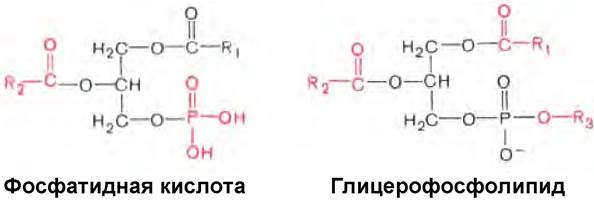
All glycerophospholipids are amphiphilic compounds: one part of the molecule (nonpolar radicals R1 and R2) exhibits pronounced Hydrophobicity, whereas the other, polar part of the molecule is hydrophilic. The hydrophilic (polar) groups consist of phosphoric acid and nitrogenous base residues (the "HEAD"), while the hydrophobic (nonpolar) groups consist of hydrocarbon radicals (the "tails"). When immersed in an aqueous environment, this enables them to form a bilayer—a double layer of phospholipid molecules where the hydrophilic heads contact water on both sides, while the hydrophobic tails reside inside the bilayer, shielded from contact with water (Fig. 46).
Fig. 46. Amphiphilic nature of phospholipids and the phospholipid bilayer
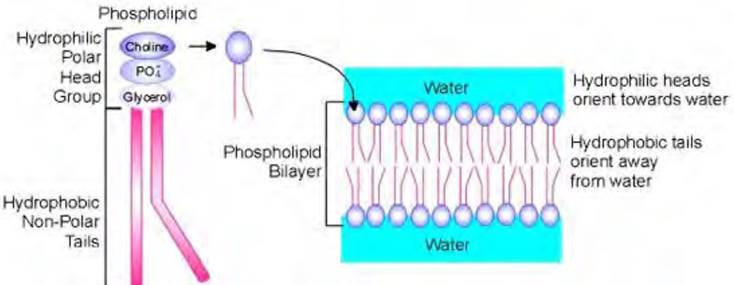
Amphiphilicity determines many physical and Chemical properties of phospholipids, such as their ability to form Liposomes and biological membranes (The Lipid Bilayer). The "tails" interact with the lipid environment, while the "heads" interact with the aqueous medium, since the nonpolar fatty tails cannot come into contact with water.
Phospholipids are also capable of forming micelles and liposomes. These are closed vesicles consisting of a single layer (micelles) or a double layer of phospholipids (Fig. 47):
Fig. 47. Schematic representation of a liposome and a micelle
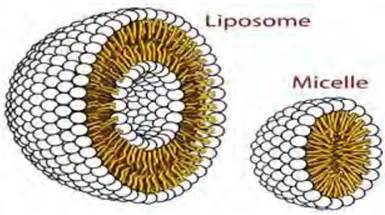
Drugs, Peptides, Proteins, and Nucleic Acids can be incorporated into the internal aqueous volume of liposomes, making it practically feasible to use liposomes as delivery vehicles for targeted Transport of substances to specific organs and tissues. This approach has found Applications in medicine, Pharmaceuticals, Genetic Engineering, and the food industry.
There are several groups (subclasses) of glycerophospholipids. Depending on the Nature of the nitrogenous base R3, glycerophospholipids are subdivided into phosphatidylcholines (lecithins), phosphatidylethanolamines (cephalins), and phosphatidylserines.

Instead of nitrogen-containing compounds, the composition of certain glycerophospholipids includes a nitrogen-free six-carbon cyclic alcohol known as Inositol, or myo-inositol. These lipids are called phosphatidylinositols.

Phospholipids are essential components of plants. The fatty acid composition of phospholipids andacylglycerols isolated from the same raw material is not identical. For instance, high-erucic acid varieties of rapeseed oil contain about 60% erucic acid, whereas their phospholipids contain 11–12%. The vast majority of phospholipids contain
residues of one saturated acid (typically at position 1) and one unsaturated acid (at position 2).
Dietary phospholipids vary in Chemical Composition and biological effects. Lecithin and cephalin are the predominant forms found in food products. These two groups of glycerophospholipids are metabolically linked and serve as major Lipid Components of cell membranes. Lecithin helps regulate Cholesterol METABOLISM, prevents cholesterol accumulation in the body, and facilitates its excretion (exhibiting the so-called lipotropic effect).
The total daily requirement for phospholipids is approximately 5 g. Phospholipids are most abundant in eggs (3.4%), and are relatively abundant in grains, legumes (0.3–0.9%), and unrefined vegetable oils (1–2%). During the storage of unrefined oil, phospholipids precipitate out as sediment. Refining vegetable oils reduces their phospholipid content to 0.1–0.2%. Phospholipids are present in high amounts in raw meat (about 0.8%) and poultry (0.5–2.5%). They are also found in butter (0.3–0.4%), fish (0.3–2.4%), bread (0.3%), and potatoes (about 0.3% combined with Glycolipids). Most fruits and vegetables contain less than 0.1% phospholipids.
6.4.4. Sphingophospholipids and Glycosphingolipids
These compounds are derivatives of the aliphatic amino alcohol sphingosine. The structural backbone of Sphingolipids is sphingosine, linked via an amide bond to a fatty acid acyl group. The simplest representative of sphingolipids is ceramide, whose phosphocholine derivative is known as sphingomyelin:

Sphingomyelin is the only phospholipid whose backbone does not contain a glycerol residue.
Glycosphingolipids are also derivatives of ceramide and contain one or more sugar residues.
Galactosylceramide is the major glycosphingolipid of the brain and other neural tissues, though it is also found in small amounts in many other tissues.
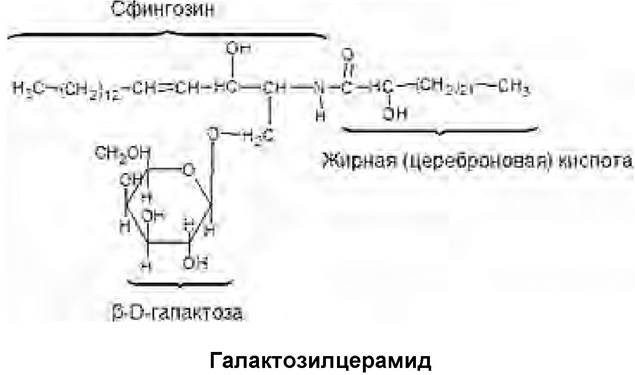
Sphingolipids are widely distributed in nature and are present in significant quantities in the Cells of the nervous system of animals and humans. Glycosphingolipids, which are Components of the outer leaflet of The Plasma membrane, can participate in intercellular interactions and contacts. Some of them act as Blood group determinants.
6.4.5. Steroids
Steroids are derivatives of cyclopentanoperhydrophenanthrene, which contains three non-linearly fused cyclohexane rings (A, B, and C) and a cyclopentane ring (D). One of the most important representatives of steroids is cholesterol:

Cholesterol esters serve as a storage form of cholesterol. Cholesterol is the precursor for all Other Steroids, including Sex Hormones (testosterone, estradiol, etc.), Adrenal Cortex Hormones (corticosteroids), bile acids, and vitamin D.
Cholesterol is found in animal fats rather than plant fats. Plants and Yeasts contain compounds structurally similar to cholesterol, including ergosterol:

Ergosterol is a precursor of vitamin D. Upon exposure to UV radiation, ergosterol acquires anti-rachitic properties (via the opening of ring B).
Bile acids are important representatives of steroids. The sodium salts of bile acids act as effective emulsifiers. By emulsifying fats, they facilitate their Digestion AND ABSORPTION through the formation of micellar lipid solutions in an aqueous environment.
Most bile acid molecules contain 24 carbon atoms. However, bile acids with 27 or 28 carbon atoms also occur. The structure of the predominant bile acids varies among different animal species. Mammalian bile acids are typically characterized by the presence of 24 carbon atoms in the molecule,
whereas those of certain amphibians contain 27 carbon atoms. Nearly all bile acids are derivatives of cholanic acid (Formula Ia):

The most common are its mono-, di-, and tri-hydroxy-substituted derivatives containing 24 carbon atoms; di-, tri-, and tetrahydroxy-substituted bile acids containing 27 (Ib) and 28 (Ic) carbon atoms are also known.
6.5. Biological Membranes
All living cells are separated from their environment by a cell membrane. Eukaryotes are characterized by the formation of membrane-bound subcellular Organelles within cells, such as The Nucleus and Mitochondria. Membranes incorporate active biochemical systems responsible for the selective transport of substances into and out of The Cell, the binding of hormones and other regulatory molecules, the catalysis of enzymatic reactions, the transmission of nerve impulses, and so on. Membranes are active biochemical systems that play a pivotal role in vital cellular processes. There are various types of membranes that differ in their functions, which are determined by their structure.
6.5.1. Membrane Functions
Barrier function: membranes isolate the cell from its surrounding environment and divide the internal cellular volume into relatively isolated compartments.
Transport function, which ensures the selective transport of substances and establishes a nonequilibrium distribution of ions between the cell and the extracellular environment.
Receptor function. Specifically arranged proteins participate in the processes of "recognizing" other cells and foreign proteins, as well as in the reception of light and mechanical stimuli.
Energy-producing function. Protein enzyme complexes form systems for electron transport, energy storage in the form of ATP, and The regulation of intracellular processes by extracellular hormones and intracellular mediators.
Metabolic function. The majority of enzymes are membrane-bound.
6.5.2. Chemical composition of Membranes
Membranes consist of lipid and protein molecules, the relative amounts of which vary among different membranes: ranging from 1/5 protein + 4/5 lipids to 3/4 protein + 1/4 lipids. Carbohydrates are present in the form of Glycoproteins and glycolipids, accounting for 0.5–10% of the membrane mass.
The bulk of Membrane Lipids is represented by phospholipids, glycolipids, and cholesterol. These are amphiphilic lipids that form a bilayer structure. All interactions are non-covalent in nature. The two monolayers are oriented so that the resulting bilayer structure features an internal non-polar core and two polar surfaces.
Membrane Proteins are integrated into the lipid bilayer in two ways. Peripheral (extrinsic) membrane proteins are associated with the hydrophilic surface of the lipid bilayer. Integral membrane proteins are embedded within the hydrophobic region of the bilayer (Fig. 48). Surface proteins bind to the hydrophilic groups of the lipid bilayer via hydrophilic amino acid radicals. Integral proteins can span both sides of the membrane. The embedded portion of integral proteins contains a high proportion of Amino Acids with hydrophobic radicals, which facilitate hydrophobic interactions with membrane lipids. Some membrane proteins are covalently linked to monosaccharide residues or oligosaccharide chains, thus forming glycoproteins. Each cell
type possesses a unique Membrane Structure, which is determined primarily by glycoproteins.
Fig. 48. Diagram of The cell membrane structure

Proteins facilitate The transport of specific molecules into or out of the cell, establish structural connections between the Cytoskeleton and cell membranes, or act as receptors for receiving and transducing chemical signals from the environment.
The Lipid Composition of the monolayers differs. For instance, in the erythrocyte plasma membrane, phosphatidylcholines predominate in the outer leaflet, whereas phosphatidylserines are more abundant in the inner leaflet. The carbohydrate moieties of proteins and lipids are located on the outer surface of the membrane. Furthermore, membrane surfaces differ in their protein composition. The degree of such membrane Asymmetry varies among different cell types and can change during the cell's life cycle and Aging.
6.5.3. Membrane Properties
All cellular membranes are dynamic, fluid structures because lipid and protein molecules are not linked by covalent bonds and are capable of rapidly altering the membrane configuration.
Membranes are highly dynamic structures. They rapidly repair themselves after injury and can stretch and compress during cellular movements.
Branched glycoprotein chains protruding from the cell membrane participate in recognizing environmental factors as well as in the mutual recognition of related cells. Recognition is also closely linked to the Regulation of the transport of molecules and ions across the membrane. Thus, sugars can function as informational molecules (similar to proteins and nucleic acids). Membranes also contain specific receptors, electron carriers, energy transducers, and enzymatic proteins.
All natural membranes are asymmetric, meaning that identical lipid molecules are present in unequal concentrations on the outer and inner surfaces. The arrangement of membrane proteins is also asymmetric.
Another vital property of the membrane is its selective permeability. This property establishes the plasma membrane as an osmotic barrier. Water and dissolved gases possess the maximum permeability, whereas ions pass through the membrane much more slowly. The Diffusion of Water across a membrane is known as osmosis.
The rigidity (firmness) and fluidity of membranes also depend on their composition. Increased rigidity is caused by a higher ratio of saturated to unsaturated fatty acids, as well as cholesterol. The Physical Properties of membranes depend on the arrangement of proteins within the lipid layer. Membrane lipids are capable of diffusion within the layer parallel to the membrane surface (lateral diffusion). Proteins are likewise capable of lateral diffusion, whereas transverse (flip-flop) diffusion in membranes is severely restricted.
6.5.4. Membrane Transport
The transport of substances into and out of the cell, as well as between the Cytoplasm and various subcellular organelles (mitochondria, nucleus, etc.), is mediated by membranes. The transport Properties of the membrane are characterized by semipermeability, meaning that certain compounds can cross it while others cannot.
One of the primary functions of membranes is the regulation of substance transport. There are two modes of substance Transport Across the membrane: passive and Active Transport.
Passive transport (diffusion) occurs when a substance moves across the membrane from a region of higher concentration to a region of lower concentration (i.e., along the concentration gradient of that substance) without the expenditure of cellular energy. There are Two Types of diffusion: simple and facilitated (Fig. 49).
Fig. 49. Mechanisms of Substance transport across the membrane

Simple diffusion is typical for small neutral molecules (Н2O, СO2, O2), as well as hydrophobic low-molecular-weight Organic compounds. These molecules can pass through membrane pores or channels without any interaction with membrane proteins as long as a concentration gradient is maintained.
Facilitated Diffusion is characteristic of hydrophilic molecules that are transported across the membrane also along the concentration gradient, but with the help of special carrier proteins. Facilitated diffusion features high selectivity because the carrier protein has a binding site complementary to the transported substance, and the transport is accompanied by Conformational Changes in the protein.
Active transport is coupled with Energy Expenditure and serves to transport substances against their concentration gradient. It is carried out by specialized carrier proteins that form the so-called ion pumps. The best studied is the sodium-potassium ion pump in animal cells, which actively pumps out Na+ ions while taking up K+ ions. Due to this, the cell maintains a high concentration of K+ and a low concentration of Na+ compared to the external environment. This process consumes ATP energy. The concentrations of Mg2+ and Ca2+ are regulated in a similar manner.
Unlike ions and monomers, macromolecules of proteins, nucleic acids, Polysaccharides, or even larger particles cannot pass through cell membranes. The mechanisms by which cells can uptake such substances or expel them differ from the transport mechanisms of ions and polar compounds.
The Transport of Macromolecules, their complexes, and particles into the cell occurs via endocytosis. During endocytosis (endo... - inward), a specific region of the Plasmalemma captures and essentially envelops the extracellular material, enclosing it within a membranous vacuole formed as a result of membrane invagination. Subsequently, this vacuole fuses with a lysosome, whose enzymes break down macromolecules into monomers (Fig. 50). The uptake of fluid and substances dissolved in it via small vesicles is called pinocytosis. The uptake of substances by The Mechanism of endocytosis (pinocytosis) is characteristic of all cells.
Fig. 50. Transport of macromolecules into the cell via Endocytosis and Exocytosis

The reverse process of endocytosis is exocytosis (exo... - outward). Macromolecules such as Plasma Proteins, Peptide Hormones, digestive enzymes, and Extracellular matrix proteins are synthesized within cells and then secreted into the intercellular space or blood. However, the membrane is impermeable to such macromolecules or complexes, and their secretion occurs via exocytosis. The key feature of exocytosis is that the secreted substances are localized within vesicles and do not mix with other cellular macromolecules or organelles.
During exocytosis, the contents of secretory vesicles are released into the extracellular space when they fuse with the plasma membrane. The vesicle approaches the cytoplasmic membrane, fuses with it, and its contents are discharged into the extracellular environment.
Questions and Exercises for Self-Check
1. Provide a classification of lipids.
2. What is the Biological Role of individual lipid classes?
3. Write the general formula and give a brief Description of the physicochemical properties of fats.
4. Write the formulas of the most common saturated fatty acids that make up triacylglycerols (TAG).
5. Write the formulas of the most common unsaturated fatty acids that make up triacylglycerols (TAG).
6. Which fatty acids are essential dietary factors?
7. Which lipid constant allows one to judge the molecular weight of fatty acids making up a fat?
8. What information does the acid value of a fat provide?
9. Which lipid constant contains information about the unsaturation of a fat?
10. What substances are formed as a result of the oxidative rancidity of fats?
11. Which lipid constant allows one to assess the occurrence of oxidative rancidity in fats?
12. Write the structural formula of cholesterol and briefly describe its biological functions in the body.
13. Write the structural formula of lecithin and briefly describe its biological functions in the body.
14. Write the structural formula of cephalin and briefly describe its biological functions in the body.
15. Draw a diagram of the Biological Membrane Structure and provide a brief description of its components.
16. Draw a diagram of a micelle and indicate which lipid substances form these particles.
17. Draw a diagram of a liposome and describe the Practical Applications OF liposomes.
18. Describe the structure and biological role of bile acids.
19. How is The active transport of substances into the cell carried out?
20. How does the transport of macromolecules, their complexes, and particles occur out of and into the cell?
Tasks for Independent Work
Option 1
1. Write the hydrogenation reaction equation for linolenic arachidonoolein. What is the consistency of the initial and resulting fats? What compounds are formed upon the saponification of the obtained TAG? Calculate the saponification number for this TAG.
2. Provide a comparative characterization of two oils given their iodine values: 80-85 and 119-144. Which of them is classified as a drying oil and why?
Option 2
1. Write the chemical formula of palmitooleostearin. What compounds are formed upon the saponification of this TAG? Calculate the saponification number for this TAG.
2. Provide a comparative characterization of two oils given their iodine values: 80-85 and 103-112. Which of them is classified as a semi-drying oil and why?
Option 3
1. Write the chemical formula of oleoarachidonostearin. What compounds are formed upon the saponification of this TAG? Calculate the saponification number for this TAG.
2. Provide a comparative characterization of two oils given their iodine values: 80-85 and 119-144. Which groups do these oils belong to—drying, semi-drying, or non-drying? Justify your answer.
Option 4
1. Mustard oil contains acids such as oleic, arachidonic, and linolenic. Write the structural formula of a triglyceride composed of these acids. Calculate the saponification number for this TAG. What compounds are formed upon the saponification of this TAG?
2. Provide a comparative characterization of two oils given their iodine values: 96-103 and 119-144. Which of them is classified as a non-drying oil and why?
Option 5
1. Edible oil obtained from peanut seeds may contain triglycerides formed by oleic and arachidonic acids in a 1:2 ratio (13). Provide the formulas for all isomeric TAGs. How can this liquid oil be converted into a solid fat? Write the reaction equation. Calculate the saponification number of the TAG. What compounds are formed upon the saponification of this TAG?
2. Provide a comparative characterization of two oils given their iodine values: 93-102 and 169-192. Which of them is classified as a non-drying oil and why?
Option 6
1. Write the formulas for all isomeric triglycerides containing one stearic acid residue and two oleic acid residues. Name the products. What is the consistency of these isomeric fats? Calculate the saponification number of the TAG. What compounds are formed upon the saponification of this TAG?
2. Provide a comparative characterization of two oils given their iodine values: 93-102 and 131-143. Which of them is classified as a drying oil and why?
Option 7
1. Select and name the fat that has: a) the highest melting point; b) the highest saponification value; c) the highest iodine value. Justify your choice.
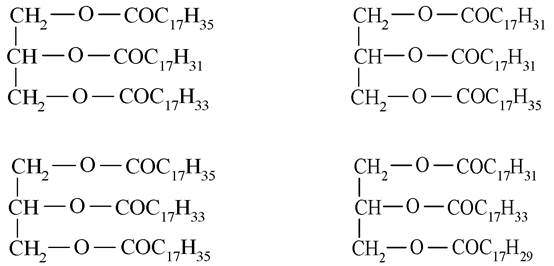
2. Provide a comparative characterization of two oils given their iodine values: 81-90 and 140-175. Which groups do these oils belong to—drying, semi-drying, or non-drying? Justify your answer.
Option 8
1. Write the structural formulas of all isomeric triglycerides containing stearic, palmitic, and arachidonic acid residues. Name all isomers. Calculate the saponification value for this TAG.
2. Provide a comparative characterization of two oils given their iodine values: 93-102 and 131-143. Which of them is classified as a drying oil and why?
Option 9
1. Linseed and hemp oils contain triglycerides with linoleic, oleic, or linolenic acid residues. Write the structural formula of linolenodiolein. Write the reaction scheme for The production of solid fat from this oil and name the reaction product. Calculate the saponification value for this TAG.
2. Provide a comparative characterization of two oils given their iodine values: 80-85 and 111-131. Which groups do these oils belong to—drying, semi-drying, or non-drying? Justify your answer.
Option 10
1. One of the three main triglycerides of cottonseed oil is palmitooleolinolein. Write the structural formula of this compound. What are drying oils and how are they used?
2. Provide a comparative characterization of two oils given their iodine values: 80-85 and 119-144. Which groups do these oils belong to—drying, semi-drying, or non-drying? Justify your answer.
Last update: 06/08/2026
Editorial and Educational Adaptation: This material has been compiled based on the primary/original source text. The project team performed an editorial review, corrected technical inaccuracies, structured sections, and adapted the content for an educational format.
What was processed:
- elimination of formatting defects (OCR errors, structural breaks, corrupted characters);
- editorial organization of content;
- standardization of terminology in accordance with academic sources;
- verification of factual statements against the original source text.
All mentions of the author, publication year, and origin of the primary text have been preserved in accordance with the source.