Principles of Biochemistry Volume 3 - A. Lehninger 1985
Selected Aspects of Human Biochemistry
Hormones
Adrenal cortex hormones are steroids
The Hormones of the adrenal cortex, namely androgens and estrogens, are the principal fat-soluble Steroid Hormones. We begin with the hormones of the adrenal cortex because, alongside other Functions, they also influence Carbohydrate METABOLISM. The secretion of Adrenocortical Hormones is regulated by the Hypothalamus. In response to stressful situations, the hypothalamus releases corticotropin-releasing hormone, which travels to the anterior pituitary, stimulating the release of corticotropin into the bloodstream. Corticotropin is a polypeptide consisting of 39 amino acid residues (Section 6.9). Its normal concentration in the Blood ranges from 10-11 to 10-12 M. Given that the half-life of this hormone in the blood is only about 10 min, it is evident that under steady-state conditions it is continuously synthesized and degraded. Corticotropin binds to receptors located On the surface of adrenocortical Cells, stimulating them to synthesize their characteristic steroid hormones. More than 30 Steroids are synthesized in the adrenal cortex.
They are termed corticoids (corticosteroids) and are divided into three main groups. The first group comprises the glucocorticoids, the most important representative of which is cortisol (Fig. 25-23); in several of their effects, the hormones of this group oppose Insulin. Cortisol stimulates Gluconeogenesis from Amino Acids and promotes Glycogen accumulation in the Liver; it also raises blood glucose levels and reduces glucose utilization in peripheral Tissues. Furthermore, it enhances fatty acid utilization and stimulates the Formation of Ketone bodies. Glucocorticoids also exhibit pronounced anti-inflammatory and anti-allergic effects. Excessive secretion of glucocorticoids is the cause of Cushing's Disease, which is characterized by such symptoms as fatigue and loss of Muscle mass (due to the increased rate of amino acid conversion into glucose), as well as the redistribution of body fat, which, in particular, leads to a moon face.
The second group of adrenal cortical steroids consists of the mineralocorticoids, whose function is to promote the retention of Na+ ions and The excretion of K+ ions by the Kidneys; in this way, these hormones maintain the Water-salt balance in the body. The most important mineralocorticoid is aldosterone (Fig. 25-23). This hormone also possesses weak glucocorticoid activity; likewise, cortisol exhibits weak mineralocorticoid activity.
Class="center">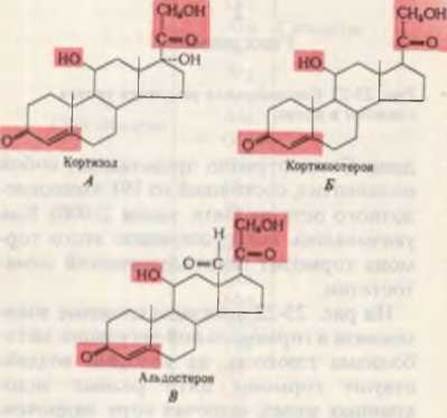
Fig. 25-23. The three major STEROID HORMONES OF the adrenal cortex. Identical structural regions are highlighted with a red Background. All three hormones possess both glucocorticoid and mineralocorticoid activity, though cortisol predominantly exerts glucocorticoid effects, while aldosterone primarily exerts mineralocorticoid effects. Corticosterone exhibits both activities to an equal degree. A. The glucocorticoid cortisol stimulates gluconeogenesis from amino acids and possesses anti-inflammatory activity. B. Corticosterone exhibits both glucocorticoid and mineralocorticoid action. C. The mineralocorticoid aldosterone causes retention of Na+ ions and loss of K+ ions in the urine.
Adrenal steroids belonging to the third group occupy an intermediate position in their properties between glucocorticoids and mineralocorticoids. The primary hormone of this group is corticosterone. As can be seen in Fig. 25-23, A number of common structural elements are characteristic of corticosteroids across all three groups.
Adrenal Cortex Hormones are lipid-soluble and easily pass through The Cell membranes of target tissues into the Cytoplasm, where they bind to specific intracellular receptor Proteins. The resulting hormone-receptor complexes, which can be regarded as intracellular messengers, penetrate the Cell Nucleus. There, they regulate the Transcription of specific genes and thereby promote The Biosynthesis of specific Enzymes and proteins responsible for the ultimate action of these hormones.
Insufficient secretion of adrenocortical hormones causes Addison's disease, which is characterized by fatigue, weakness, Skin pigmentation, and a craving for salt. Patients with this condition are highly sensitive to stress and infections.
Last update: 06/08/2026
Editorial and Educational Adaptation: This material has been compiled based on the primary/original source text. The project team performed an editorial review, corrected technical inaccuracies, structured sections, and adapted the content for an educational format.
What was processed:
- elimination of formatting defects (OCR errors, structural breaks, corrupted characters);
- editorial organization of content;
- standardization of terminology in accordance with academic sources;
- verification of factual statements against the original source text.
All mentions of the author, publication year, and origin of the primary text have been preserved in accordance with the source.