Biochemistry - The Chemical Reactions of Living Cells, Volume 2 - D. Metzler 1980
Biosynthesis; how new molecules are formed
Intracellular degradation of polysaccharides and glycolipids
Glycolipids
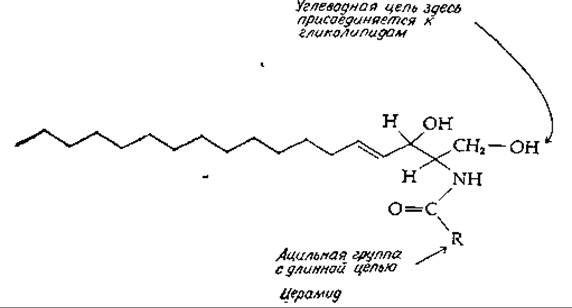
It is generally assumed that glycolipids, much like Glycoproteins, are synthesized on the membranes of The Endoplasmic reticulum, with the newly formed glycolipids embedded in the membrane surface facing the lumen of the endoplasmic reticulum cisternae. From there, they are transported to the Golgi apparatus and eventually delivered to The Cell surface, becoming part of the outer leaflet of The Plasma Membrane. The major Class of glycolipids is the Sphingolipids, represented by cerebrosides and gangliosides. Both cerebrosides and gangliosides are derived from ceramides, which are N-acylated sphingosines (Table 2-8). Figure 12-5 illustrates some of the biosynthetic Pathways leading from sphingosine to these compounds. The sources of acyl, glycosyl, and sulfate groups are the corresponding CoA, CDP, UDP, and CMP derivatives. This scheme also outlines The Biosynthesis of sphingomyelin, as well as 3-phosphoadenosine-5-phosphosulfate, which will be discussed further in this chapter.
Each step of the biosynthesis shown in Fig. 12-5 requires a specific transferase. Although most of these transferases are known to be membrane-bound, detailed information regarding these Enzymes remains scarce. Furthermore, it is quite likely that The sequence of transferase actions is not always strictly fixed1), and the overall biosynthetic pathway may be significantly more complex than depicted in the figure.
A striking aspect of glycolipid METABOLISM is the existence of at least ten specific lysosomal storage diseases known as sphingolipidoses [24–28]. The biochemical defects underlying these disorders are indicated in Fig. 12-5 and Table 12-1. The first sphingolipidosis to be studied was Gaucher's disease, which is inherited in an autosomal recessive manner. This condition is characterized by the excessive accumulation of glucosylceramide, ultimately leading to severe enlargement and Impairment of the Liver and Spleen. In patients who develop the disease in adulthood, the spleen can enlarge to 4 to 5 times its normal size. In infants, the disease follows a more severe course than in adults and is accompanied by delayed mental development. As demonstrated by Brady, The rate of cerebroside synthesis in these patients remains normal. Later, in 1965, it was discovered that Gaucher's disease is caused by a deficiency in one of the lysosomal Hydrolases involved in glycolipid Catabolism (block No. 3 in Fig. 12-5, where Catabolic pathways are indicated by dashed arrows), thereby blocking their degradation pathway.
1) An example of an alternative biosynthetic sequence is The formation of galactosylceramide via the direct transfer of galactose to sphingosine followed by subsequent acylation:

However, the pathway illustrated in Fig. 12-5 appears to be of greater physiological significance.
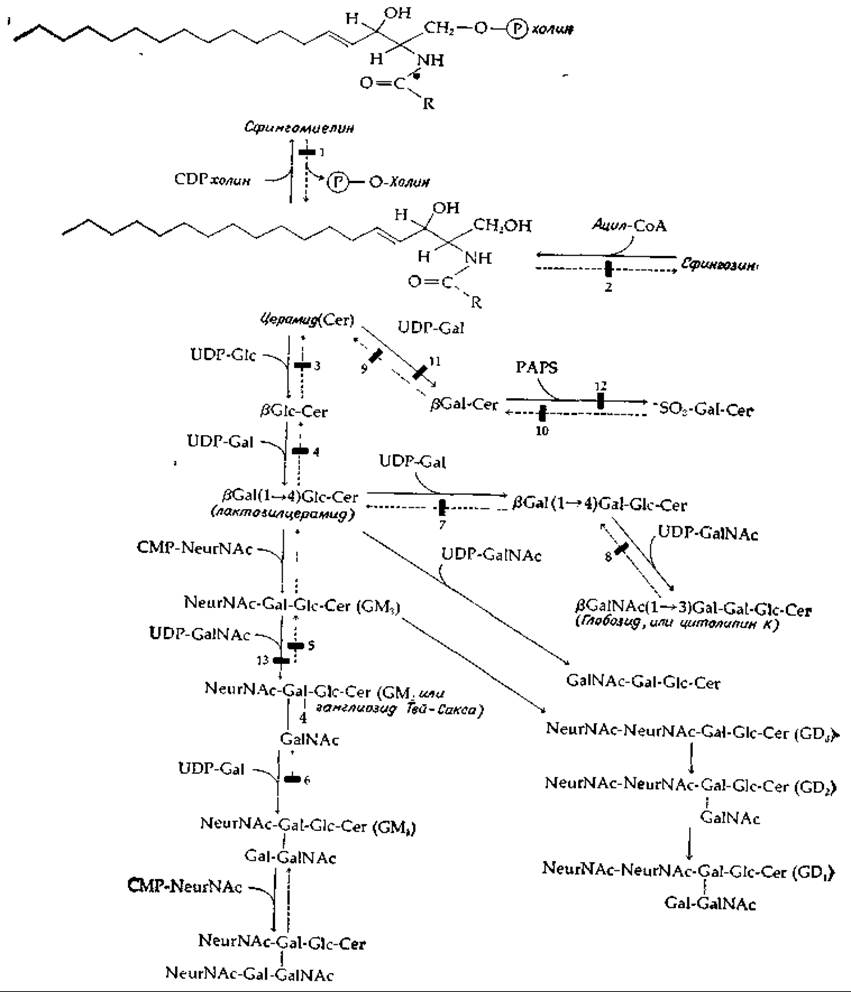
FIG. 12-5. BIOSYNTHESIS AND DEGRADATION of glycosphingolipids. Bold lines indicate metabolic steps blocked in inherited Metabolic Disorders.
Table 12-1 Glycolipid storage diseases (sphingolipidoses)
|
Number in Fig. 12-5 |
Disease |
Defective enzyme |
|
1. Niemann-Pick disease |
Sphingomyelinase |
|
|
2. Farber's disease (lipogranulomatosis) |
Ceramidasea |
|
|
3. Gaucher's disease |
ß-Glucosidase |
|
|
4. Galactosylceramidosis |
ß-Galactosylhydrolase |
|
|
Hexosaminidase Ab |
||
|
6. Generalized gangliosidosis |
ß-Galactosidasec |
|
|
7. Fabry's disease |
a-Galactosidased,e |
|
|
8. Sandhoff disease |
Hexosaminidases A and B |
|
|
9. Krabbe leukodystrophy |
Galactocerebrosidase |
|
|
10. Metachromatic leukodystrophy |
Sulfatase |
|
|
13. Hematoside (GM3) storage |
GM3 N-acetylgalactosaminyltransferasef |
|
a Sugita M., Dulaney I. T., Moser H. W., Science, 178, 1100–1102 (1972).
b Tallman J. F., Brady R. O., JBC, 247, 7570–7575 (1972).
c The same defect has been identified in a line of Siamese cats; Baker H. J., Jr., Lindsey J. R., McKhann C. M., Farrell D. F., Science, 174, 838–839 (1971).
d Beutler E., Kuhl W., JBC, 247, 7195–7200 (1972).
e Crawhall J. C., Banfalvi M., Science, 177, 527–528 (1972).
f Fishman P. H., Max S. R., Tallman J. F., Brady R. O., Maclaren N. K., Cornblath M., Science, 187, 68–70 (1975).
Another well-known condition is Fabry's disease, which results from a defect in an X-linked Gene responsible for the Cleavage of galactose residues from cerebrosides. As a consequence, trihexosylceramide accumulates because its degradation is blocked at reaction step 7 (Fig. 12-5).
The most common and thoroughly studied sphingolipidosis is Tay-Sachs disease. First described in 1881, over 500 cases of this disorder have since been reported. It is a severe condition characterized by progressive neurodegeneration, blindness, paralysis, and mental deterioration, leading to death typically around 3 years of age. Approximately 30 children are born with this pathology each year in North America, and worldwide the incidence is likely 5 to 7 times higher.
Last update: 06/08/2026
Editorial and Educational Adaptation: This material has been compiled based on the primary/original source text. The project team performed an editorial review, corrected technical inaccuracies, structured sections, and adapted the content for an educational format.
What was processed:
- elimination of formatting defects (OCR errors, structural breaks, corrupted characters);
- editorial organization of content;
- standardization of terminology in accordance with academic sources;
- verification of factual statements against the original source text.
All mentions of the author, publication year, and origin of the primary text have been preserved in accordance with the source.