BIOCHEMISTRY - L. Stryer - 1984
VOLUME 2
PART III. BIOSYNTHESIS OF MACROMOLECULE PRECURSORS
CHAPTER 20. BIOSYNTHESIS OF MEMBRANE LIPIDS AND STEROID HORMONES
20.8. Tay-Sachs Disease: An Inherited Defect in Ganglioside Degradation
Gangliosides are present in highest concentration in The Nervous system, especially in the Gray matter, where they make up 6% of all Lipids. Gangliosides are constantly synthesized and degraded through the sequential removal of terminal sugar residues. The glycoside Hydrolases that catalyze these reactions are highly specific. Ganglioside degradation takes place in Lysosomes. These Organelles contain A wide variety of degradative Enzymes and are designed for the orderly breakdown of cellular components.
Impairments in The Cell's ability to degrade gangliosides can lead to severe clinical consequences.
Symptoms of Tay-Sachs disease usually appear in an infant before the age of one year. Characteristic early symptoms include weakness, developmental delay, and feeding difficulties. Blindness typically develops within a few months. Death from Tay-Sachs disease usually occurs before the age of 3. This disease is accompanied by striking pathological Changes in the nervous system: the ganglion Cells of the Cerebral Cortex AND certain other Brain regions become grossly swollen. In addition, distinct cherry-red spots are visible on the retina.
The ganglioside content in the brain of an infant suffering from Tay-Sachs disease is greatly elevated. Most strikingly, the concentration of the GM2 ganglioside is increased manyfold compared to normal. The abnormally high content of this ganglioside is due to a deficiency of the enzyme that cleaves off the terminal N-acetylgalactosamine residue. The enzyme whose absence (or insufficient activity) causes this disease is specific β-N-acetylhexosaminidase.
Class="center">
Fig. 20.6. Electron micrograph of a lysosome

Tay-Sachs disease is inherited as an autosomal recessive trait. The carrier frequency is 1/30 among Americans of Jewish descent and 1/300 among other Americans. Consequently, the disease frequency among Americans of Jewish descent is approximately 100 times higher. Tay-Sachs disease can be diagnosed during embryonic development. This is accomplished by taking a sample of Amniotic Fluid via amniocentesis and assaying it for β-N-acetylhexosaminidase activity.
Fig. 20.7. Three-dimensional model of Cholesterol

20.9. Cholesterol Is Synthesized from Acetyl-Coenzyme A
We now turn to the synthesis of cholesterol, a steroid that regulates the fluidity of Introduction/5.html">Eukaryotic Cell membranes (Sec. 10.17).

In addition, cholesterol serves as a precursor for Steroid Hormones such as progesterone, testosterone, estradiol, and cortisol. An important step in early research on cholesterol synthesis was taken by Konrad Bloch in the 1940s. He prepared acetate containing labeled carbon atoms and fed it to rats. Cholesterol synthesized in the bodies of these rats contained an isotopic label, indicating that acetate is a precursor of cholesterol. Indeed, all 27 carbon atoms of cholesterol are derived from acetyl-CoA. Further progress in studying cholesterol synthesis was achieved by using acetate labeled at either the methyl or carboxyl carbon atom as a precursor. Upon degradation of cholesterol synthesized from acetate labeled at a specific carbon atom, it was possible to establish THE ORIGIN OF every atom in the molecule (Fig. 20.8). This played a crucial role in formulating and experimentally testing hypotheses regarding The pathway of cholesterol synthesis.

Fig. 20.8. Label distribution in the cholesterol molecule synthesized from acetate labeled at the methyl (shown in blue) or carboxyl (shown in red) carbon atoms

20.10. Mevalonate and Squalene Are Intermediates in Cholesterol Synthesis
The next major breakthrough was the discovery of squalene, a C30 hydrocarbon and intermediate in cholesterol synthesis. Squalene is composed of six isoprene units. The discovery of squalene raised a new question: how are isoprene units synthesized from acetate.
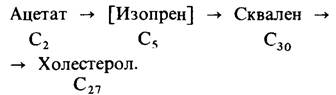
The answer came unexpectedly from research on bacterial mutants that had nothing to do with The Study of cholesterol synthesis. It turned out that mevalonate can replace acetate, compensating for its deficiency in acetate-requiring mutants. The discovery of mevalonate was crucial for deciphering the Cholesterol Biosynthesis pathway, as it soon became clear that this six-carbon acid could undergo decarboxylation to yield the postulated five-carbon isoprene intermediate. Subsequently, using isotopic labeling, it was demonstrated that mevalonate indeed serves as a precursor to squalene and that it can be formed from acetate. It was found that the activated isoprene intermediate is isopentenyl pyrophosphate, which is formed by the decarboxylation of a mevalonate derivative. Thus, the synthesis of cholesterol from acetate could be schematically represented as follows:

Last update: 06/08/2026
Editorial and Educational Adaptation: This material has been compiled based on the primary/original source text. The project team performed an editorial review, corrected technical inaccuracies, structured sections, and adapted the content for an educational format.
What was processed:
- elimination of formatting defects (OCR errors, structural breaks, corrupted characters);
- editorial organization of content;
- standardization of terminology in accordance with academic sources;
- verification of factual statements against the original source text.
All mentions of the author, publication year, and origin of the primary text have been preserved in accordance with the source.