BIOCHEMISTRY - L. Stryer - 1984
VOLUME 2
PART III. BIOSYNTHESIS OF MACROMOLECULE PRECURSORS
CHAPTER 20. BIOSYNTHESIS OF MEMBRANE LIPIDS AND STEROID HORMONES
20.4. Phosphoacylglycerols Can Also Be Synthesized from Preformed Precursors
Preformed Choline can also be utilized in the synthesis of phosphatidylcholine. Such reactions are referred to as the salvage pathway (Fig. 20.2). Choline is phosphorylated by ATP to yield phosphorylcholine, which then reacts with CTP to form CDP-choline.
Class="center">
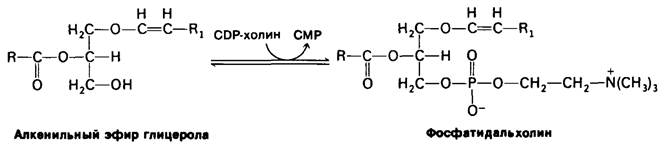
The phosphorylcholine moiety of this molecule is transferred to diacylglycerol, yielding phosphatidylcholine. It is noteworthy that in the salvage pathway, the activated molecule is a cytidine derivative of choline phosphate rather than phosphatidate.
Fig. 20.2. Synthesis of phosphatidylcholine via the salvage pathway
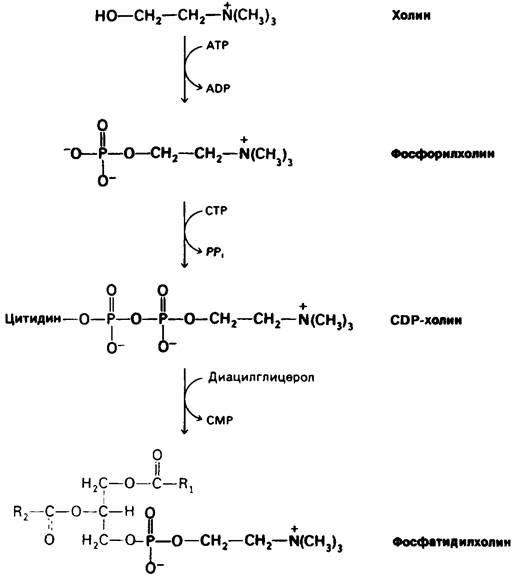
Phosphatidylethanolamine can be synthesized from ethanolamine through a similar reaction sequence. Plasmalogens are also formed via the salvage pathway. They differ from phosphoacylglycerols in that an α,β-unsaturated fatty acid residue is attached by an ether linkage at the C-1 position of glycerol. The final reaction in the synthesis of phosphatidylcholine (the plasmalogen corresponding to phosphatidylcholine) is The transfer of phosphorylcholine from CDP-choline to a glycerol alkenyl ether.
20.5. Several Specific Phospholipases Have Been Isolated
Enzymes can serve as highly specific biochemical Reagents. For example, as we have already seen, Trypsin is an indispensable tool in Cell/13.html">Protein Structure determination. Specific phospholipases can play an equally vital role in studying Introduction/36.html">Biological Membranes and their phospholipid components. Phospholipases are classified into distinct groups according to their Specificity. Figure 20.3 shows the bonds hydrolyzed by phospholipases A1, A2, C, and D.
Fig. 20.3. Specificity of phospholipases

20.6. Ceramide Synthesis: The Fundamental Structural Unit of Sphingolipids
Let us now turn from Phospholipids to Sphingolipids. Their backbone is not glycerol, but sphingosine, a long-chain aliphatic amine. Palmitoyl-CoA and Serine condense to form dehydrosphinganine, which is subsequently converted into sphingosine.
The amino group of sphingosine is acylated in all sphingolipids (Fig. 20.4). A long-chain acyl-CoA reacts with sphingosine to form ceramide (N-acylsphingosine). The terminal hydroxyl group in sphingolipids is also substituted. In sphingomyelin, the substituent is phosphorylcholine, derived from CDP-choline. In cerebroside, glucose or galactose is attached to the terminal hydroxyl group of ceramide. UDP-glucose and UDP-galactose serve as sugar Donors for cerebrosides. In ganglioside, an oligosaccharide is linked to ceramide via a glucose residue (see Fig. 20.5).

20.7. Gangliosides Are Carbohydrate-Rich Sphingolipids Containing Acidic Sugars
Gangliosides are among the most complex sphingolipids. An oligosaccharide chain containing at least one acidic sugar residue is attached to ceramide. These acidic sugars are N-acetylneuraminate and N-glycolylneuraminate, collectively known as sialic acids. The nine-carbon backbone of these molecules is synthesized from phosphoenolpyruvate (a C3 unit) and N-acetylmannosamine-6-phosphate (a C6 unit).
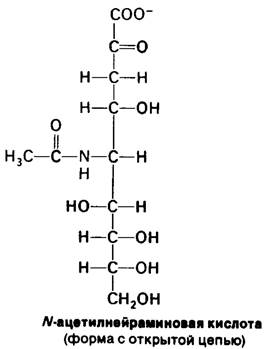
Gangliosides are synthesized by the ordered, sequential addition of sugar residues to ceramide. The activated donors of these sugar residues are UDP-glucose, UDP-galactose, and UDP-N-acetylgalactosamine. The CMP derivative of N-acetylneuraminate serves as the activated donor for this acidic sugar. CMP-N-acetylneuraminate is synthesized from CTP and N-acetylneuraminate; the activated carbon atom is located at position 1, as in UDP-sugars. The structure of the resulting ganglioside is determined by the Specificity of the cell's Glycosyltransferases. More than 15 different gangliosides have been described in total. Figure 20.5 illustrates the structure of one of them, GM1.
Fig. 20.4. Ceramide as a precursor of sphingomyelin and gangliosides


Fig. 20.5. STRUCTURE OF THE ganglioside GM1. Abbreviations used: Gal, galactose; GalNAc, N-acetylgalactosamine; Glc, glucose; NAN, acetylneuraminic acid. The bond types between sugars are indicated above the lines denoting the bonds, for example, β1,4

Last update: 06/08/2026
Editorial and Educational Adaptation: This material has been compiled based on the primary/original source text. The project team performed an editorial review, corrected technical inaccuracies, structured sections, and adapted the content for an educational format.
What was processed:
- elimination of formatting defects (OCR errors, structural breaks, corrupted characters);
- editorial organization of content;
- standardization of terminology in accordance with academic sources;
- verification of factual statements against the original source text.
All mentions of the author, publication year, and origin of the primary text have been preserved in accordance with the source.