Principles of Biochemistry Volume 1 - A. Lehninger 1985
Biomolecules
Enzymes
Impairment of the catalytic activity of enzymes may be caused by mutations
Numerous human Genetic Disorders are known in which a particular enzyme is either completely inactive or possesses a defect affecting its catalytic or regulatory function. In such diseases, The polypeptide chains of the "defective" enzyme contain one or more "incorrect" Amino Acids resulting from Mutations in the DNA segments that encode this enzyme. The catalytic activity of an enzyme depends not only on the presence of specific amino acid residues within its catalytic and regulatory centers, but also on its overall three-dimensional Structure. Consequently, the replacement of even a single amino acid residue at a critical position in the chain can alter or even completely abolish the enzyme's catalytic activity—much like the substitution of a single amino acid residue in the Hemoglobin molecule gives rise to sickle-Cell hemoglobin with impaired function (Sec. 8.18). If the genetically altered enzyme is part of an enzyme system catalyzing a central metabolic pathway, the consequences can be severe, potentially leading to fatal Metabolic Disorders.
Table 9-8 lists several of the most serious human genetic diseases caused by structural abnormalities in specific Enzymes. These disorders will be discussed in subsequent chapters. Considerable efforts are underway to prevent the undesirable consequences of such genetic enzyme defects. One approach that has been tested involves introducing the normal, active form of the defective enzyme—immobilized within a filtering capsule inserted into a Blood vessel—into the Organism. This method offers the hope that metabolites accumulating in the body due to a genetic defect will be converted into normal products as the blood circulates through the capsule containing the active enzyme.
Class="center">Table 9-8. Some Genetic Diseases Caused by Specific Enzyme Defects
|
Disease |
Defective Enzyme |
|
Albinism |
Tyrosine 3-monooxygenase |
|
Homogentisate 1,2-dioxygenase |
|
|
Galactosemia |
Galactose-1-phosphate uridylyltransferase |
|
Homocystinuria |
Cystathionine β-synthase |
|
Phenylketonuria |
Phenylalanine 4-monooxygenase |
|
Hexosaminidase A |
Genetic alterations in enzymes do not always lead to harmful consequences. Frequently, they manifest simply as variations in secondary phenotypic traits, such as eye or Hair color (Fig. 9-24). Occasionally, a genetic mutation causes an enzyme to function more efficiently, conferring a selective advantage to the organism in the struggle for survival.
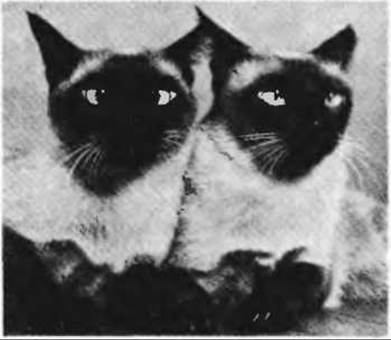
Fig. 9-24. The characteristic coloration of Siamese cats results from a genetic alteration in the enzyme responsible for dark coat pigment synthesis; due to this defect, the enzyme is active only in the cooler PARTS OF THE body.
Last update: 06/08/2026
Editorial and Educational Adaptation: This material has been compiled based on the primary/original source text. The project team performed an editorial review, corrected technical inaccuracies, structured sections, and adapted the content for an educational format.
What was processed:
- elimination of formatting defects (OCR errors, structural breaks, corrupted characters);
- editorial organization of content;
- standardization of terminology in accordance with academic sources;
- verification of factual statements against the original source text.
All mentions of the author, publication year, and origin of the primary text have been preserved in accordance with the source.