Principles of Biochemistry Volume 1 - A. Lehninger 1985
Biomolecules
Enzymes
Chapter Summary
Enzymes are Proteins that catalyze strictly specific Chemical Reactions. They bind to a substrate molecule, resulting in The formation of an intermediate enzyme-substrate complex, which then dissociates into the free enzyme and the reaction product. As the Substrate Concentration S increases while the Enzyme Concentration E remains constant, the catalytic activity of the enzyme rises until it reaches the maximum velocity Vmаx characteristic of that specific enzyme, at which point practically all of the enzyme is in the form of the ES complex and, consequently, is saturated with the substrate. This relationship between substrate concentration and enzymatic reaction rate is described by a hyperbolic curve. The substrate concentration at which the reaction rate is half of Vmаx is termed the Michaelis-Menten constant (KM). This constant characterizes the catalytic action of an enzyme with respect to a specific substrate. The Michaelis-Menten Equation
Class="center">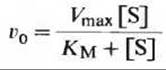
relates The rate of an enzymatic reaction to the substrate concentration and Vmax through the constant KM. This equation also applies to two-substrate reactions proceeding via a single-displacement or double-displacement mechanism (the "ping-pong" mechanism). Each enzyme has an optimum pH, i.e., a specific pH value at which its activity reaches its maximum level. All enzymes exhibit strict Specificity toward the substrates upon which they act. Enzymes can be inactivated through the irreversible modification of certain functional groups crucial for their catalytic activity. They can also undergo reversible inhibition via competitive or non-competitive mechanisms. Competitive Inhibitors, which usually structurally resemble the substrate, reversibly compete with it for binding to the Active Site, but unlike the substrate, they do not undergo any chemical transformations mediated by the enzyme. Non-competitive inhibitors bind not to the active site, but to another region of the enzyme molecule. They can attach to either the free enzyme or the enzyme-substrate complex, and their effect cannot be overcome by increasing the substrate concentration. Enzymes accelerate chemical reactions by ensuring the proper orientation of the substrate molecule in close proximity to the catalytic center, providing proton-donor and proton-acceptor groups for catalysis, forming unstable covalent intermediates with the substrate, and inducing strain or distortion in the substrate molecule.
In addition to catalytic activity, some enzymes also possess regulatory activity. They act as "conductors" that set the pace of metabolic processes. Certain regulatory enzymes, known as allosteric enzymes, control reaction rates through the reversible, non-covalent binding of specific modulators, or effectors, to a regulatory or allosteric site on the enzyme. Such modulators may be either the substrates themselves or intermediate metabolic products. Another class includes regulatory enzymes capable of altering their activity through the Covalent Modification of specific functional groups required for enzyme activity. Some enzymes exist in multiple forms, termed Isoenzymes, which differ in their kinetic characteristics. Many human genetic diseases stem from impaired functioning of one or more enzymes resulting from Mutations.
Books
Barman T. Enzyme Handbook, vol. 1, Springer-Verlag, New York, 1969. A useful summary of data on the main METABOLISM/8.html">Properties of Enzymes known at the time, classified according to international rules.
Enzyme Nomenclature, Academic, New York, 1979. Recommendations of the International Commission on Enzymes.
Fersht A. Enzyme Structure and Mechanism, Freeman, San Francisco, 1977. A clearly written, concise Introduction to this field of science.
Friedmann H., Herbert (ed.). Benchmark Papers in Biochemistry, vol. 1, Enzymes, Hutchinson Ross, Stroudsburg, Pa., 1981. A collection of classic papers on enzyme chemistry with editorial commentary. An exceptionally interesting book.
Newsholme E. A., Start C. Regulation in Metabolism, Wiley, New York, 1973. Chapters 1 and 2 examine The properties of regulatory enzymes.
Segel I. H. Enzyme Kinetics: Behavior and Analysis of Rapid Equilibrium and Steady State Enzyme Systems, Wiley, New York, 1975. For more advanced readers.
Articles
Anderson C. M., Zucker F. H., Steitz T. A. Space-Filling Models of Kinase Clefts and Conformational Changes, Science, 204, 375-380 (1979). The structure of hexokinase and other ATP-utilizing enzymes.
Dische Z. The Discovery of Feedback Inhibition, Trends Biochem. Sci., 1, 269 (1976).
Enzymes: One Hundred Years, FEBS Lett. Suppl., vol. 62 (1976).
Koshland D. E., Jr., Neet K. E. The Catalytic and Regulatory Properties of Enzymes, Annu. Rev. Biochem., 37, 359-410 (1968). A series of engaging articles presented on the occasion of the 100th anniversary of the coinage of the word "enzyme".
Monod J., Changeux J.-P., Jacob F. Allosteric Proteins and Cellular Control Systems, J. Mol. Biol., 6, 306-329 (1963). A classic paper that first put forward THE CONCEPT OF Allosteric Regulation.
Mosbach K. Enzymes Bound to Artificial Matrixes, Sci. Am., 224, 26-33, March (1971). Matrix-bound enzymes not only mimic the Action of Certain cellular enzymes but are also used as biocatalysts in industry and medicine.
Phillips D. C. The Three-Dimensional Structure of an Enzyme Molecule, Sci. Am., 215, 78-90, November (1966) (offprint 1055). An outstanding article dedicated to the three-dimensional structure and Catalytic Mechanism of Lysozyme.
Schmidt E., Schmidt F. W. Clinical Enzymology, FEBS Lett. Suppl., vol. 62 (1976). The Use of enzymes in disease Diagnosis.
Segal H. L. Enzymatic Interconversion of Active and Inactive Forms of Enzymes, Science, 180, 25-31 (1973).
1. Preserving the sweet flavor of corn. The sweet taste of kernels in freshly harvested ears of corn is due to their high sugar content. Corn sold a few days after harvest has a lower sugar content because about 50% of the free sugar in the kernels converts into starch within a single day of storage. To preserve the sweet taste of freshly picked corn, husked ears are immersed in boiling Water for a few minutes ("blanched") and then cooled in cold water. Corn processed in this manner and stored frozen retains its sweet flavor. What is the biological basis for this Treatment?
2. Intracellular concentration of enzymes. To estimate the actual concentration of enzymes in a bacterial Cell as a first approximation, assume it contains 1,000 different enzymes dissolved in the Cytosol. We can greatly simplify the problem by further assuming that the Molecular Weight of each is 100,000 and that all 1,000 enzymes are present at equal concentrations. Calculate the average molar concentration of enzymes in such a hypothetical cell based on the following conditions: in a bacterial cell (which is a cylinder 1 µm in diameter and 2 µm in height), the cytosol (specific gravity 1.20) contains 20% (by weight) soluble protein, and all of this soluble protein consists entirely of various enzymes.
3. Urease catalysis. The enzyme urease accelerates the rate of urea Hydrolysis by a factor of 1014 at pH 8.0 and 20 °C. If a given amount of urease can completely hydrolyze a given amount of urea in 5 min at pH 8.0 and 20 °C, how long would it take for the complete hydrolysis of urea under the same conditions in the absence of urease? Assume that both reactions take place under sterile conditions with no bacterial contamination.
4. Requirements met by enzyme active sites. The Active Site of an enzyme typically appears as a "pocket" on the enzyme surface, lined with amino acid side chains necessary for substrate binding and the catalysis of its chemical transformation. The carboxypeptidase molecule, which sequentially cleaves C-terminal amino acid residues from substrates (Peptides), consists of a single polypeptide chain (307 amino acid residues). The three main catalytic groups in the active site are Arginine 145, Tyrosine 248, and glutamic acid 270 (the numbers indicate the positions of the Amino Acids in the enzyme's Amino Acid Sequence).
a) If carboxypeptidase were an ideal α-Helix, at what distance (in nm) from each other would arginine 145 and tyrosine 248 be located; and arginine 145 and glutamic acid 270? (Hint: see Fig. 7-6).
b) Explain how these Three amino acids, situated so far apart in the polypeptide chain, can catalyze a reaction whose participants occupy a space on the order of a few tenths of a nanometer.
c) If only these three catalytic groups participate in the hydrolysis process, why does the enzyme need to have so many amino acid residues?
5. Quantitative determination of Lactate dehydrogenase. The Muscle enzyme lactate dehydrogenase catalyzes the reaction:
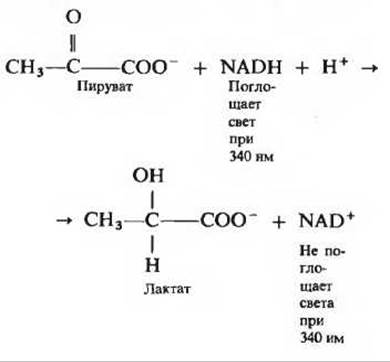
Unlike NAD+, the NADH solution absorbs light at 340 nm (in the near ultraviolet region of the spectrum). This property is used to determine the concentration of NADH in solution by measuring the absorbance of the solution at 340 nm using a spectrophotometer. Explain how these properties of NADH can be utilized for the quantitative determination of lactate dehydrogenase.
6. Estimation of Vmax and KM directly from reaction velocity data. Although graphical Methods are usually employed to accurately determine The values of Vmax and KM that characterize an enzymatic reaction (see, for example, Box 9-2), these values can be estimated by measuring reaction velocities at increasing substrate concentrations. Based on the Definitions of Vmax and KM, estimate the approximate values of these parameters for the enzymatic reaction using the following data 7
|
[S], M |
v, μmol/L·min |
|
2.5·10-6 |
28 |
|
4.0·10-6 |
40 |
|
1·10-5 |
70 |
|
2·10-5 |
95 |
|
4·10-5 |
112 |
|
1·10-4 |
128 |
|
2·10-3 |
139 |
|
1·10-2 |
140 |
7. Physical meaning of Vmax. In a laboratory, two students independently isolated the enzyme lactate dehydrogenase (from chicken Heart), which catalyzes the reduction of Pyruvate to lactate. The enzyme was obtained as a concentrated solution. Both students then measured the enzymatic activity of their solutions under identical conditions at various substrate concentrations, thereby determining Vmax and KM for their preparations. Comparing their results, they noticed that their KM values matched, whereas their Vmax values differed significantly. One student argued that the differing Vmax values indicated they had obtained different isoforms of the same enzyme. The other student argued that, despite the different Vmax values, they had isolated the exact same enzyme form. Who is correct? Explain how this discrepancy can be resolved.
8. Relationship between reaction velocity and substrate concentration: the Michaelis-Menten equation.
a) At what substrate concentration will an enzyme operate at a velocity equal to 1/4 of its maximum, given that its maximum substrate turnover velocity is 30 μmol/min·mg and its KM value is 0.005 M?
b) Determine what fraction of Vmax the reaction velocity will be at substrate concentrations equal to 1/2 KM, 2KM, and 10KM.
9. Graphical determination of Vmax and KM values. When determining the catalytic activity of a peptidase from the Small Intestine that hydrolyzes the dipeptide glycylglycine:
Glycylglycine + H2O → 2 Glycine,
the following experimental data were obtained:
|
[S], mM |
1.5 |
2.0 |
3.0 |
4.0 |
8.00 16.0 |
|
Product, mg/min |
0.21 |
0.24 |
0.28 |
0.33 |
0.40 0.45 |
Using these data, graphically determine (see Box 9-2) the values of KM and Vmax for this enzyme preparation.
10. Turnover number of Carbonic anhydrase. Erythrocyte carbonic anhydrase, which has a molecular weight of 30,000, is one of the most active enzymes known today. It catalyzes the reversible Hydration reaction of CO2
H2O + CO2 ⇂ H2CO3,
which plays a vital role in The transport of CO2 from the Tissues to the Lungs. Calculate the turnover number of carbonic anhydrase if, under optimal conditions, 10 μg of pure carbonic anhydrase catalyzes the hydration of 0.30 g of CO2 in 1 min at 37 °C.
11. Irreversible Enzyme Inhibition. Many enzymes are irreversibly inhibited by heavy Metal Ions such as Mg2+, Cu2+, or Ag+, which can react with sulfhydryl groups essential for enzyme activity to form mercaptides:
E—SH + Ag+ → E—S—Ag + H+.
The affinity of Ag+ ions for sulfhydryl groups is so high that these ions can be used for the quantitative titration of —SH groups. An amount of AgNO3 sufficient to completely inactivate the enzyme was added to 10 mL of a solution containing 1 mg/mL of pure enzyme. This required 0.342 μmol of AgNO3. Calculate the minimum molecular weight of the enzyme. Why is the molecular weight value obtained in this manner considered a minimum?
12. Protection of an enzyme from thermal Denaturation. When an enzyme solution is heated, it gradually loses its catalytic activity over time. This is due to the unfolding of the native enzyme molecule, which, as its thermal energy increases, adopts a random coil conformation. When a hexokinase solution is incubated for 12 min at 45 ˚С, the enzyme loses 50% of its activity; however, if hexokinase is incubated at 45 ˚С in the presence of a very high concentration of one of its substrates, glucose, it loses only 3% of its activity. Explain why the thermal denaturation of hexokinase slows down in the presence of one of its substrates.
13. Clinical application of differentiated enzyme inhibition. Human Blood serum contains enzymes known as acid Phosphatases, which hydrolyze biological phosphoesters in a weakly acidic environment (pH 5.0):
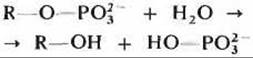
Acid phosphatases are synthesized in erythrocytes, Liver, Kidneys, Spleen, and the Prostate Gland. From a medical standpoint, the prostate enzyme is of critical importance because an elevated concentration of it in the blood often indicates prostate Cancer. Prostatic phosphatase is strongly inhibited by tartrate ions, whereas acid phosphatases from other tissues are not inhibited by these ions. How can these data be used to develop a method for the specific determination of prostatic acid phosphatase activity in human blood serum?
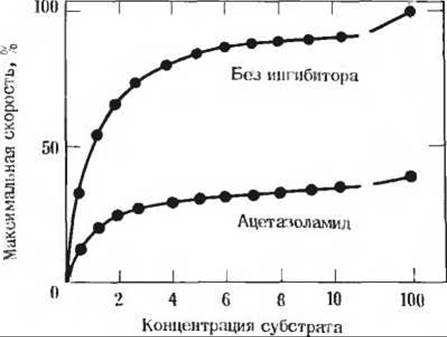
14. Inhibition of carbonic anhydrase by acetazolamide. Carbonic anhydrase is strongly inhibited by acetazolamide, which is used as a diuretic and as a therapeutic agent for glaucoma, a condition characterized by a pathological increase in intraocular pressure. In these and other secretory processes, carbonic anhydrase plays a crucial role by participating in The regulation of pH and bicarbonate content in many human Body Fluids. The figure shows an experimental curve representing the dependence of the reaction rate catalyzed by carbonic anhydrase on substrate concentration. When the experiment is conducted in the presence of acetazolamide, the lower curve is obtained. Based on an Analysis of the curves and your knowledge of the kinetic properties of competitive and noncompetitive Enzyme Inhibitors, determine the type of inhibition caused by acetazolamide. Explain the reasoning behind your Conclusion.
15. Treatment for methanol poisoning. Methanol (wood alcohol), once commonly used as an automotive antifreeze, is extremely toxic; the ingestion of as little as 30 mL of methanol can be fatal. This unusually high toxicity is caused not so much by methanol itself, but by its metabolite, formaldehyde. Methanol is rapidly oxidized to formaldehyde by the liver enzyme Alcohol dehydrogenase:
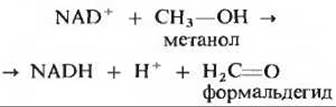
One of the treatment approaches for methanol poisoning involves administering ethanol (ethyl alcohol) to the patient, either orally or intravenously, in quantities that would cause intoxication in a healthy person. Explain why this treatment is effective.
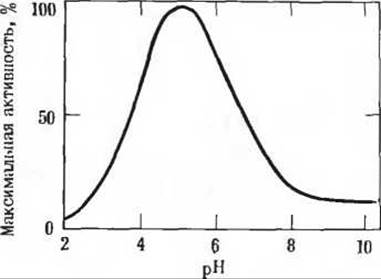
16. pH optimum of lysozyme. The enzymatic activity of lysozyme is maximal at pH 5.2 and decreases at both lower and higher pH values (see figure). Lysozyme contains two amino acid residues in its active site that are essential for catalysis: glutamic acid at position 35 and aspartic acid at position 52. The pK' values for the carboxyl groups of the side chains of these two residues are 5.9 and 4.5, respectively. In what ionization state (protonated or deprotonated) is each of these amino acid residues at the pH optimum of lysozyme? How can the shape of the pH-activity curve shown in the figure be explained based on the ionization states of these two residues?
Problem 16
Last update: 06/08/2026
Editorial and Educational Adaptation: This material has been compiled based on the primary/original source text. The project team performed an editorial review, corrected technical inaccuracies, structured sections, and adapted the content for an educational format.
What was processed:
- elimination of formatting defects (OCR errors, structural breaks, corrupted characters);
- editorial organization of content;
- standardization of terminology in accordance with academic sources;
- verification of factual statements against the original source text.
All mentions of the author, publication year, and origin of the primary text have been preserved in accordance with the source.