Fundamentals of Biochemistry - Filippovich, Y. B. 1999
Enzymes
Enzyme Nomenclature
For a very long time, enzymology lacked a strictly scientific nomenclature for Enzymes. Enzyme names were assigned based on random features (trivial nomenclature), the substrate name (rational nomenclature), The chemical composition of the enzyme, and finally, the type of catalyzed reaction and The Nature of the substrate.
Examples of trivial nomenclature include names of such enzymes as Pepsin (from the Greek pepsis — Digestion), Trypsin (from the Greek trypaô — to liquefy), and Papain (derived from the name of the melon tree Carica papaya, from whose juice it is isolated). Functionally, all these enzymes are proteolytic, meaning they accelerate the Hydrolysis of Proteins. A descriptive name was given to a group of colored intracellular enzymes that accelerate oxidation-reduction reactions in The Cell — Cytochromes (from the Greek citos — cell and chroma — color).
Rational nomenclature became the most widespread. According to this system, an enzyme's name is formed by combining the name of the substrate with the characteristic suffix "-ase". It was proposed more than a century ago, in 1883, by E. Duclaux, a student of L. Pasteur. Thus, the enzyme accelerating the Hydrolysis of Starch was named amylase (from the Greek amylon — starch), that of fats — lipase (from the Greek lipos — fat), of proteins — protease, of urea — urease (from the Greek urea — urea), and so on.
When analytical chemistry Methods achieved considerable success in deciphering the Chemical Nature of prosthetic groups, a new enzyme nomenclature emerged. Enzymes began to be named after their prosthetic group; for example, heme enzymes (prosthetic group: heme), pyridoxal enzymes (prosthetic group: pyridoxal), and the like.
Subsequently, enzyme names began to indicate both the Nature of the substrate and the type of catalyzed reaction. For instance, the enzyme that removes hydrogen from a succinic acid molecule is called succinate dehydrogenase, thereby emphasizing both the chemical nature of the substrate and the removal of hydrogen atoms during the enzymatic process:
Class="center">
In 1961, the International Commission on Enzyme Nomenclature presented a nomenclature project built on strictly scientific principles to the V International Congress of Biochemistry1. The project was approved by the congress, and the new nomenclature firmly established itself in enzymology. According to this (Moscow) nomenclature, an enzyme's name is composed of the chemical name of the substrate and the name of the reaction carried out by the enzyme. If the chemical reaction accelerated by the enzyme involves The transfer of a group of atoms from a substrate to an acceptor, the enzyme's name also includes the chemical name of the acceptor.
For example, a pyridoxal enzyme that catalyzes the Transamination reaction between L-Alanine and a-ketoglutaric acid is named L-alanine: 2-oxoglutarate aminotransferase:
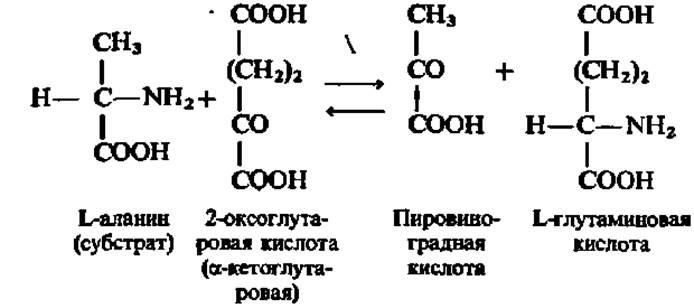
This name highlights three features simultaneously: 1) the substrate is L-alanine; 2) the acceptor is 2-oxoglutaric acid; 3) the amino group is transferred from the substrate to the acceptor.
Enzyme names based on scientific nomenclature gain immensely in accuracy, but in many cases become much more complex than older, trivial ones. Thus, urease (the trivial name), which accelerates the hydrolysis of urea into carbon dioxide (IV) and ammonia, is designated in scientific nomenclature as carbamide amidohydrolase:
H2N—СО—NH2+ Н2О—2NH3 + СО2
This name provides the exact chemical designation of the substrate and indicates that the enzyme catalyzes the hydrolysis of the amide group. Trehalase, which accelerates the hydrolysis of trehalose, is called trehalose 1-glucohydrolase.
Due to the considerable complexity of scientific names in the new nomenclature, it is permitted to retain old trivial (working) enzyme names alongside the new ones. The International Commission compiled a detailed list of all enzymes known at the time, which was significantly expanded in 1972 during a revision of both the Classification and Nomenclature of certain enzymes. In this list, each enzyme's new scientific name is accompanied by its old name, the Chemistry of the catalyzed reaction, and, in some cases, the nature of the enzyme. This eliminates any possibility of confusion in enzyme naming. In 1964, the list included 874 enzymes; subsequently, it was substantially expanded to 1,770 enzymes in 1972 and 2,003 enzymes in 1979.
1 The Congress took place in Moscow on August 10–16, 1961.
Each enzyme in the specified list is assigned an individual number (code). For example, the code for urease is expressed as 3.5.1.5. This means that urease belongs to the 3rd class (first digit) of enzymes, all representatives of which catalyze hydrolysis reactions. The second digit (5) indicates that urease belongs to the 5th subclass of this class, which includes all enzymes that accelerate the hydrolysis of non-peptide C—N bonds. The third digit of the code (1) indicates that urease belongs to the sub-subclass of the 5th subclass, members of which accelerate the hydrolysis of linear amides, and the final digit (5) is the ordinal number of urease within that sub-subclass.
The previously mentioned Lactate dehydrogenase has the code 1.1.1.27, meaning it belongs to the 1st class of enzymes (oxidoreductases), the 1st subclass (oxidoreductases acting on CH—OH groups as hydrogen atom Donors), the 1st sub-subclass (nicotinamide adenine dinucleotide serves as the hydrogen atom acceptor — see more on this below in this chapter), and occupies the 27th position in the List of enzymes of the aforementioned sub-subclass. Thus, the code precisely indicates the enzyme's position in the general list. Currently, scientific publications customarily include the enzyme's code in parentheses upon its first mention.
In our subsequent Structure/133.html">Discussion of classification and individual representatives of enzymes, we will use both scientific (systematic) and trivial (working) names.
Last update: 06/08/2026
Editorial and Educational Adaptation: This material has been compiled based on the primary/original source text. The project team performed an editorial review, corrected technical inaccuracies, structured sections, and adapted the content for an educational format.
What was processed:
- elimination of formatting defects (OCR errors, structural breaks, corrupted characters);
- editorial organization of content;
- standardization of terminology in accordance with academic sources;
- verification of factual statements against the original source text.
All mentions of the author, publication year, and origin of the primary text have been preserved in accordance with the source.