Principles of Biochemistry, Volume 2 - A. Lehninger 1985
Bioenergetics and Metabolism
Glycolysis: The Central Pathway of Glucose Catabolism
Pathways leading from glycogen and other carbohydrates to the central glycolytic pathway
Not only D-glucose, but many other CARBOHYDRATES as well are channeled into Glycolysis after a series of transformations, releasing the energy stored within them. Among these carbohydrates, the principal roles are played by Storage Polysaccharides, such as Glycogen and starch; Disaccharides, such as maltose, lactose, and sucrose; and Monosaccharides, such as fructose, mannose, and galactose. The pathways by which these various carbohydrates enter glycolysis are illustrated in Fig. 15-8.
The D-glucose units of glycogen and starch side chains enter glycolysis through the sequential action of two Enzymes: Glycogen phosphorylase (or starch phosphorylase in plants) and phosphoglucomutase. Glycogen phosphorylase, which is widely distributed in animal Cells, catalyzes the overall reaction shown below, where (Glucose)$_n$ represents a glycogen (or starch) side chain consisting of $n$ D-glucose units joined by a(1→4) linkages, and (Glucose)$_{n-1}$ represents the same side chain shortened by a single glucose residue cleaved from its end (for The Structure of glycogen and starch, see Fig. 11-15):
Class="center">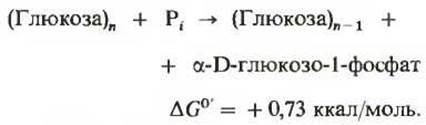

Fig. 15-8. Entry of glycogen and various hexoses into the initial stage of glycolysis.
Under intracellular conditions, given a relatively high concentration of phosphate, the glycogen phosphorylase reaction proceeds exclusively in the direction of glycogen breakdown and glucose-1-phosphate formation. In this reaction, the terminal a(1→4)-glycosidic bond at the nonreducing end of a glycogen side chain undergoes phosphorolysis: mediated by phosphate, the terminal glucose residue is cleaved from the chain to yield a-D-glucose-1-phosphate. As a result of this reaction, the glycogen side chain becomes shorter by one glucose unit (Fig. 15-9). Glycogen phosphorylase attacks the nonreducing ends of glycogen side chains repeatedly until it reaches a point four glucose units away from an a(1→6) linkage (Fig. 11-15). At this point, its action stops.
For glycogen degradation by glycogen phosphorylase to continue, the polysaccharide must first be acted upon by another enzyme, a(1→6)-glucosidase. This enzyme catalyzes two reactions. In the first reaction, it cleaves three of the aforementioned four glucose residues from the chain and transfers them to the end of another outer side chain. In the second reaction, catalyzed by a(1→6)-glucosidase, the fourth glucose residue, attached at the branch point by an a(1→6) linkage, is removed. Hydrolysis of the a(1→6) linkage at the branch point yields a molecule of D-glucose and exposes a new segment of the chain, consisting of glucose residues joined by a(1→4) linkages, to the action of glycogen phosphorylase.

Fig. 15-9. Removal of the terminal glucose residue at the nonreducing end of a glycogen chain by glycogen phosphorylase. This process is repeated many times, cleaving glucose residues one by one until the terminal residue is the fourth one from the branch point (see text). Note the simplified representation of the hydroxyl groups of glucose residues; hydrogen atoms attached to the pyranose rings are omitted.
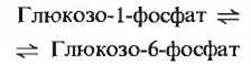
Glucose-1-phosphate, the end product of the reaction catalyzed by glycogen phosphorylase (or starch phosphorylase), is converted to glucose-6-phosphate by the enzyme phosphoglucomutase. This enzyme (which has been isolated in pure form from numerous sources) catalyzes the reversible reaction:
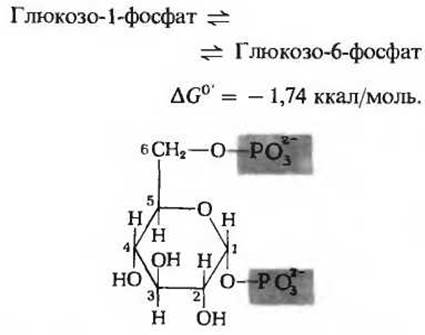
Fig. 15-10. a-D-glucose-1,6-diphosphate, one of the Cofactors required for phosphoglucomutase activity.
Glucose-1,6-diphosphate is required as a cofactor for the action of phosphoglucomutase (Fig. 15-10). The Role of this cofactor becomes apparent when considering the intermediate steps of the enzymatic mechanism. As seen in the reaction sequence below, the enzyme alternates between two forms—phosphorylated and unphosphorylated (or dephosphorylated):
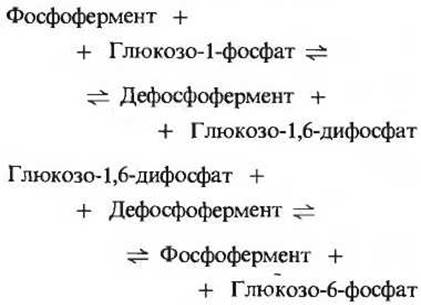
Overall equation:
Phosphoglucomutase is also remarkable in another respect: it belongs to a large class of enzymes characterized by the presence of a Serine residue in their Active Site, which is essential for catalytic activity. It is this specific serine residue that participates in the interaction with glucose-1,6-diphosphate, as its hydroxyl group becomes esterified with phosphoric acid. Serine-class enzymes (Fig. 9-12), to which phosphoglucomutase belongs, are irreversibly inhibited by certain organic phosphates, such as diisopropyl fluorophosphate. In this process, the inhibitors interact with the hydroxyl group of the aforementioned serine residue, forming a phosphorylated enzyme derivative devoid of catalytic activity (Fig. 9-10).
Last update: 06/08/2026
Editorial and Educational Adaptation: This material has been compiled based on the primary/original source text. The project team performed an editorial review, corrected technical inaccuracies, structured sections, and adapted the content for an educational format.
What was processed:
- elimination of formatting defects (OCR errors, structural breaks, corrupted characters);
- editorial organization of content;
- standardization of terminology in accordance with academic sources;
- verification of factual statements against the original source text.
All mentions of the author, publication year, and origin of the primary text have been preserved in accordance with the source.