Biological Membranes - A. N. Ogurtsov 2012
Structure and Functions of Biomembranes
Passive Transmembrane Transport
Diffusion of Water Molecules Across the Membrane
The phospholipid phase of the membrane readily dissolves non-polar substances, such as organic Fatty acids and esters, which easily permeate through the lipid phase. Conversely, polar and Water-soluble substances—such as salts, bases, sugars, Amino Acids, and alcohols—penetrate Cell/29.html">The Lipid Bilayer with great difficulty.
Against this backdrop, the anomalously high value of the lipid membrane permeability coefficient for water appears puzzling. Recently, the permeation of small polar molecules through lipid bilayer membranes has been attributed to The formation of small free cavities—kinks (from the English "kink")—between the fatty acid tails of phospholipid molecules during their thermal motion. These kinks are formed by a gauche-trans-gauche conformation of the lipid molecules (Figure 50).
Class="center">
Figure 50 - Schematic representation of hydrocarbon chains in a biomembrane: a - in the fully trans conformation; b - in the gauche-trans-gauche conformation; c - in the cis-trans-gauche conformation. Kink blocks in the hydrocarbon chains of membranes: d - within a single hemilayer; e - across both layers of the lipid bilayer
Gauche Conformations (gauche(+) and gauche(-), involving a rotation of ±120° relative to the trans conformation) have energies that are only slightly higher than that of the trans conformation (by 2-3 kJ/mol), but these states are separated by an energy barrier of 12-17 kJ/mol. While hydrocarbon chains in the fully trans conformation form linear structures, the appearance of a single gauche conformation in the chain bends its spatial configuration by an angle of -120°.
In densely packed membrane systems where hydrocarbon chains maintain a fully trans conformation, this bending generates severe Steric hindrances that prevent the appearance of isolated gauche conformations.
Steric hindrances during the melting of hydrocarbon chains in membranes are mitigated by the simultaneous appearance of two gauche conformations in the chain (gauche(+) and gauche(-)) separated by a C-C bond in the trans conformation.
Although the energy of such a state is twice as high as that of a single gauche conformation, the resulting rotational state of the chain does not cause substantial lattice expansion. This is because successive chain rotations of +120° and -120° allow the overall spatial configuration of the chain to remain rectilinear (Figure 50). The segment of the chain residing in the gauche(+)-trans-gauche(-) conformation forms a step or loop in the hydrocarbon chain, known as a kink.
The formation of a kink is accompanied by a decrease in the effective chain length by ~0.127 nm. Concurrently, a portion of the chain is displaced by ~0.15 nm to create free volume, and the total volume occupied by the lipid molecule increases by 0.025-0.050 nm3 (Figure 50).
Although the appearance of a single kink in a hydrocarbon chain is insufficient to melt it, isolated kinks facilitate the formation of kinks in adjacent hydrocarbon chains, thereby generating alternating kink blocks (Figure 50(d)). Such blocks can form either within a single membrane hemilayer or across two oppositely positioned hydrocarbon chains. As the number of kinks in the hydrocarbon chains increases, the disorder of the membrane hydrocarbon region rises sharply.
Driven by the thermal motion of the tails, kinks can migrate across the membrane and transport trapped small molecules, primarily water molecules. Double (cis) bonds in unsaturated fatty acid chains (Figure 50(b)) of membranes can act as initiators for kink formation in adjacent saturated chains. In this case, forming a kink in the unsaturated chain requires the appearance of only a single gauche conformation along with an 80° bend in the chain.
This eliminates the steric hindrances that arise when accommodating an unsaturated chain within the hydrocarbon zone of saturated lipid membranes, which aligns well with the experimentally observed sharp decrease in the phase transition Temperature TPT of saturated lipid membranes upon The addition of small amounts of unsaturated fatty acid chains.
Thus, the low viscosity of the membrane hydrocarbon region in the liquid-crystalline state (at T > TPT) is attributed to:
1) an increase in the amplitude of torsional oscillations around C-C bonds;
2) the appearance of gauche conformations (kinks);
3) their rapid isomerization into neighboring positions.
To evaluate the efficiency of these processes, let us compare the frequency of torsional oscillations around C-C bonds, which is 8-1012 s-1, with the frequency of gauche conformation generation at room temperature.
Assuming that the energy barrier separating the trans and gauche conformations is 12 kJ/mol, we find
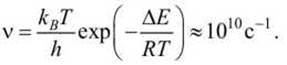
It follows that at room temperatures, gauche conformations arise at a high frequency As a result of torsional oscillations.
Under conditions of high fluidity within the hydrophobic region of membranes, a kink can isomerize and shift along the hydrocarbon chain through the synchronous Rotation of the corresponding sequence of C-C bonds by 120°. When moving to an adjacent position, the kink travels by ~13 nm. Such propagation of a kink along the hydrocarbon chain can be viewed as a form of one-dimensional diffusion, which is characterized by the diffusion coefficient DK = 0.5vK(∆L)2, where vK is the kink jump frequency and ∆L is the step size of a single jump. Assuming that the kink jump frequency is on the same order of magnitude as the frequency of gauche conformation formation, we find DK ≈ 10-5 cm2/s.
The obtained value is practically identical to the known permeability coefficients of lipid membranes for oxygen, water, and small non-electrolyte molecules. This coincidence, along with the geometric correspondence between the sizes of such molecules and the free volume generated by kink formation, suggests that Transmembrane Transport of small molecules occurs within the free volume created by the kink.
Last update: 13/08/2026
Editorial and Educational Adaptation: This material has been compiled based on the primary/original source text. The project team performed an editorial review, corrected technical inaccuracies, structured sections, and adapted the content for an educational format.
What was processed:
- elimination of formatting defects (OCR errors, structural breaks, corrupted characters);
- editorial organization of content;
- standardization of terminology in accordance with academic sources;
- verification of factual statements against the original source text.
All mentions of the author, publication year, and origin of the primary text have been preserved in accordance with the source.