Biological Membranes - A. N. Ogurtsov 2012
Structure and Functions of Biomembranes
Passive Transmembrane Transport
Passive Diffusion Across the Membrane
Diffusion is the spontaneous movement of a substance from regions of higher concentration to regions of lower concentration As a result of the random thermal motion of molecules.
The diffusion of a substance across Cell/29.html">The Lipid Bilayer (Figure 47(a)) is driven by the concentration gradient within the membrane. According to Fick's law
Class="center">
where cM1 is the concentration of the substance within the membrane near one of its surfaces, and cM2 is that near the opposite surface; I is the membrane thickness. Assuming that the concentration gradient is approximately equal to

Since measuring the concentrations cM1 and cM2 is difficult, practice relies on a formula that relates the substance flux density across the membrane to the concentrations of this substance not inside the membrane, but outside in the solutions near the membrane surfaces, c1 and c2 (Figure 48):
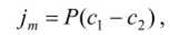
where P is the membrane permeability coefficient. The dimension of the permeability coefficient is m/s.
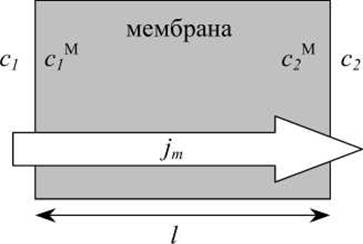
Figure 48 - Diagram of simple diffusion through a membrane lipid bilayer
The membrane permeability coefficient depends on The properties of the membrane and the transported substances. Assuming that the surface concentrations of the substance within the membrane are directly proportional to the surface concentrations outside the membrane, cM1 = kс1, cM2 = kс2, then
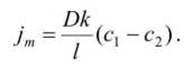
The value k is called the partition coefficient, which indicates The ratio of the substance concentration outside the membrane to that inside the membrane, i.e., how well the substance dissolves in the membrane. The permeability coefficient

is larger the greater the diffusion coefficient (the lower the membrane viscosity), the thinner the membrane, and the better the substance dissolves in the membrane (the larger k).
Atmospheric gases, such as O2 and CO2, and small uncharged molecules, such as urea and ethanol, easily pass through Artificial Membranes assembled from Phospholipids or a mixture of phospholipids and Cholesterol via passive (simple) diffusion (Figure 49).
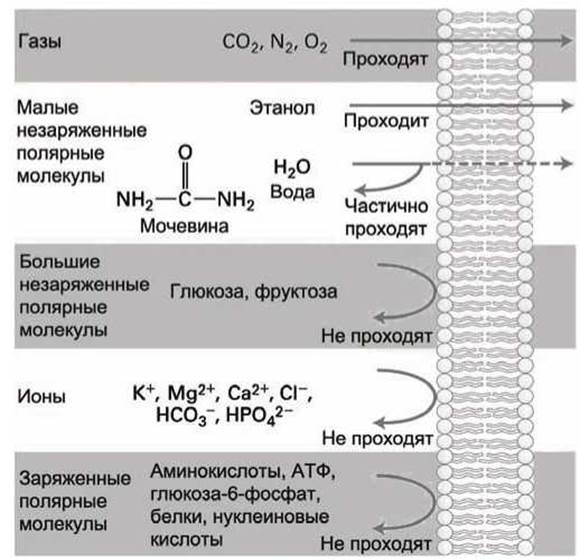
Figure 49 - Relative permeability of a phospholipid membrane to various molecules
Such molecules can also diffuse across cell membranes without the assistance of specialized transport Proteins. This type of transport does not require an external energy source, as its driving force is the concentration gradient across both sides of the membrane.
The relative rate of diffusion of any substance through the phospholipid bilayer is proportional to the concentration difference (gradient) of that substance across the membrane, and depends on the Structure/106.html">Hydrophobicity and size of the solute molecules. The diffusion of charged molecules is also affected by the electrical Membrane Potential.
Last update: 13/08/2026
Editorial and Educational Adaptation: This material has been compiled based on the primary/original source text. The project team performed an editorial review, corrected technical inaccuracies, structured sections, and adapted the content for an educational format.
What was processed:
- elimination of formatting defects (OCR errors, structural breaks, corrupted characters);
- editorial organization of content;
- standardization of terminology in accordance with academic sources;
- verification of factual statements against the original source text.
All mentions of the author, publication year, and origin of the primary text have been preserved in accordance with the source.