Plant Physiology - Musienko M. M. 2001
Physiology of Excretion in Plants
Mechanisms of Substance Excretion
The excretion of substances in plants can occur through various mechanisms, often against a concentration gradient and at the expense of ATP energy. A distinction is made between merocrine (meros — part, crino — I secrete), apocrine, and holocrine secretion.
Merocrine secretion is subdivided into:
monomolecular (eccrine) secretion, which is carried out via ion pumps across membranes;
granulocrine secretion, where substances enclosed in specific membrane packages (vesicles, membrane-bound secretory bubbles, etc.) are released into The Cell interior or specific cell compartments;
secretion directly from Endoplasmic reticulum cisternae onto The surface of the Plasmalemma.
Apocrine secretion occurs through the detachment of either a portion of the Cytoplasm along with the secretion, or, for instance, the heads of salt hairs in certain halophytes. This mechanism is also utilized during lipid secretion.
Holocrine secretion is characterized by the transformation of the entire cell into a secretion product, such as the release of mucilage by ROOT cap Cells.
At the individual cell level, secretory processes are driven by monomolecular and granulocrine secretion. Active Transport in plant cell membranes is mediated by proton H+-ATPases, Na+, K+, Ca2+-ATPases, and anion ATPases, among others. Ion pumps that facilitate monomolecular secretion can function in the plasmalemma, tonoplast, and other organelle membranes of the cell.
The cellular secretory process includes the uptake and accumulation of precursor products, the synthesis of Polysaccharides, Proteins, and terpenoids, their concentration in the form of a secretion, and finally the release of the secretion followed by the restoration of cellular structures. At THE CELLULAR LEVEL, secretion can also be performed by specialized secretory idioblasts.
A leading role in granulocrine secretion is played by the Golgi apparatus, within the dictyosomes of which the Components of the future secretion are concentrated. It is believed that compounds entering the dictyosomes from the granular endoplasmic reticulum, where they are synthesized, are first encapsulated in a membrane and subsequently transported in vesicular form to the plasmalemma. Upon fusion of the vesicles with the plasmalemma, their contents end up between The Plasma Membrane and The Cell wall, a process known as exocytosis. The vesicle membrane is integrated into the plasmalemma, ensuring its renewal and growth, while the secretion components enter the cell wall and become incorporated into its structures.
The necessity of Calcium Ions for this type of secretion has been established. It is hypothesized that calcium removes the electrostatic barrier that arises between the secretion-containing vesicle and the plasmalemma, and also induces changes in microtubules and microfilaments that direct the movement of vesicles toward the plasmalemma. This occurs through the interaction of calcium ions with the protein calmodulin, which contains four binding sites for calcium. The formation of the Ca-calmodulin complex causes the contraction of microfilaments and the assembly-disassembly of the Cytoskeleton microtubules, facilitating the movement of vesicles throughout the cell (T.S. Salamatova, 1991):
Class="center">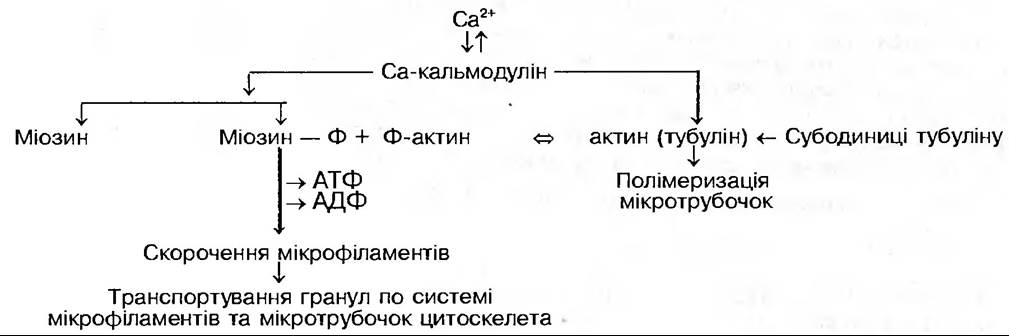
Calcium reduces the Hydration barrier during membrane fusion, lowers the negative charge of contacting membranes, forms calcium bridges between membranes, and ensures the Ca2+-dependent phosphorylation of Membrane Proteins involving calmodulin.
Granulocrine secretion occurs quite actively during the apical growth of root hairs and pollen tubes, as well as during the Formation of the phragmoplast of the primary cell wall in dividing cells. The Molecular Mechanism of vesicular secretion in plant cells requires further study. Current understanding of these mechanisms suggests their evolutionary relatedness to analogous processes in animal organisms.
Systems of Substance Excretion into the Vacuole
The vacuole is an internal compartment of The plant cell where various substances are exported during METABOLISM, some of which can be reutilized. The tonoplast, i.e., the membrane surrounding the vacuole, has a low electrical resistance (300–700 Ohm×cm2) and a low bioelectric potential (20–40 mV). The pH gradient between the vacuolar contents and the hyaloplasm (1–2 units), alongside a higher concentration of substances in the vacuole compared to the cytoplasm, indicates the existence of active transport of hydrogen ions from the cytoplasm across the tonoplast into the vacuole, as well as other substance transport systems. Indeed, the tonoplast harbors an ATP-dependent H+ pump that drives a maximal influx of H+ ions into the vacuole (approximately 15 nmol/cm2×second).
The vacuole-directed proton flux establishes an electrical gradient for The transport of organic acid anions into the vacuole as well. K+ ions can enter the vacuole in exchange for the passive efflux of hydrogen ions from it. The uptake of sugars occurs via cotransport coupled with the H+ flux. Tannins are synthesized within The endoplasmic reticulum system and enter the vacuole directly from its cisternae. Various compounds such as anthocyanins are converted into soluble glucosides prior to Vacuolar Transport and are transferred into the vacuole in this form.
In plants, Reserve Proteins (soluble albumins, a rather dense protein material incorporating phytate—the calcium-magnesium salt of Inositol phosphoric acid, globulins, etc.) are known to be deposited precisely within the vacuoles of the cell. Various mechanisms of reserve protein transport exist, including carrier-mediated pathways, vacuolar uptake via tonoplast invagination, direct release of proteins into the vacuole straight from the cisternae of the granular endoplasmic reticulum, and others (Salamatova, Zautralov, 1991).
Secretion of Lignin, Cutin, and Waxes
In modern higher plants, lignin incrusts the walls of protoxylem vessels, and later the Primary and secondary walls of the entire cell. The lignification process occurs throughout the entire Life Cycle of plant cells, proceeding particularly intensively after their growth ceases. It is believed that the polymerization of lignin takes place between Cellulose fibrils directly within the cell wall, although aromatic alcohols—the primary monomers of lignin—are synthesized in the cytoplasm, for instance, via the direct deamination of the aromatic amino acid phenylalanine. Lignin is considered a polymolecule in which monomers are linked by various types of bonds: ether, carbon-carbon, and biphenyl bonds. Monomers are supplied to the cell wall via diffusion (along a concentration gradient) or in membrane packages.
The epidermal cells of all plant Organs possess The ability to secrete the components of cutin, which form part of the cuticle. Cutin is a hydrophobic polymeric substance consisting of polyesterified long-chain fatty acid molecules (C16-C32) with a high number of substituent groups. Cutin precursors are presumably transported via granulocrine secretion or diffusion across the plasmalemma and cell wall to the surface of the epidermal cell, where they are transformed into cutin through oxidative polymerization. During this process, the cutin layer is penetrated by polysaccharide wall components (such as cellulose), thereby forming the cuticle.
The cuticle surface of many plants features a layer of an even more hydrophobic polymer—wax. Waxes are complex esters of Fatty acids and high-molecular-weight monohydric alcohols. Each type of wax is deposited in the form of precisely defined structures (numbering around 14,000 types)—ranging from an amorphous film to fibers and tubes of various Sizes and Shapes. It is believed that wax components are transported across the cell wall encased in an "envelope" of lipo- or Glycoproteins that possess external hydrophilic surfaces and can therefore be translocated within the hydrophilic cell wall.
Specialized Secretory Structures in PLANTS AND THEIR Functioning. The structures of the plant excretory system vary greatly both in their degree of specialization and in their localization within the plant Organism. First and foremost, we should note the differences in secretory structures regarding the relationship between the secretion and the protoplast of the secreting cell. The secreted substance may remain within the excretory cell or be secreted outward into other compartments. For instance, Essential Oils, balsams, and resins, although functioning as excretory substances, are quite frequently and persistently accumulated within the cell. They can be distributed throughout the cytoplasm as inclusions, or they may be secreted into intercellular spaces or onto the plant surface.
Secretory structures may be located externally, while others reside internally within certain plant organs. Some of them are structurally quite simple, taking the form of glandular hairs, others are multicellular glands with their own conducting system, and some appear as intercellular passages or cavities.
Last update: 07/08/2026
Editorial and Educational Adaptation: This material has been compiled based on the primary/original source text. The project team performed an editorial review, corrected technical inaccuracies, structured sections, and adapted the content for an educational format.
What was processed:
- elimination of formatting defects (OCR errors, structural breaks, corrupted characters);
- editorial organization of content;
- standardization of terminology in accordance with academic sources;
- verification of factual statements against the original source text.
All mentions of the author, publication year, and origin of the primary text have been preserved in accordance with the source.