Biological Chemistry - Berezov T. T., Korovkin B. F. 1998
Chemistry of Lipids
Phospholipids
Glycerophospholipids
Glycerophospholipids are derivatives of phosphatidic acid. They are composed of glycerol, Fatty acids, phosphoric acid, and typically nitrogenous compounds. The general formula of glycerophospholipids is as follows:
Class="center">
In these formulas, R1 and R2 are higher fatty acid radicals, while R3 is typically a nitrogenous base radical. A defining characteristic of all glycerophospholipids is that one part of their molecules (the R1 and R2 radicals) exhibits pronounced hydrophobic properties, whereas the other part is hydrophilic due to the negative charge of the phosphoric acid and the positive charge of the R3 radical.
Among all Lipids, glycerophospholipids possess the most pronounced polar properties. When placed in Water, only a small fraction of glycerophospholipids dissolves into a true solution, while the bulk of the lipids forms micelles. There are several groups (subclasses) of glycerophospholipids. Depending on The Nature of the nitrogenous base attached to the phosphoric acid, glycerophospholipids are classified into phosphatidylcholines (lecithins), phosphatidylethanolamines (cephalins), and phosphatidylserines. Some glycerophospholipids contain a nitrogen-free six-carbon cyclic alcohol called Inositol (or myo-inositol) instead of nitrogenous compounds. These lipids are known as phosphatidylinositols.
Phosphatidylcholines (lecithins). Unlike triglycerides, in a phosphatidylcholine molecule one of the three hydroxyl groups of glycerol is esterified not with a fatty acid, but with phosphoric acid. Furthermore, the phosphoric acid is linked via an ester bond to the nitrogenous base Choline [HO—CH2—CH2—N+(CH3)3]. Thus, a phosphatidylcholine molecule brings together glycerol, Higher Fatty Acids, phosphoric acid, and choline:

Phosphatidylethanolamines. The primary difference between phosphatidylcholines and phosphatidylethanolamines is the presence of the nitrogenous base ethanolamine (HO—CH2—CH2—N+H3) in the latter:

Among glycerophospholipids, phosphatidylcholines and phosphatidylethanolamines are the most abundant in the bodies of animals and higher plants. These two groups of glycerophospholipids are metabolically linked and serve as the major Lipid Components of Cell membranes.
Phosphatidylserines. In a phosphatidylserine molecule, the nitrogenous compound is The amino acid residue Serine 

Phosphatidylserines are far less widespread than phosphatidylcholines and phosphoethanolamines, and their physiological significance is primarily determined by their role in the synthesis of phosphatidylethanolamines.
Phosphatidylinositols. These lipids belong to the group of phosphatidic acid derivatives, yet they contain no nitrogen. The radical (R3) in this subclass of glycerophospholipids is the six-carbon cyclic alcohol inositol:

Phosphatidylinositols are widely distributed in nature, having been found in animals, plants, and microorganisms. In the animal body, they are present in the Brain, Liver, and Lungs.
Plasmalogens. Plasmalogens differ from the glycerolipids discussed above in that, instead of one higher fatty acid residue, they contain an α,β-unsaturated alcohol residue linked via an ether bond (as opposed to the ester bond formed by a fatty acid residue) to the hydroxyl group of glycerol at the C-1 position:
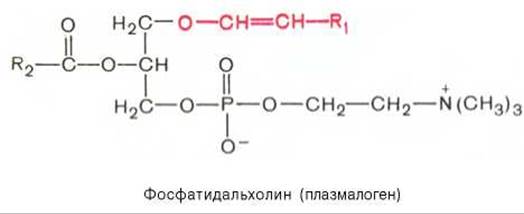
The principal subclasses of plasmalogens are phosphatidalcholines, phosphatidalethanolamines, and phosphatidalserines. In dilute acids, plasmalogens undergo Hydrolysis to yield the aldehyde of the corresponding α,β-unsaturated alcohol; thus, acid hydrolysis of plasmalogens produces "fatty" aldehydes known as plasmals, which gave rise to the term "plasmalogen."
Cardiolipin. A unique representative of glycerophospholipids is cardiolipin, which was first isolated from Heart Muscle. Chemically, cardiolipin can be viewed as a compound in which two phosphatidic acid molecules are linked by a single glycerol molecule. Unlike other glycerophospholipids, cardiolipin is essentially a "double" glycerophospholipid. It is localized in The inner mitochondrial membrane. Its function remains unclear, although it is known that, unlike other Phospholipids, cardiolipin possesses immunological properties.

In this formula, R1, R2, R3, R4 are higher fatty acid radicals.
It should be noted that free phosphatidic acid does occur in nature, but in relatively small amounts compared to glycerophospholipids. The fatty acids incorporated into glycerophospholipids include both saturated and unsaturated species (most commonly stearic, palmitic, oleic, and linoleic acids).
It has also been established that most phosphatidylcholines and phosphatidylethanolamines contain one saturated higher fatty acid at the C-1 position and one unsaturated higher fatty acid at the C-2 position. Hydrolysis of phosphatidylcholines and phosphatidylethanolamines in the presence of specific Enzymes (such as phospholipase A2 found, for example, in cobra venom) leads to the Cleavage of the unsaturated Fatty acid and The formation of lysophospholipids—lysophosphatidylcholines or lysophosphatidylethanolamines—which exhibit potent hemolytic activity:

Last update: 06/08/2026
Editorial and Educational Adaptation: This material has been compiled based on the primary/original source text. The project team performed an editorial review, corrected technical inaccuracies, structured sections, and adapted the content for an educational format.
What was processed:
- elimination of formatting defects (OCR errors, structural breaks, corrupted characters);
- editorial organization of content;
- standardization of terminology in accordance with academic sources;
- verification of factual statements against the original source text.
All mentions of the author, publication year, and origin of the primary text have been preserved in accordance with the source.