Biological Chemistry - Berezov T. T., Korovkin B. F. 1998
Lipid Chemistry
Phospholipids
Sphingolipids (Sphingophospholipids)
Sphingomyelins. These are the most common Sphingolipids, found primarily in the membranes of animal and plant Cells, with Nervous Tissue being particularly rich in them. Sphingomyelins are also present in the Tissues of the Kidneys, Liver, and other Organs. Upon Hydrolysis, a sphingomyelin molecule yields one molecule of a fatty acid, one molecule of the dihydric unsaturated alcohol sphingosine, one molecule of a nitrogenous base (most commonly Choline), and one molecule of phosphoric acid. The general formula for sphingomyelins can be represented as follows:
Class="center">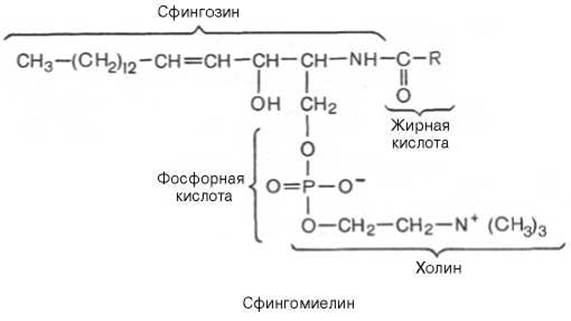
The overall structural layout of a sphingomyelin molecule bears a certain resemblance to that of Glycerophospholipids. A sphingomyelin molecule contains a polar "HEAD" carrying both a positive charge (the choline residue) and a negative charge (the phosphoric acid residue) simultaneously, along with two non-polar "tails" (the long aliphatic chain of sphingosine and the acyl radical of a fatty acid). In some sphingomyelins, such as those isolated from the Brain and Spleen, dihydrosphingosine (reduced sphingosine) is found in place of sphingosine:

Last update: 06/08/2026
Editorial and Educational Adaptation: This material has been compiled based on the primary/original source text. The project team performed an editorial review, corrected technical inaccuracies, structured sections, and adapted the content for an educational format.
What was processed:
- elimination of formatting defects (OCR errors, structural breaks, corrupted characters);
- editorial organization of content;
- standardization of terminology in accordance with academic sources;
- verification of factual statements against the original source text.
All mentions of the author, publication year, and origin of the primary text have been preserved in accordance with the source.