Fundamentals of Biochemistry - Filippovich, Y. B. 1999
Lipids and Their Metabolism
Complex Lipids
Phospholipids. Phospholipids are complex esters of polyhydric alcohols with Higher Fatty acids, containing phosphoric acid residues and attached additional groups (such as nitrogenous bases, Amino Acids, glycerol, Inositol, etc.).
Among the polyhydric alcohols found in the composition of various phospholipids, three are identified: glycerol, myo-inositol, and sphingosine:
Class="center">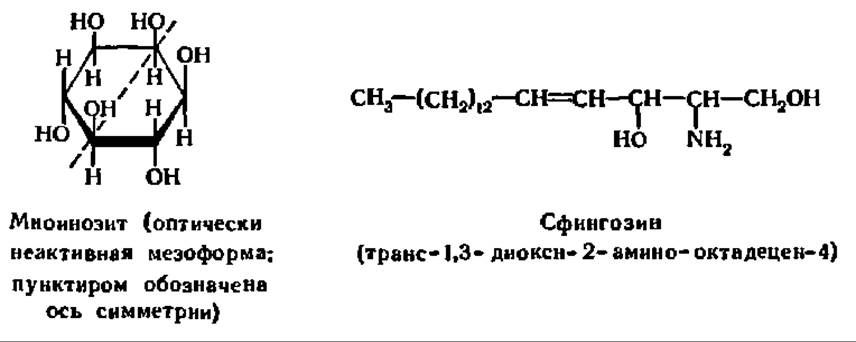
Accordingly, phospholipids are divided into three groups: Glycerophospholipids, inositol phospholipids, and sphingophospholipids. Glycerophospholipids are often referred to as phosphatides, as they can be considered derivatives of phosphatidic acid (see below), while inositol phospholipids are known as phosphoinositides.
The higher fatty acids present in phospholipid molecules include palmitic, stearic, linoleic, linolenic, and arachidonic acids, as well as lignoceric, nervonic, and others (see Table 25).
Depending on the type of phospholipid, its molecular Structure incorporates one or two higher fatty acid residues. Phosphoric acid, as a rule, is present in phospholipid molecules as a single molecule.
Only certain types of inositol phospholipids contain two or more phosphoric acid residues.
The nitrogen-containing components of phospholipids are diverse. The most common are ethanolamine, Choline, and Serine (see below). The Chemical Structure of phospholipids indicates that their molecules contain regions capable of interacting with solvent molecules in diametrically opposite ways.
The hydrocarbon radical of the higher fatty acid residue(s) forms the lyophobic part, whereas the ionizable phosphoric acid and nitrogenous base residues form the lyophilic part. Due to this feature, phospholipids presumably participate in maintaining the selective, unidirectional permeability of subcellular membranes.
Phospholipids are solid, fat-like substances; they are colorless but rapidly darken in air due to The oxidation of double bonds in their unsaturated fatty acid components. They dissolve readily in benzene, petroleum ether, chloroform, and the like. Solubility in alcohol, acetone, and diethyl ether varies among different phospholipid groups. They are insoluble in Water, but can form stable emulsions and, in some cases, colloidal solutions.
Phospholipids are found in both animal and plant organisms, being particularly abundant in the Nervous Tissue of humans and vertebrates. In invertebrates, the phospholipid content in The Nervous system is 2–3 times lower. Phospholipids are also prevalent in plant seeds, animal hearts and livers, bird eggs, etc. Microorganisms possess specific phospholipids of their own.
Phospholipids readily form complexes with Proteins and, in the form of phospholipoproteins, are present in all living Cells, playing a primary role in The formation of Cell walls and intracellular membranes.
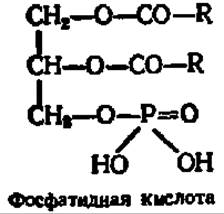
Glycerophospholipids, or phosphatides, are complex esters of glycerol, higher fatty acids, phosphoric acid, and a nitrogenous base. They are regarded as derivatives of phosphatidic acid, which gives this group of phospholipids its name:
Depending on The Nature of the nitrogenous base, phosphatides are subdivided into phosphatidylcholine (lecithins), phosphatidylethanolamine (cephalins), phosphatidylserine, and phosphatidylthreonine:
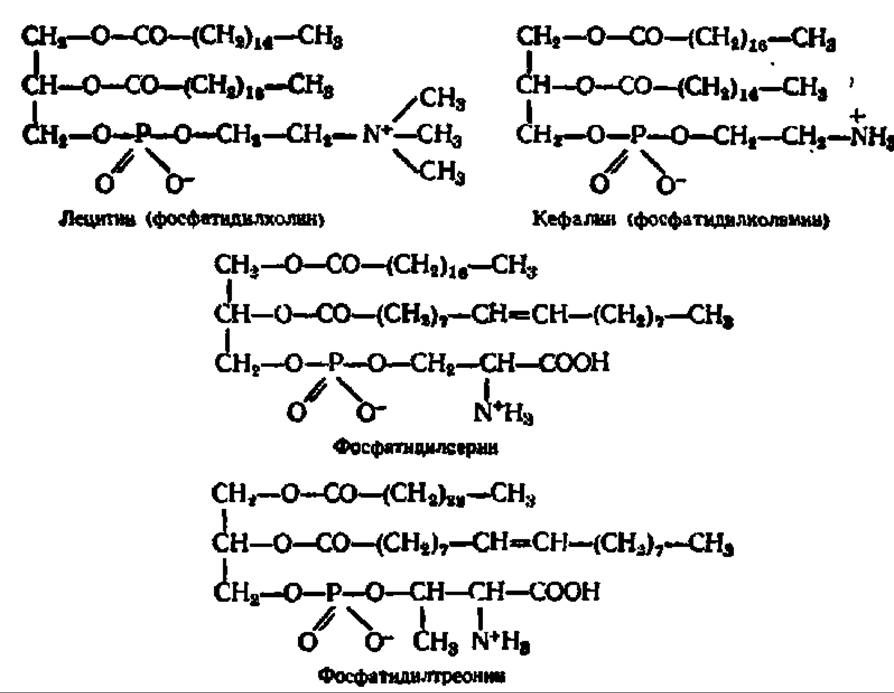
Among these, lecithins are the most widely distributed in nature. The presence of choline as the nitrogenous base in lecithins was first established by K. S. Dyakonov (1867).
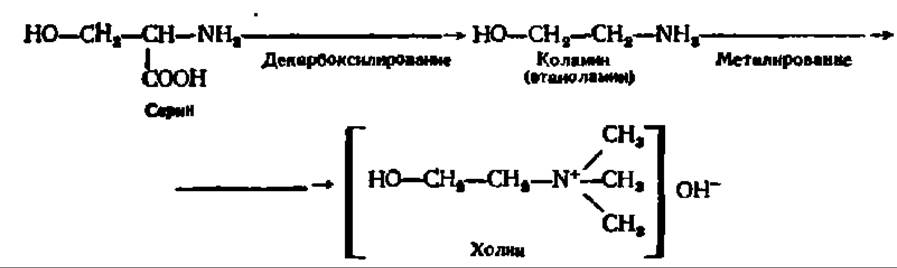
The first Three types of nitrogen-containing phosphatides presumably can interconvert, as they differ only in The structure of their nitrogenous bases, which allows for a genetic relationship such as the following:
Certain phosphatides discovered relatively recently do not contain a nitrogenous base; instead, their molecular positions are occupied by glycerol and its derivatives:
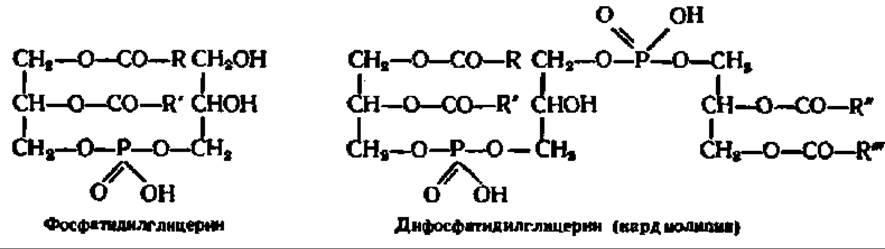
Phosphatidylglycerol is an essential constituent of METABOLISM/14.html">Chloroplasts and is present in small quantities in Bacterial cells and animal tissues. Cardiolipin is one of the essential
compounds found in mitochondrial membranes, particularly in Heart Muscle Mitochondria; it has been detected not only in animals, but also in plants and Bacteria. Both of these compounds can undergo aminoacylation at the glycerol residue to form aminoacylphosphatidyl- and aminoacyldiphosphatidylglycerols (also known as lipoamino acids), which provide a reservoir of amino acids for Protein Biosynthesis in chloroplasts, where they were discovered (M. I. Molchanov, 1964).
Possessing an asymmetric structure (the 2nd carbon atom of the glycerol residue is always asymmetric), phosphatides are optically active and form corresponding stereoisomers. Additionally, they exhibit isomerism due to the shifting of higher fatty acid residues from the α- to the β-position or vice versa.
Inositol phospholipids (phosphoinositides) represent a group of phospholipids whose structure has been elucidated over the past 10–15 years thanks to intensive chemical synthesis research conducted by research groups belonging to the schools of N. A. Preobrazhensky and L. D. Bergelson. The simplest monophosphoinositide has the following structure:
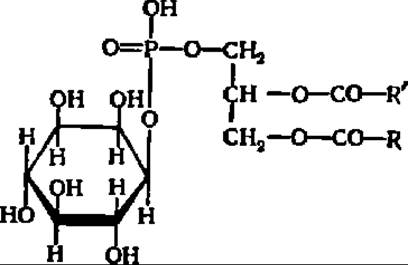
As can be seen, it resembles a phosphatide in which the nitrogenous base is replaced by an inositol residue.
When an inositol phospholipid molecule contains two or three phosphoric acid residues, all of them are linked to the inositol residue. Inositol phospholipids of this type have been isolated from the Brain and obtained synthetically. Their concentration is particularly high in the myelin sheaths of nerve fibers in the Spinal Cord. The turnover rate of phosphate groups in phosphoinositide diphosphates is much higher than that in other phospholipids. Due to the presence of dissociated phosphate groups, phosphoinositide diphosphates facilitate Ion transport across Introduction/36.html">Biological Membranes. They also serve as a source of secondary messengers released in response to hormonal and other signals (see pp. 456 and 474). Many phosphoinositides contain CARBOHYDRATES, amines, amino acids, and sphingosine.
Unlike the phosphatides and inositol phospholipids discussed above, sphingophospholipids contain a higher fatty acid residue attached to a dihydric amino alcohol (sphingosine) via a peptide bond:
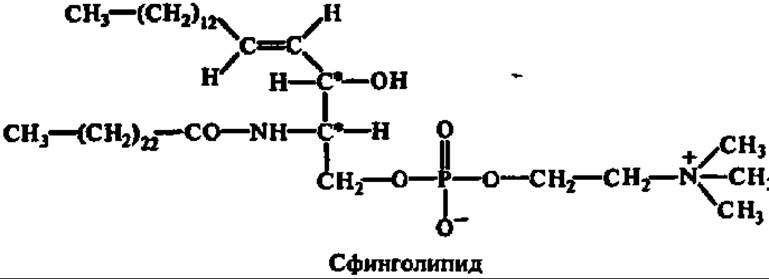
The Main Components of sphingophospholipids—phosphoric acid and choline—are attached in the same manner as in phosphatides. It is specifically in Sphingolipids that lignoceric and nervonic acids are found in significant amounts, which are less characteristic of other phospholipid groups.
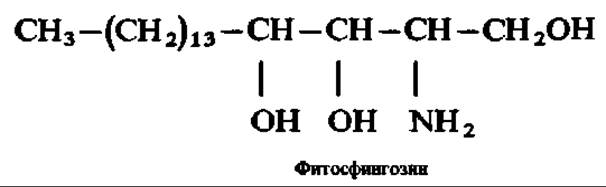
Representatives of this group of phospholipids appear to be more characteristic of the animal kingdom than of the plant kingdom. However, an amino alcohol very similar to sphingosine has been isolated from plant-derived phospholipids (corn grain):
This same alcohol has been found in Yeasts and Fungi, and recently in the human brain and Kidneys, indicating the potential existence of analogous phospholipids in both PLANT AND ANIMAL sources.
Sphingophospholipids are insoluble in diethyl ether, a property utilized in separating them from phosphatides. They are also characterized by poor solubility in acetone and greater resistance to oxidizing agents compared to phosphatides.
Sphingolipids exhibit highly complex spatial configurations associated with the possibility of optical isomerism (two asymmetric carbon atoms in the molecule) and cis-trans isomerism at the double bond site. This accounts for their organ and species Specificity. Furthermore, it has been established that the organ specificity of sphingolipids depends on the qualitative composition of higher fatty acids; for instance, the presence of nervonic acid is characteristic of brain sphingolipids.
Glycolipids. The second group of complex Lipids consists of glycolipids. They are characterized by the fact that a polar mono- or oligosaccharide moiety (glucose, galactose, glucosamine, galactosamine, their N-acetyl derivatives, etc.) is linked via a polyhydric alcohol residue (glycerol, sphingosine) to nonpolar radicals of higher fatty acids (palmitic, stearic, oleic, lignoceric, nervonic, cerebronic, etc.) through glycosidic and ester bonds.
Examples include monogalactosylglycerol and cerebron, respectively:
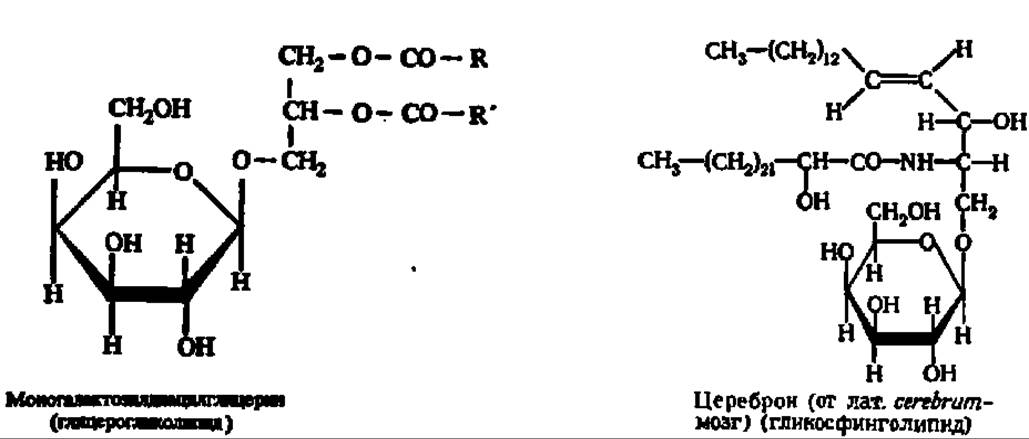
Glyceroglycolipids and glycosphingolipids are widely distributed in nature. Particular attention is currently focused on glycosphingolipids containing an oligosaccharide component, such as globosides:
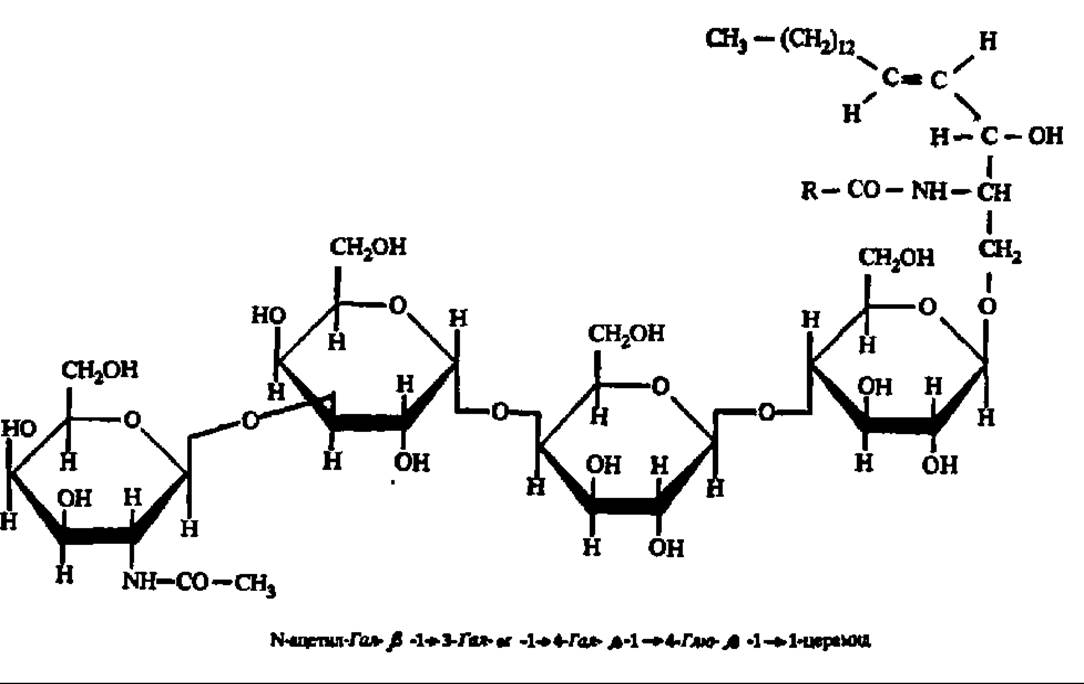
Already 110 globo-, lacto-, and gangliosphingolipids have been studied. They regulate cell growth, serve as markers for the transformation of normal cells into Cancer cells, ensure the compaction of blastomeres during egg Cleavage, interact with protein toxins, and perform A number of other vital Functions.
Recently, it has been shown that they participate in the reception of Hormones, growth factors, and Lectins, regulate cell growth and differentiation, and act as immunomodulators and secondary messengers.
Diol lipids. In natural lipids, ester bonds with higher Fatty acid and phosphoric acid residues, as well as ether bonds with higher alcohol and carbohydrate residues, can be formed by dihydric alcohols—ethanediol, as well as propanediols, butanediols, and pentanediols.
Such lipids are referred to as diol lipids. They are widespread among plants, animals, and microorganisms as minor Components of the lipid fraction, although in marine invertebrates and fish they often constitute the major portion of reserve lipids. They also serve as Structural elements of Endoplasmic reticulum membranes, though not of mitochondria. It has been observed that they undergo turnover more actively than lipids in which glycerol functions as the alcohol. There are 9 known groups of diol lipids isolated from various sources.
Ornithine lipids. The first reports regarding the existence of this new type of lipid date back to 1963. Over the subsequent two decades, the structure of many of them was elucidated, and hypotheses concerning their functional role were proposed.
Ornithine lipids are characteristic of microorganisms. Their essential constituents are higher fatty $\beta$-hydroxy acids and The amino acid ornithine (or Lysine); depending on the structural type, Ethylene glycol or 1,3-propanediol residues may also be present. The most widespread ornithine lipids in nature have the following structure:
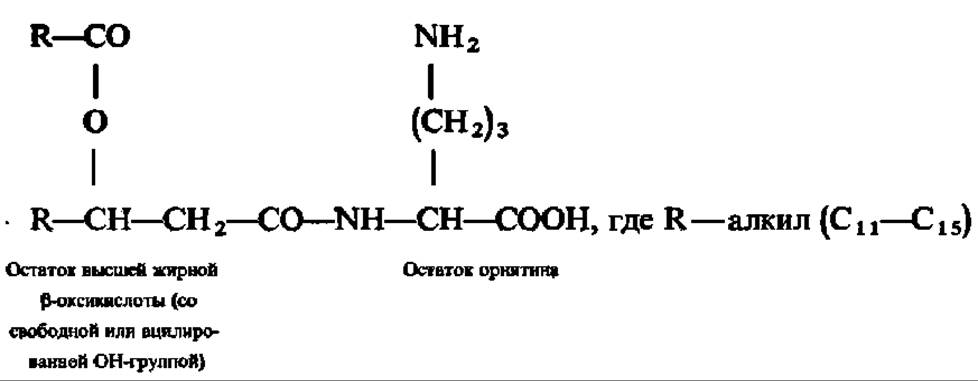
It has been established that ornithine lipids in microbial cells are capable of replacing phosphatidylethanolamine as a structural element of Cytoplasmic membranes. This is particularly pronounced under conditions of phosphate starvation.
Last update: 06/08/2026
Editorial and Educational Adaptation: This material has been compiled based on the primary/original source text. The project team performed an editorial review, corrected technical inaccuracies, structured sections, and adapted the content for an educational format.
What was processed:
- elimination of formatting defects (OCR errors, structural breaks, corrupted characters);
- editorial organization of content;
- standardization of terminology in accordance with academic sources;
- verification of factual statements against the original source text.
All mentions of the author, publication year, and origin of the primary text have been preserved in accordance with the source.