Plant Physiology - M.M. Musiienko 2001
Root nutrition of plants
Ion transport across the plasma membrane
The absorption of inorganic nutrients by plants occurs through the ROOT epidermis. According to current data, ions travel from the epidermis to the endodermis primarily via the symplast. Their Cell-to-cell pathway within the root cortex layer proceeds through plasmodesmata by diffusion and cytoplasmic streaming (Fig. 120).
Class="center">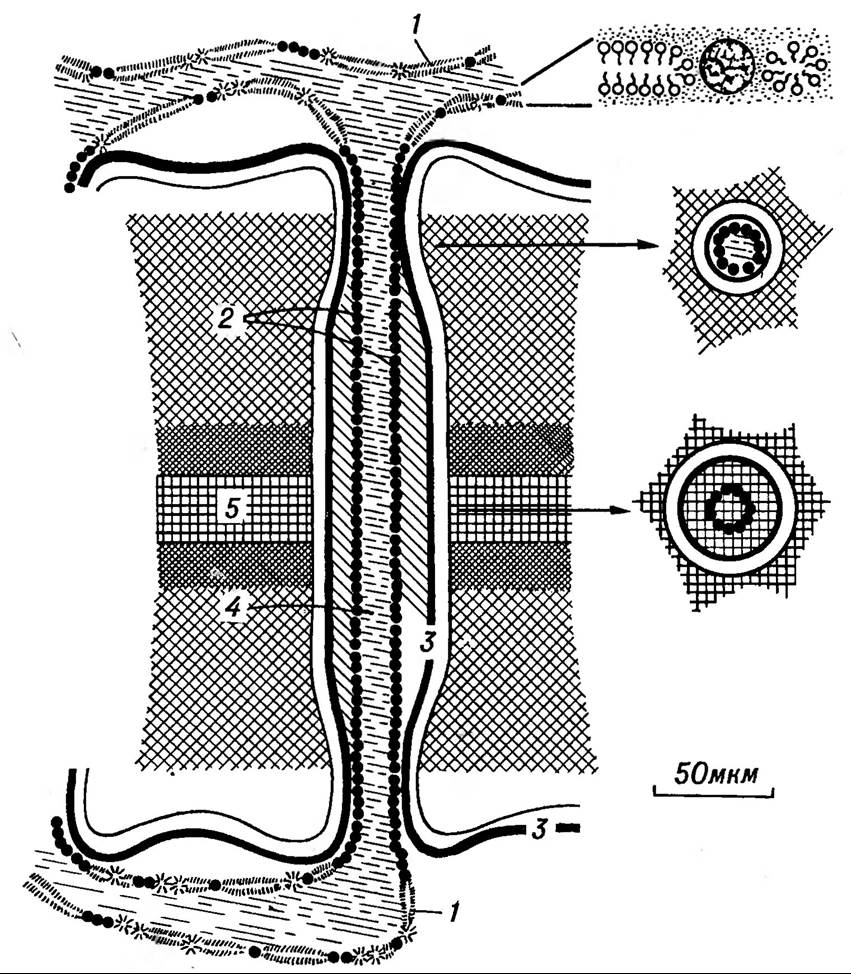
Fig. 120. Cytology/cytology/92.html">SCHEMATIC Structure OF a plasmodesma: 1 — Endoplasmic reticulum membrane as a bimolecular layer; 2 — continuation of the membrane within the channel; 3 — Plasmalemma; 4 — cavity of the plasmodesmal channel; 5 — intercellular substance
To penetrate the Cytoplasm, ions must first cross the plasmalemma and then the tonoplast or another membrane—the envelope of any cellular organelle—to enter a specific cellular compartment. Ions cross the membrane either passively or actively, which likely occurs at different sites on the membrane.
Passively, ions can diffuse through the membrane in various directions (diffusion) due to their own kinetic energy, without utilizing ATP or other Energy Sources. Recently, reports have emerged that inorganic ions cross the membrane via aqueous protein channels, known as permeases. Transport Proteins are highly selective and do not undergo changes during transport, which makes them similar to Enzymes. To emphasize this similarity, they were named permeases. However, unlike enzymes, permeases do not cause chemical alterations in the substance they transport.
Polypeptides and proteins capable of forming channels for specific ions have been isolated from Fungi and certain Bacteria. These substances are called ionophores. When added to artificial lipid membranes, they accelerate ion penetration through the membrane a million-fold (e.g., the Antibiotics gramicidin and valinomycin).
Generally, the first Ion Channels were discovered in Nerve Cells, and later in other membranes. It is believed that there are mainly Two Types of such organic insert elements: selective ion conductance channels and functional (enzymatic) proteins. Unlike structural proteins located on the membrane surface, functional proteins are assembled into compact globules. They possess hydrophobic properties and are therefore partially or completely embedded in The Lipid Bilayer of the membrane. It is highly probable that they are enzymes, among which are the so-called ATP synthases. As we will see later, these very enzymes form The basis of ion pump operation.
As for ion conductance channels, they are also protein structures, but they lack enzymatic activity. In plant cell membranes, as suggested by D. B. Vakhmistrov, there are at least potassium, sodium, calcium, and chloride channels. It is these selective ion conductance channels that make the membrane excitable, i.e., capable of conducting an electrical excitation impulse. Thus, most substances required by The Cell are transported across the membrane via transport carrier proteins (Fig. 121).
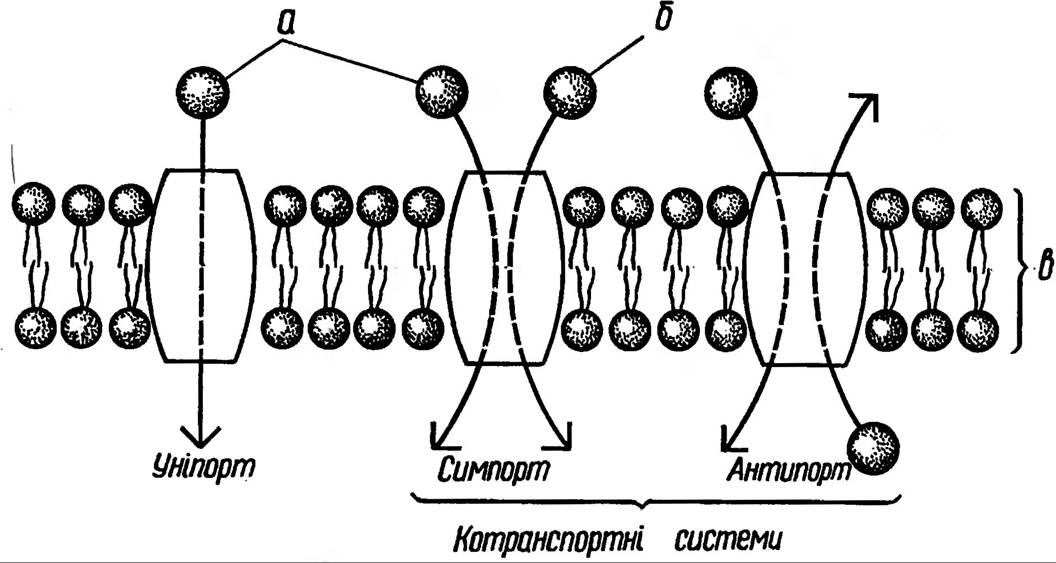
Fig. 121. Schematic of transport protein function. Uniport is the simple transport of any solute across the membrane. In cotransport systems, The transport of one substance depends on the simultaneous or sequential transport of another substance, either in the same direction (symport) or in the opposite direction (antiport): a, b — transported substances; c — lipid layer
Cotransport systems
When a protein transports a single substance, it is called uniport. Others function as cotransport systems, in which the transport of one substance is coupled with the simultaneous transport of another. If the transport occurs in the same direction, it is symport; in opposite directions, it is antiport:
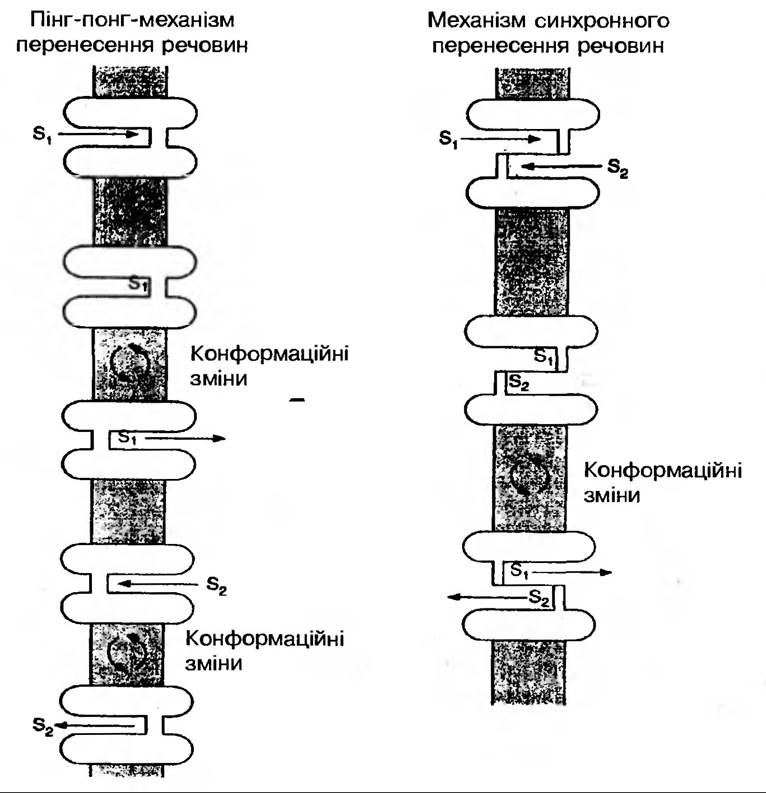
Two types of transport involving carrier proteins are distinguished: Facilitated Diffusion, driven by the concentration gradient of the substance, and Active Transport, where the movement of a substance against a concentration and electrochemical gradient requires Energy Expenditure (Fig. 122).
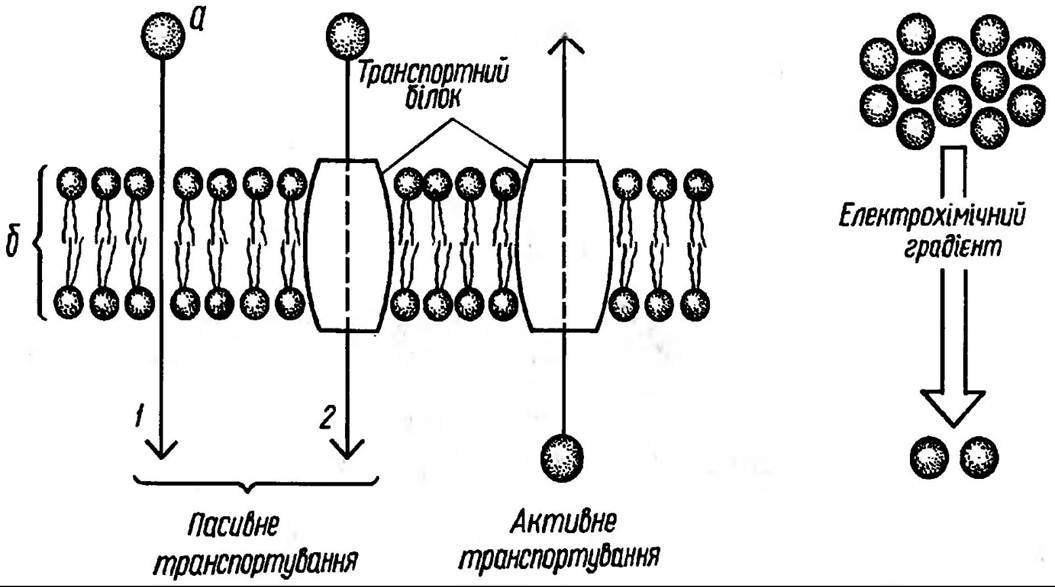
Fig. 122. Schematic of passive transport along an electrochemical gradient and active transport against an electrochemical gradient. Simple diffusion and facilitated diffusion are passive processes, whereas active transport requires energy: a — transported molecule, b — lipid layer, 1 — simple diffusion, 2 — facilitated diffusion
Last update: 07/08/2026
Editorial and Educational Adaptation: This material has been compiled based on the primary/original source text. The project team performed an editorial review, corrected technical inaccuracies, structured sections, and adapted the content for an educational format.
What was processed:
- elimination of formatting defects (OCR errors, structural breaks, corrupted characters);
- editorial organization of content;
- standardization of terminology in accordance with academic sources;
- verification of factual statements against the original source text.
All mentions of the author, publication year, and origin of the primary text have been preserved in accordance with the source.