Biochemistry - The Chemical Reactions of Living Cells, Volume 2 - D. Metzler 1980
Organization of Metabolism: Catabolic Pathways
Fatty Acid Oxidation
Oxidation of Unsaturated Fatty Acids
The β-oxidation of unsaturated acids, such as ∆9-oleic acid, yields ∆3-cis-enoyl-CoA as an intermediate. The oxidation process can proceed further only upon the action of a specific ∆3-cis-∆2-trans-enoyl-CoA isomerase [1] [Equation (9-5)].
Class="center">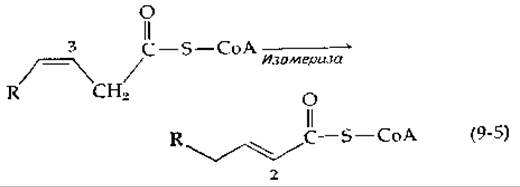
Note the similarity between this equation and Equations (7-57) and (7-58).
Box 9-B
Genetic Disorders: Refsum's Disease
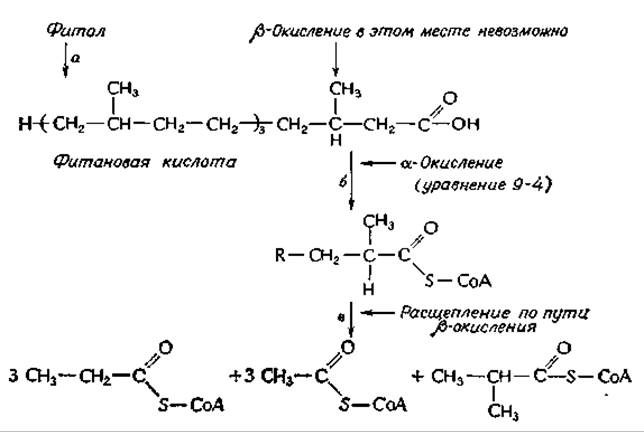
This inherited (autosomal recessive) Lipid METABOLISM disorder leads to the accumulation of phytanic acid, a 20-carbon branched-chain fatty acid, in Tissues. Phytanic acid is normally produced in the body from phytol, a plant alcohol that is esterified as part of chlorophyll (Fig. 13-19). Since the β-oxidation of phytanic acid is blocked, its breakdown begins with α-oxidation, followed by β-oxidation to yield (from a single starting molecule) three molecules of propionyl-CoA, three molecules of acetyl-CoA, and one molecule of isobutyryl-CoA.
Patients with Refsum's disease are unable to oxidize phytanic acid due to impairments in the α-oxidation systema. It remains difficult to determine definitively whether the severe neurological disorders observed in Refsum's disease are caused by the accumulation of phytanic acid in Brain tissue or by the failure of the brain to synthesize certain essential odd-chain Fatty acids.
Question for the reader: What is the most likely effect of incorporating phytanic acid into brain Cell membranes?
а Steinberg D., Herndon J. Н., Jr., Uhlendorf В. W., Mize C. F., Avigan Milne G. W. A., Science, 156, 1740—1742 (1967).
Last update: 06/08/2026
Editorial and Educational Adaptation: This material has been compiled based on the primary/original source text. The project team performed an editorial review, corrected technical inaccuracies, structured sections, and adapted the content for an educational format.
What was processed:
- elimination of formatting defects (OCR errors, structural breaks, corrupted characters);
- editorial organization of content;
- standardization of terminology in accordance with academic sources;
- verification of factual statements against the original source text.
All mentions of the author, publication year, and origin of the primary text have been preserved in accordance with the source.