BOTANY VOLUME 2 - PLANT PHYSIOLOGY - 2007
6. METABOLIC PHYSIOLOGY
6.2. Mineral Nutrition
6.2.1. Chemical composition of the Plant Body
Photoautotrophic plants absorb (along with light energy) A wide variety of inorganic substances from their environment: СО2 from the atmosphere and numerous other elements from the soil. An analysis of plant chemical composition reveals a characteristic distribution of elements that does not match that of the atmosphere, hydrosphere, or lithosphere, thus clearly demonstrating the chemical autonomy of the biosphere (Fig. 6.16).
Class="center">Fig. 6.16. Distribution of elements in the Earth's biosphere, hydrosphere, lithosphere, and atmosphere (based on atomic count, in relative units). Lithosphere = Earth's crust (from Greek lithos — stone). Water content in the atmosphere is not included

As in all organisms, water constitutes the largest fraction of the fresh weight of living plant Tissues (for the Structure and properties of water, see 1.1). Protoplasm contains an average of 85 – 90% water; even lipid-rich Organelles such as Cell/35.html">Mitochondria and METABOLISM/14.html">Chloroplasts contain about 50% water. Seeds, particularly lipid-storing ones, are among the plant Organs with the lowest water content (Table 6.5).
Table 6.5. Water Content
Plant |
Water content, % of fresh weight |
HEAD lettuce (inner leaves) |
94.8 |
Tomato (ripe fruit) |
94.1 |
Radish (taproot) |
93.6 |
Watermelon (pulp) |
92.1 |
Apple (pulp) |
84.1 |
Potato (tuber) |
77.8 |
Wood (fresh) |
approx. 50 |
Corn (dry caryopses) |
11.0 |
Bean (dry seeds) |
10.5 |
Peanut (unshelled pods with Skin) |
5.1 |
Pleurococcus (terrestrial alga) in a dry, yet viable state |
5.0 |
6.2.1.2. Dry Mass and Ash Content
Plant dry mass is determined after drying at a Temperature slightly above 100 °C (usually 105 °C) to a constant weight. Dry biomass contains various inorganic and, above all, organic components, which should be regarded partly as vital and partly as by-products of metabolism. Autotrophic plants far surpass animals in The Diversity of their Organic compounds.
Organic compounds are constructed from only a few elements. Among these, the six "cornerstones" or primary "building blocks" are the most essential: C, O, H, N, S, P. Carbon dominates by weight (accounting for about 50% of the organic dry matter), whereas hydrogen accounts for only 5 to 7% by weight (nevertheless, the molar ratios of C and H do not differ greatly; see Fig. 6.16).
If dry biomass is heated to a high temperature in the presence of air, some of the main elements are released as gases (CO2, H2O, NH3, SO2), while oxides or carbonates of numerous other elements remain in the ash. The ash fraction of dry matter depends heavily on the plant species and organ, as well as on its habitat. It is low in Lichens (0.4 – 7%), fruits, and seeds (1 – 5%), and very high in certain leaves (e.g., Zygophyllum stapfii from Southwestern Africa at 56.8%). Table 6.6 lists the relative values of total ash content and the proportions of individual elements for a range of plants.
Table 6.6. Ash content and composition in various parts of plant organisms
Ash, % of dry mass |
Detected per 100 parts of ash |
|||||||||
K2O |
Na2O |
CaO |
MgO |
Fe2O3 |
P2O5 |
SO3 |
SiO2 |
Cl2 |
||
Tubercle bacillus |
9.56 |
8.2 |
11.5 |
8.6 |
9.8 |
9 |
47.0 |
10.8 |
? |
1.2 |
Penny bun, fruiting body |
6.39 |
57.8 |
0.9 |
5.9 |
2.4 |
1.0 |
26.1 |
8.1 |
— |
3.5 |
Rye, caryopses |
2.09 |
32.1 |
1.5 |
2.9 |
11.2 |
1.2 |
47.7 |
1.3 |
1.4 |
0.5 |
Apple tree, fruit |
1.44 |
35.7 |
26.2 |
4.1 |
8.7 |
1.4 |
13.7 |
6.1 |
4.3 |
— |
Carrot, ROOT |
5.47 |
36.9 |
21.2 |
11.3 |
4.4 |
1.0 |
12.8 |
6.4 |
2.4 |
4.6 |
Potato, tuber |
3.79 |
60.1 |
2.9 |
2.6 |
4.9 |
1.1 |
16.9 |
6.5 |
2.0 |
3.5 |
Tobacco, stem |
7.89 |
43.6 |
10.3 |
19.1 |
0.8 |
1.9 |
14.2 |
3.5 |
2.4 |
3.6 |
Tobacco, leaves |
17.16 |
29.1 |
3.2 |
36.0 |
7.4 |
1.9 |
4.7 |
3.1 |
5.8 |
6.7 |
White cabbage, outer leaves |
20.82 |
23.1 |
8.9 |
28.5 |
4.1 |
1.2 |
3.7 |
17.4 |
1.9 |
12.6 |
Expressed as percentages, K, Na, Ca, and P predominate in the ash. In addition, Mg, Fe, Si, Cl, and S are consistently present, and Al, Mn, B, Cu, Zn, and other elements are frequently found in greater or lesser amounts. It appears that there is virtually no chemical element that cannot be detected in a plant.
Ash analysis alone does not allow one to conclude whether a detected element is essential for the plant as a whole, whether it is required in the measured quantity, or whether it is simply an incidentally acquired component. Only plant Nutrition experiments using media of known composition can provide clarity on this matter.
The cultivation of plants in nutrient solutions of defined composition—first attempted by Julius Sachs and now widely adopted in agronomic practice—is termed hydroponics (from Greek hydor – water; Latin ponere – to place, to set). By intentionally altering the composition of these nutrient solutions, researchers can determine the necessity of various nutrient elements for the plant: when supplied with all essential elements, plants develop quite normally, whereas in the absence or deficiency of required elements, they exhibit deficiency symptoms (Fig. 6.17).
Fig. 6.17. Deficiency symptoms in 12-week-old tobacco plants grown hydroponically under individual nutrient deficiencies
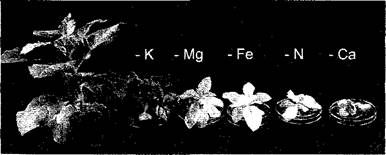
Plants require the following 10 elements in large quantities (>20 mg/L), and they are therefore designated as Macronutrients: C, O, H, N, S, P, Mg, K, Ca, Fe1; among these, the first three are absorbed from the air and water as CO2 and O2, while the remaining seven must be supplied to the nutrient medium as ions. Iron is required in much smaller quantities than the other elements (about 6 mg/L) and is therefore frequently grouped with micronutrients, a term chosen because of the small amounts required. Essential elements that are constantly needed in trace amounts (<500 µg/L) include Mn, B, Zn, Cu, Mo, and Cl.
1 Iron occupies a "borderline" position between macro- and micronutrients. Here, the authors do not adhere to a definitive stance, listing Fe among both macronutrients and micronutrients (see below). Furthermore, the cited data regarding iron requirements are contradictory: >20 mg/L or approximately 6 mg/L. — Ed. note.
Only certain higher plants require such Trace Elements as Na, Se, Co, Ni, and Si (see 6.2.2.3).
Nutritional requirements differ somewhat in lower plants (Table 6.7). Among Algae, green algae (Chlorophyta) share the same requirements as higher plants, although Ca acts more as a trace element than a macroelement for them. Many marine algae and algae from enclosed bodies of water require sodium, much like certain freshwater cyanobacteria, often in substantial amounts of chloride (which can be replaced by bromide in some species).
Table 6.7. Mineral element requirements for various organisms ("+" = required; "-" = requirement not yet demonstrated; ± = requirement demonstrated only for specific species)
Elements |
Higher plants |
Algae |
||
N, Р, S, Mg, Fе, Мn, Zn, Сu |
+ |
+ |
+ |
+ |
Са |
+ |
+ |
± |
± |
В |
+ |
± |
- |
- |
СI |
+ |
+ |
- |
± |
Na |
± |
± |
- |
± |
Мо |
+ |
+ |
+ |
± |
Sе |
± |
- |
- |
+ |
Si |
± |
± |
- |
- |
Со |
- |
± |
- |
+ |
J |
- |
± |
- |
- |
V |
- |
± |
- |
- |
Ni |
± |
± |
± |
The green alga Scenedesmus obliquus requires vanadium. A number of algae grow only when supplied with vitamin B12 (which contains cobalt); these species (e.g., Ochromonas malhamensis) are also cultivated for the biological assay of this vitamin.
Among fungi, eumycetes have the same macroelement requirements as autotrophic higher plants, with the difference that potassium is utilized by some representatives only at low concentrations. The same holds true for calcium, which is not even essential for certain species. Among trace elements, boron appears to be unnecessary for fungi.
Bacteria require all the known macroelements of higher plants (excluding iron), except for calcium, which is either non-essential or required only in trace amounts. Among trace elements, only iron and manganese appear to be required by bacteria as a whole. Free-living, atmospheric nitrogen-fixing bacteria, such as Azotobacter species, require molybdenum as a trace element, similarly to symbiotic nitrogen fixers. Molybdenum is a component of the enzyme Nitrogenase, which converts atmospheric nitrogen into ammonia (NH3). Some species (e.g., Azotobacter) possess an alternative vanadium-containing nitrogenase. Nickel is indispensable for gaseous hydrocarbon-producing bacteria, clostridia, and methanogenic bacteria. The enzyme Glutathione peroxidase contains selenium in bacteria. A number of bacteria, particularly marine ones, are halophiles in the sense that they not only grow better in media with NaCl, but strictly require the presence of common salt. Extreme halophiles grow optimally at an NaCl concentration of approximately 25% (about 4 M). Salt acts partly as an osmotic agent and partly as a nutrient.
6.2.2.1. The Significance of Mineral Elements for Plants
Mineral elements perform Functions in The Cell that are non-specific, on the one hand, and others that can be fulfilled only by specific elements or ions (or at least by chemically closely related ones), on the other. Non-specific functions include contributing to the osmotic potential of the cell and their role in maintaining electroneutrality.
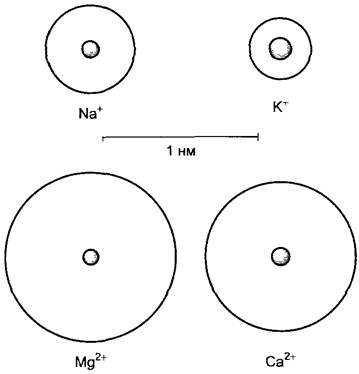
The action of inorganic ions on protein Hydration is more specific. As a rule, at the pH values prevailing within the cell, Proteins carry a certain electrical charge. Charged groups attract water dipoles (see Fig. 1.2) and form hydration shells. In the presence of high concentrations of inorganic ions, which also form hydration shells, competition for water availability arises, which, depending on the circumstances, can lead to Protein Denaturation. This principle is utilized in Protein Purification (e.g., via salting-out with ammonium sulfate (NH4)2SO4). Negatively charged proteins (which predominantly occur in the Cytoplasm at the prevailing pH of 7.2–7.4) are neutralized (discharged) under The Influence of cations, thereby causing dehydration (effectively "squeezing out" water). A cation's capacity to neutralize the charges of Biopolymers increases with its charge and, for a given charge, decreases with the size of its own hydration shell. Ca2+ discharges protein molecules relatively more strongly than Mg2+, and K+ relatively more strongly than Na+ (Fig. 6.18). Influences of this kind can affect the conformation and catalytic activity of protein molecules. This partly underlies the action of ions such as K+, Ca2+, and Mg2+ on enzyme activity. In living Cells, Homeostasis mechanisms ensure a high degree of constancy in intracellular ionic composition, so that substantial fluctuations in the overall level of protein hydration generally do not occur. Homeostasis (from Greek homoios = similar, stasis = standing still) is generally understood as the regulated state of a cell or organism necessary to maintain a stable internal environment.
Fig. 6.18. Diameter of certain ions and their hydration shells
The Regulation of Metabolic processes by inorganic ions, particularly Metal Ions, is largely based on highly specific interactions between ions and specialized protein groups.
✵ For instance, the activation of ribulose-1,5-bisphosphate carboxylase by Mg2+ is based on The formation of a Mg2+-carbamate complex with the ε-amino group of a specific Lysine residue in the large subunit of the enzyme (6.5.1; see Fig. 6.69). In the light, the Mg2+ concentration in the stroma increases, thereby promoting enzyme activation in the presence of CO2.
✵ ATP predominantly reacts not in its free form (as an acid), but as a Mg2+-ATP complex.
✵ Cytoplasmic Ca2+ is typically maintained at concentrations around 10-7 M. There is evidence that, under certain circumstances in plant cells, these concentrations can rise by approximately an order of magnitude (>10-6 M), similar to animals. This leads to the activation of, for example, Ca2+-dependent
protein Kinases and, via the Ca2+-binding protein calmodulin, to A change in the activation state of numerous cellular proteins (including a cascade of multiple protein kinases). Thus, Ca2+ functions as an element of cellular signaling pathways.
The action of metals as constituents of prosthetic groups is highly specific. Cytochromes, ferredoxin, and lipoxygenases contain iron; plastocyanin, ascorbate oxidase, and phenoloxidases contain copper; nitrate reductase, nitrogenase, and aldehyde oxidases contain molybdenum. Metal ions facilitate the binding and activation of substrates by Enzymes and play a crucial role in Electron Transport and The transfer of atoms and molecular groups.
Finally, mineral elements are essential for The Biosynthesis of organic compounds. Nitrogen, sulfur, and phosphorus are constituents of numerous Biomolecules. Plants absorb them predominantly in the form of oxoanions (NO3-, SO42-, H2PO4-). Individual macro- and microelements will be discussed in more detail below.
• Nitrogen is generally absorbed by plants from the medium as nitrate (NO3-), and more rarely as NH4+. It is present in reduced form within organic compounds (Amino Acids, proteins, Nucleic Acids, Coenzymes, etc.). In green plants, approximately half of the total plant nitrogen and about 70% of leaf nitrogen is located in chloroplasts. Typically, only 10–20% or less of the nitrogen is present as free nitrate or ammonium ions (for details on Nitrogen metabolism, see Section 6.6). In certain plants, nitrate also accumulates in the cell sap ("nitrophiles", e.g., Chenopodium album and Urtica dioica) and plays an important role in maintaining ion balance and osmoregulation.
• Phosphorus is absorbed primarily as singly charged dihydrogen phosphate (H2PO4-) and is not reduced within the cell, but occurs as inorganic phosphate in ester and anhydride bonds—for example, as a constituent element of NUCLEOTIDES and their derivatives, nucleic acids, sugar phosphates, Phospholipids, coenzymes, and in phytin within the Cells of the aleurone layer (i.e., calcium-magnesium salts of phytic acid, the hexaphosphoric ester of myo-Inositol). Its primary role thus lies in being a component of vital structural structures and participating in the cell's Energy Metabolism.1
1 Mono- and di-substituted phosphates possess high buffering capacities, which is why The Role of phosphorus in maintaining intracellular pH is also considered. — Ed. note
• Sulfur is absorbed by plants (except for a few special cases among bacteria) predominantly in the form of sulfate (SO42-) and is usually reduced prior to incorporation into organic compounds (see 6.7); when sulfate is incorporated into organic compounds (e.g., sulfolipids—see Fig. 1.21) or certain secondary compounds (see 6.16.4), the inclusion of the stable acid group increases the water solubility or polarity of these compounds. Like nitrogen, sulfur constitutes a roughly constant proportion of cellular proteins: there are approximately 36 nitrogen atoms per sulfur atom. If sulfate uptake exceeds the demand for reduced sulfur, free sulfate may accumulate in the plant, often reaching concentrations even higher than those of nitrate. Unlike nitrogen, reduced sulfur in higher plants can be re-oxidized and subsequently stored as sulfate. The uptake of sulfate into the cell is regulated by its intracellular concentration.
• Potassium. K+ is the only monovalent cation required by all plants; it can be replaced by rubidium (Rb+) in only a few microorganisms. Potassium plays its principal role as a cofactor in enzymatic reactions and, owing to its high proportion in the cellular mineral fraction (see Table 6.6), as an osmotic agent. High concentration is also important for its function as a cofactor, since K+ has a relatively low affinity for organic ligands, including enzymes, coenzymes, and enzyme substrates. K+ concentrations reach 100–120 mM in the cytoplasm and 20–200 mM in chloroplasts. As an osmotically active factor, potassium plays a key role in osmoregulation associated with Nastic Movements (such as stomatal opening and closure; see 8.3.2.5), movements of plant organ joints, etc. (see 8.3.2). Potassium ions play an important role in phloem transport (see 6.8) as well as in the binding of mRNA to Ribosomes. Potassium is not incorporated into organic compounds within the cell.
• Magnesium occurs in the Earth's crust primarily as carbonate. As a constituent of chlorophyll and protopectin, as well as a component of the cell walls of various algae (such as brown algae), magnesium is indispensable. Magnesium incorporated into chlorophyll accounts for more than 10% of the leaf's total magnesium, while the total magnesium in chloroplasts often exceeds half. It is partially stored in the form of phytate. In addition, magnesium serves as a cofactor for numerous enzymatic reactions, particularly those involving ATP (as the Mg2+-ATP complex). In pure solutions, magnesium acts as a potent poison and, at high concentrations, disrupts the uptake of potassium from the medium. Conversely, magnesium uptake is hindered by other cations, such as potassium, ammonium, calcium, manganese, and hydrogen ions. Magnesium deficiency resulting from soil acidification1 in certain habitats has been discussed as a potential cause of forest tree decline. This further underscores The Importance of a balanced mineral nutrient supply for plant growth.
1 During soil acidification, magnesium and calcium carbonates are converted into soluble salts, leading to the leaching of these elements from the soil and resulting in their deficiency. — Transl. note.
• Calcium occurs in the Earth's crust as carbonate, sulfate, or phosphate. Within the cell, calcium as a divalent cation can form salts with acidic components of cell walls, similar to magnesium (e.g., with protopectin in the middle lamellae, the walls of root hairs and pollen tubes, or with alginic acid in algal cell walls), thereby acting as an essential structural component. Calcium deficiency impairs, for instance, pollen tube growth and pollen germination, and leads to damage in Meristems, primarily the root meristem. Monocots require significantly lower calcium concentrations for optimal growth than dicots. Calcium plays a major role in maintaining the Structure and function of all cell membranes. The concentration of free calcium is low in the cytoplasm and chloroplasts, whereas it is high in the apoplast and, to some extent, in the vacuole. The low calcium content in the cytoplasm is maintained by the low permeability of the Plasmalemma to this ion and The activity of energy-dependent pumps (ATPases) in the plasmalemma and Endoplasmic reticulum, which transport Calcium Ions against a massive gradient (calcium concentration increases 10,000- to 1,000,000-fold from the cytoplasm to the apoplast). Excess calcium is deposited in The Cell as phytate, oxalate, carbonate, or (less frequently) sulfate or phosphate, and in the form of these sparingly soluble salts is largely removed from metabolic Circulation.1 (For the role of Ca2+ in cellular signaling pathways, see 7.3.3, 8.3.2.5; for the determination of calcium, see Box 7.4.)
• Iron is an obligate component of several chemical compounds within the cell. These include various porphyrin derivatives, such as the heme groups of cytochromes and Other Enzymes like catalases and peroxidases, as well as leghaemoglobins (see 6.15, Fig. 6.56). Non-heme iron compounds, such as ferredoxin (see Fig. 6.56), should also be mentioned. Although iron is not a constituent of chlorophylls (see Fig. 6.44), it is absolutely essential for their synthesis: iron starvation leads to symptoms of chlorophyll deficiency (chlorosis) that closely resemble those of magnesium deficiency. Given the critical role of iron in the biosynthesis of chlorophyll and iron-containing compounds in photosynthetic electron transport, it is readily understandable that the majority of iron in a leaf is localized in the chloroplasts.
1 Sparingly soluble calcium salts are typically formed within vacuoles. — Transl. note.
Iron deficiency frequently occurs in alkaline soils, where iron is precipitated by carbonates and bicarbonates ("alkaline chlorosis"). An excess of manganese or other heavy metals can also lead to iron starvation, as these ions compete with iron for uptake and physiological binding sites.
In the soil, Fe3+ and occasionally Fe2+ are present primarily in complexed forms. Roots predominantly absorb Fe2+ (with cereals being an exception); therefore, Fe3+ must be reduced at the root surface (see 6.2.2.3).
6.2.2.3. Trace Elements (Micronutrients)
• Manganese. To date, only a single manganese-containing protein of unknown function ("manganin" from peanuts) has been isolated from plants. However, manganese plays a vital role as a cofactor for numerous enzymes, such as those in The Citric Acid Cycle, as a component of manganese-containing superoxide dismutase, and by participating in photosynthetic oxygen evolution (see 6.4.5). Manganese deficiency can cause chlorosis. The condition known as grey speck disease in oats and other crops, which occurs primarily on marshy soils, is a consequence of manganese deficiency in the soil or its presence in a form unavailable
to the plant. Citrus crops also frequently suffer from manganese deficiency. Fungi, such as Aspergillus niger, likewise require manganese.
• Boron (as B(OH)3) is essential at low concentrations for Higher Plants and certain algae (though not for many microorganisms or animal cells), yet even slight excess concentrations act toxically. While a wide range of diagnostic symptoms for boron deficiency has been described, the precise MECHANISM OF ACTION of this element remains largely elusive; this is due, in part, to the lack of a radioisotope of boron suitable for biochemical analyses. Neither a bioorganic compound nor an enzyme containing boron has been identified to date.1
1 Recently, unstable boric acid esters with Cell wall substances have been successfully isolated. It is hypothesized that the formation of these esters reduces permeability to macromolecules, which in turn affects the functioning of The cell wall matrix. — Transl. note.
The most striking symptom of boron deficiency is the dieback of meristems ("Heart rot" in fodder and sugar beets), which may be rooted in disrupted RNA metabolism. Furthermore, boron deficiency leads to impaired flower development, a disturbed plant water balance, and disrupted export of sugars from leaves via the phloem.
Pollen of tomatoes, water lilies, and many other plants can germinate or elongate pollen tubes exclusively in the presence of trace amounts of borate in the stigma secretion. In addition, borate can influence the oxidative pentose phosphate cycle (see 6.10.3.5) by forming complexes with 6-phosphogluconate. Under boron deficiency, this process should proceed particularly efficiently, thereby leading to the excessive accumulation of Phenolic Compounds characteristic of boron-deficient plants. Interactions between boron and membranes are also being discussed, which could potentially affect ATP-dependent transport processes and the action of phytohormones; furthermore, links between boron and Lignin formation and xylem differentiation are being explored.
• Zinc occurs in plants at concentrations approximately 10 times higher than that of copper and about 1/10 that of iron. Zinc transport takes place via both the xylem and the phloem. Zinc is a constituent of more than 70 enzymes, including Alcohol dehydrogenase, Carbonic anhydrase, and superoxide dismutase (copper- and manganese-containing isozymes also exist), and serves as a cofactor for various other enzymes. In higher plants, zinc deficiency leads to severe growth disorders, such as little-leaf syndrome and the inhibition of internode elongation. This is primarily attributed to a disruption in growth regulator metabolism under zinc deficiency. Zinc is also an indispensable micronutrient for many lower plants (such as fungi like Aspergillus niger, and algae). As a structural element of ribosomes (being part of their composition), zinc deficiency results in impaired Protein Biosynthesis. Finally, it is required for maintaining The structure of Biomembranes and acts as a component of certain Transcription factors (zinc-finger proteins, see 7.2.2.3).
• Copper is bound to humic and fulvic acids in the soil. In plants, it is present at concentrations of roughly 3–10 µg/g dry weight and serves as an essential constituent of various enzymes ( notably ascorbate oxidase, superoxide dismutase, and cytochrome c oxidase) and redox molecules (plastocyanin). In plant conducting tissues, copper is predominantly complexed (e.g., with amino acids). Copper deficiency causes the condition known as "reclamation disease" (or heather raw humus disease) on acidic heath soils, resulting in low grain yields (empty glumes). Copper starvation also impairs lignin synthesis: diamine oxidase, which supplies H2O2 for The oxidation of lignin precursors, is a copper-containing enzyme. Pollen from plants grown under copper deficiency is inviable. Copper becomes toxic at concentrations of 20–30 µg/g dry weight.
• Molybdenum is a constituent of nitrogen-fixation enzymes—nitrogenase (see 9.2.2) and nitrate reductase (see 6.6.1)—as well as sulfite oxidase, aldehyde oxidase, and xanthine dehydrogenase. Consequently, its absence manifests more severely in plants supplied with nitrate rather than ammonium nitrogen. With the exception of nitrogenase, molybdenum in all other molybdenum-containing enzymes is incorporated into a specialized pterin (molybdopterin, see Fig. 6.89), which shares an identical structure across archaea, bacteria, and eukaryotes (plants and animals). This molybdenum cofactor combines with various apoenzymes to form the holoenzyme, with molybdenum residing at the active center of the enzyme.
• Chlorine is present in plants at concentrations of 50–500 µmol/g dry weight (or significantly higher in halophytes) in the form of the chloride ion (Cl-); it accumulates primarily in chloroplasts and cell sap. Chlorine plays a role in photosynthetic oxygen evolution.
Although 130 chlorine-containing organic compounds have been described in plants, none of them play a vital role in metabolism. Quantitatively, The most significant is currently methyl chloride (CH3Cl), which is produced by marine macroalgae, wood-rotting fungi, and certain land plants at a global rate of 5 million tons per year. In specific plants, such as maize, coconut palms, and onions, chloride participates in the osmoregulation of stomatal movements (see 8.3.2.5), and in many plants, in osmoregulation generally. This may be related to the experimentally observed chloride deficiency, which induces wilting symptoms. Under natural conditions, chloride deficiency is unlikely to occur; rather, excessive, supra-optimal concentrations are more frequently encountered. Chloride is of great importance for the activity of the tonoplast proton ATPase, which, in contrast to the plasmalemma isozyme, depends not on K+ but on Cl-.
• Cobalt, as a component of vitamin B12, is required by many bacteria, algae, and animal cells; in higher plants, its effect is indirect and occurs only when they engage in symbiotic Nitrogen Fixation (see 9.2.2) (vitamin B12 is required by the bacterial symbionts). In Escherichia coli and mammals, methylcobalamin serves as a cofactor in Methionine synthesis, working alongside other methyl-group carriers such as methyltetrahydrofolate and S-adenosylmethionine. Cobalt is also a component of certain vitamin B12-independent enzymes in bacteria (e.g., methionine aminopeptidase, nitrile hydratase, bromoperoxidase, and glucose isomerase). Methionine aminopeptidase from baker's Yeast and aldehyde decarbonylase from algae also contain cobalt.
• Sodium is present in soil solutions in temperate latitudes at concentrations of 0.1–1 mmol/L (similar to potassium); in semi-arid or arid regions, its concentration reaches 50–100 mmol/L (predominantly as NaCl). As mentioned above, sodium uptake is considerably lower than potassium uptake. Sodium is required as a trace element by certain C4 and CAM plants, but typically not by C3 plants. The light-dependent uptake of Pyruvate into mesophyll chloroplasts in certain C4 plants (see 6.5.8) (though not of the NADP-malic enzyme type), such as Zea mays and Sorghum bicolor, is mediated by a pyruvate-Na+ symport. If the growth of C3 or C4 halophytes is stimulated by high sodium concentrations in the medium (10–100 mmol), this is not due to a specific metabolic requirement for sodium for a particular life process, but rather to their high demand for osmotically active ions.
• Silicon occurs in the Earth's crust predominantly as Si(OH)4. Its concentration in soil solutions ranges between 30 and 40 mg/L in SiO2 equivalents. The global average concentration of SiO2 in rivers is 150 µmol/L. Diatoms require silicon not only for building their cell walls, but also as a micronutrient for metabolic processes, primarily Cell Division. Among higher plants, a distinction is made between silicon accumulators (such as certain grasses and Equisetum) and non-accumulators (like most dicots). For the former, silicon is an essential growth factor, just as it is for diatoms. Due to the ubiquitous presence of silicon and potential contamination of nutrient solutions from culture vessel walls or dust, deficiency symptoms for this element are difficult to demonstrate.
• Selenium is present in the cells of certain archaea, bacteria, and mammals in the form of selenocysteine (Sec). In selenocysteine, the SH group is replaced by an SeH group. Selenocysteine is found, for example, in the active center of formate dehydrogenase in Escherichia coli and glutathione peroxidase in mammalian cells. The only known selenium-containing protein isolated from plants to date is glutathione peroxidase from the green alga Chlamydomonas reinhardtii.
Higher plants apparently do not contain selenoproteins; no genes for selenium-containing proteins or for enzymes responsible for selenium incorporation have been found in The Genome of the baker's yeast Saccharomyces cerevisiae. In Escherichia coli, four genes are involved in selenium incorporation. Translation utilizes the UGA codon, which normally functions as a stop codon (see 7.3.1.1). Sulfate (SO42-) and selenate (SeO42-) compete for the same uptake system in roots. Certain plant species of the genera Astragalus, Xylorrhiza, and Stanleya hyperaccumulate selenium (see 6.2.2.4), a trait shared to a lesser extent by certain Brassicaceae such as Sinapis arvensis and Brassica oleracea var. italica (broccoli). Selenium can be released into the atmosphere by plants in gaseous form, specifically as dimethyl selenide.
• Nickel is a constituent of urease in higher plants and is also required by certain prokaryotes (e.g., as a component of hydrogenases). Nickel deficiency in soybean plants, for instance, leads to leaf necrosis resulting from the local accumulation of urea (up to 2.5%). Further symptoms include delayed seedling growth and reduced nodule formation. The nickel content in vegetative parts of higher plants generally ranges from 1 to 10 µg/g dry weight.1
1 The role of nickel may turn out to be even broader. For instance, the soils of New Caledonia contain high concentrations of Ni, yet the island's unique flora remains practically unstudied from a biochemical perspective. — Note by the Editor.
6.2.2.4. Mineral Salts as Factors of Plant Habitats
Both the composition and the quantity of available mineral salts in a plant's habitat (soil for terrestrial plants, water for aquatic plants) can vary considerably. It is common for necessary mineral nutrients in these habitats to be accompanied by accompanying substances with toxic effects, particularly certain heavy metals. An excess of essential elements can also produce adverse side effects. Only rarely are all mineral elements present in the substrate in the optimal proportions achieved during hydroponic cultivation in optimized nutrient solutions (Table 6.8). For the most part, mineral nutrition in natural habitats—and above all in cultivated soils—acts as a limiting factor for plant growth. While undisturbed natural lands maintain a nutrient equilibrium in which minerals absorbed by organisms are eventually returned to the soil upon their death, agricultural lands lose significant amounts of minerals with every harvest. For this reason, it is essential to replenish them through appropriate soil Fertilization, as the well-being of the soil microflora depends directly upon it.
Table 6.8 Composition of Knop's nutrient solution.1 Total mineral concentration: 0.22 %; pH 4.2
Compound |
Concentration, g/L |
Compound |
Concentration, mg/L |
Ca(NO3)2 |
1.00 |
H3PO4 |
3.00 |
KNO3 |
0.25 |
MnSO4 H2O |
3.00 |
KH2PO4 |
0.25 |
ZnSО4 7Н2O |
4.40 |
КСI |
0.12 |
(NH4)6Mo-O24 4Н2O |
1.80 |
MgSO4 7Н2O |
0.50 |
Fe EDTA |
2.75 mL* |
* Contains 24.9 g of FeSO4 7Н2O and 26.1 g of ethylenediaminetetraacetic acid per 1 L
1 Originally, Knop's nutrient medium contained no trace elements (they entered the solution merely as impurities in the Reagents and water), and iron was supplied as chloride or sulfate. The modern (modified) formula of Knop's medium is given here rather than the classical one. — Note by the Editor.
Both in natural habitats and on cultivated lands, Justus von Liebig—the pioneer of artificial fertilization—formulated the law of the minimum, according to which plant growth is limited specifically by the element present in relatively the lowest amount.1 In agricultural areas, soils must be amended primarily with nitrogen, phosphorus, and potassium to ensure consistently high yields. Liming regulates soil pH and maintains the crumbly structure necessary for soil aeration and water retention, as well as for the availability of nutrients to plants (see 6.2.3.1).
1 Liebig's law holds true for humid temperate climates, where elements are leached from the soil not only through harvesting but also by rainwater and snowmelt. In arid climates, crop yield is influenced not only by deficiencies but also by excesses of certain soil elements, such as salinization caused by MgSO4 or NaCl. Here, the law of the minimum should be reformulated as the law of the optimum: yield is determined by the element whose concentration deviates most strongly from the optimum (in either direction). — Note by the Editor.
Significant differences in the presence and availability of mineral nutrients have greatly influenced Plant Adaptations to their environmental conditions (see Chapter 13.6.6). Let us examine a few Examples.
✵ Plants of saline habitats. High salt concentrations exert, on the one hand, a non-specific osmotic effect and, on the other hand, a specific effect depending on the type of active ion. Adapted plants (halophytes) can counteract the negative WATER POTENTIAL OF salt-rich solutions (seawater  ~ -2 MPa; in isolated lagoons
  it may be even more negative due to water evaporation) by establishing correspondingly lower internal water potentials, thereby enabling them to absorb water directly from their habitat. Often, this is achieved by accumulating Na+ and Cl- ions within the cell. Excess salt can be eliminated in the form of crystal clusters (see 6.18), by shedding plant parts (such as glandular hairs in Atriplex), or by sequestering salt in large vacuoles (in succulents such as Salicornia), thereby removing it from metabolism.
Much like seawater, saline soils in humid regions contain predominantly NaCl, meaning that the specific salt effect involves either Na+ or Cl-. The sensitivity of various plants to these ions differs greatly. Halophilic bacteria and algae thrive in concentrated common salt solutions. Barley, beets, spinach, cotton, tobacco, onions, and radishes are relatively tolerant to NaCl; these are followed in THE SPECTRUM OF tolerance by grapevines, olives, date palms, various pine species, oaks, plane trees, and black locust (which makes these plants less vulnerable to road-salting practices). Horse chestnuts and lindens are salt-sensitive, followed by wheat, potatoes, stone fruit crops, lemons, and many legumes.
• Calcicoles and calcifuges (plants of limestone and silicate soils). Among ferns (see 11.2) and angiosperms (see 11.2), there are species that actively avoid limestone soils, as well as others—often closely related—that occur exclusively on calcareous soils. Calcicoles are adapted to soils rich in Ca2+ and HCO3- with a relatively high pH, which are well-drained, warm, dry, and poor in heavy metals and phosphates. On acidic sandy soils consisting primarily of silica, calcicole plants may suffer primarily from high concentrations of iron, aluminum, and manganese ions. Conversely, silicate plants adapted to acidic soils detoxify excess heavy metal ions through complexation.
• Accumulator plants concentrate specific elements in their tissues. Examples include Orites excelsa (Proteaceae), which accumulates up to 79 % Al2O3 in its wood ash; Symplocos spicata (Symplocaceae) with 72 g of Al per kg of dry matter; and Miconia acinodendrum (Melastomataceae) with 66 g of Al per kg of dry matter. The tea plant Camellia sinensis accumulates up to 27 % Al in its dry leaf matter; because Al3+ is essential for its development, it thrives only on acidic soils (pH < 6). Aluminum apparently enters the plant via the phosphate uptake system in the form of AlF4- (an analogue of orthophosphate). One consequence of this is the high fluoride content in tea leaves (up to 180 mg/kg in young leaves, and up to 1.5 g/kg of dry matter in old leaves). Other notable hyperaccumulators include the African species Aeolanthus biformifolius (Lamiaceae), which contains up to 1.3 % Cu in its dry matter, and Sebertia acuminata (Sapotaceae) from New Caledonia, with 1–2 % nickel in its dry matter. The blue-green latex of this plant is essentially a 1 M nickel citrate solution (26 % nickel on a dry weight basis). Psychotria douarrei (Rubiaceae), native to New Caledonia, contains 4.7 % nickel. The dry leaf matter of Maytenus bureaviana (Celastraceae), also from New Caledonia, contains 3.2 % manganese. Certain North American species of milkvetch (Astragalus) are also hyperaccumulators, concentrating selenium, uranium, and vanadium; Astragalus pattersonii can contain up to 1.2 g of selenium per kg of ash. Selenium levels of 1–5 mg/kg of dry weight are toxic to grazing livestock. The toxicity of selenium stems from its incorporation into amino acids in place of sulfur (selenocysteine, selenomethionine), which can result in the formation of non-functional proteins. Selenium-tolerant Astragalus species synthesize the non-proteinogenic amino acid methylselenocysteine and sequester it safely in their vacuoles.
Plants whose ash composition closely reflects the chemical makeup of their substrate can serve as indicator plants. Some of these grow exclusively on specific soils: for example, the zinc violet (Viola calaminaria) thrives only on Zn-rich substrates, whereas the lichen Lecanora vinetorum occurs solely on copper-rich soils (such as the vineyard terraces—Weinberggerüste—in South Tyrol). Plant communities can likewise signal the presence of specific elements or combinations of elements. For instance, the lichen community Acarosporetum sinopicae is restricted to substrates rich in heavy metals, particularly iron-bearing ones, such as the tailings from medieval iron-ore mining dumps in the Harz Mountains.
The flower color of Malcolmia maritima (Brassicaceae) shifts from pink to yellowish-green when grown on soils containing Cu, Zn, or Pb (due to the formation of metal-anthocyanin complexes). A similar color change can be observed in Papaver commutatum (induced by copper or molybdenum) or in Leptospermum species from the Myrtaceae family (due to chromium). Recognizing such ecological relationships can be of great practical importance for mineral prospecting, assessing soil fertilizer requirements, agricultural and forestry zoning, geological mapping, and other Applications.
Researchers have even proposed "phytoextraction" for recovering precious metals using plants. For example, Brassica juncea can absorb up to 50 mg of gold per kg of dry biomass when grown in gold-bearing ore or sand. The term "phytoremediation" refers to the extraction of heavy metals toxic to humans and animals—such as cadmium or lead—from contaminated soils through the cultivation of accumulator plants. Thus, growing Brassica juncea reduces lead levels in contaminated soils, while Thlaspi coerulescens is well suited for remediating zinc- and cadmium-polluted soils.
Heavy metals are defined as metals with a density exceeding 5 g/cm3. This group includes essential plant mineral nutrients such as zinc and copper, as well as non-essential elements like cadmium, lead, mercury, uranium, and precious metals. At high concentrations, many heavy metals exert toxic effects on plants, humans, and animals because their ions form stable complexes with thiol groups (—SH), thereby inhibiting numerous enzymes. The very mechanisms responsible for supplying plants with necessary heavy metals simultaneously serve to limit their toxicity once optimal concentrations are exceeded.
Across all studied plant groups (algae, bryophytes, vascular plants), exposure to heavy metals induces the synthesis of specialized chelating Peptides known as phytochelatins. These are synthesized from glutathione (i.e., non-ribosomally) and share the general structure: (γ-glutamic acid–Cysteine)n–Glycine (where n = 2–11) (Fig. 6.19). In legumes (Fabales), homophytochelatins take THE PLACE OF phytochelatins, with the glycine residue being replaced by β-Alanine.
Fig. 6.19. Structure of phytochelatin and homophytochelatin. Metal chelation occurs via —SH groups, resulting in the formation of mercaptide (thiolate) bonds.

Another group of heavy-metal-binding compounds consists of metallothioneins. These are small (molecular mass approx. 10 kDa), cysteine-rich proteins synthesized on ribosomes whose production in plants is triggered by heavy metals. Much like phytochelatins and homophytochelatins, they bind heavy metal ions through their thiol groups. As a result, these ions are sequestered and removed from immediate cellular circulation, yet can be released back into cellular metabolism when needed (for instance, to serve as Cofactors). An undesirable side effect of these accumulation mechanisms is that heavy metals can enter the food chain of humans and animals via plant-based foods. Estimates suggest that roughly half of all human cadmium poisonings occur through plant-derived foods.
6.2.3. Uptake and Distribution of Mineral Elements in the Plant
6.2.3.1. Availability of Mineral Elements
With the exception of carbon, oxygen, and hydrogen—which are absorbed in the form of CO2, O2, and H2O—all other essential elements must be taken up in ionic form (Table 6.9). In rhizophytes, this uptake generally occurs via the roots, whereas leaves (with the exception of specialized epiphytes like Tillandsia; see 11.2) are capable of absorbing ions only to a very limited extent. Aquatic plants, however, can absorb mineral ions directly from the surrounding water through their submerged organs or floating leaves, as they possess highly permeable cuticles or lack them entirely. In addition, rooted aquatic plants also take up ions from the sediment via their roots.
Soil (Fig. 6.20; see also 12.5.2.3) is a complex, multiphase system undergoing continuous physical, chemical, and biological changes. The solid phase of the soil consists primarily of weathering products from rock-forming minerals (silicates, clay particles, limestone) and the breakdown products of organic matter, humus. The voids between these structures are filled partly with an aqueous solution (the liquid phase, soil moisture, soil solution) and partly with a gas whose composition differs significantly from atmospheric air (soil air). For optimal plant growth, roughly half of these pore spaces should be filled with solution and the other half with air to maintain root Respiration. A crumbly soil structure ideal for this balance is formed through the precipitation of negatively charged clay particles by limestone, which simultaneously neutralizes humic acids and prevents soil acidification.
Table 6.9. List of mineral elements absorbed in ionic form
Anions |
Cations |
||
Element |
Absorption form |
Element |
Absorption form |
N S Р СI В Mo |
Nitrate (NO3-) Sulfate (SО24-) Phosphate (РО3-4 Н2РO4-) Chloride (СI-) Borate (ВО3-3) Molybdate (МоО2-4) |
К Mg Са Fe Мn Zn Сu |
К+ Mg2+ Са2+ Fe2+ (Fe3+) Mn2+ Zn2+ Cu2+ |
Fig. 6.20. Root hairs in the soil

Humus consists of refractory material, living microorganisms, humic acids, fulvic acids, and alkali-insoluble humin. Humic and fulvic acids are complex macromolecules composed of phenolcarboxylic and aliphatic carboxylic acids, and they are chemically very stable (persisting in nature for up to 1,400 years). They exhibit high cation-exchange and redox capacities.
Mineral nutrient elements are present in the soil In both dissolved and bound forms. Only a tiny fraction is dissolved (< 0.2% of the total amount, existing as a less than 0.01% aqueous solution). Approximately 98% is bound (in precipitated form) within minerals, sparingly soluble compounds (sulfates, phosphates, carbonates), humus, and other organic matter, and is released extremely slowly through weathering and chemical decomposition. The remaining 2% is held by adsorption On the surface of colloidal soil particles carrying a net negative charge. Unlike dissolved ions, these bound ions cannot leach into the soil solution without external influences. They are released via exchange adsorption with ions secreted by the plant (e.g., H+, HCO3-) and subsequently utilized. Clay particles and humic substances serve as the primary carriers for such adsorption-bound ions. Their exchange capacity depends on charge density and active surface area, which is approximately 600–800 m2/g for the smectite clay montmorillonite and 700 m2/g for humic substances. The charge on both clay particles and humus is predominantly negative, meaning that cations are the primary ions bound.
To a lesser extent, clay particles can also bind anions. The strength of adsorption binding for cations decreases in the series Al3+, Ca2+, Mg2+, NH4+, K+, Na+, and for anions in the series PO43-, SO42-, NO3-, Cl-. The NO3- ion is highly mobile in the soil, K+ is moderately mobile, and the mobility of PO43- is much lower than that of other ions. Adsorption binding of ions in the soil is crucial for supplying plants with mineral nutrients because it prevents leaching; furthermore, the soil solution remains in equilibrium with the adsorbed "reservoir," which continuously replenishes consumed ions in a regulated manner (see 13.6.1).
Finally, various compounds exuded by the root (organic acids and amino acids, as well as sugars, Vitamins, etc.) alter the living conditions for microorganisms (fungi, bacteria) in the immediate vicinity of the root—the rhizosphere—thereby influencing the rates at which these microorganisms break down soil minerals and decompose organic matter.
Soil pH has a profound impact on the availability of soil nutrients, and it can vary dramatically over very small distances. Its effects range from controlling The rate of organic matter breakdown and mineralization (acid soils inhibit decay due to the acid-sensitivity of bacteria) to shaping soil structure and, ultimately, its ion-adsorption and ion-exchange properties. Different plant species prefer or tolerate distinct soil pH ranges. For instance, certain peat mosses thrive exclusively on acidic soils (acidophilic species with a narrow tolerance range), whereas heather (Calluna vulgaris) grows optimally in acidic soils but also tolerates neutral and slightly alkaline ones (an acidophilic-basitolerant species). Colt's-FOOT (Tussilago farfara), by contrast, can be classified as basiphilic-acidotolerant. Most higher plants can survive as monocultures across soil pH values roughly between 2.5 and 8.5, with varying optima. This physiological optimum often does not coincide with the ecological optimum of their distribution, as competition forces many species out of their physiological comfort zone. Species with a wide tolerance range are naturally more adaptable.
6.2.3.2. Uptake of mineral elements by the root
The plant root system—especially the root tip up to and including the root Hair zone (see 4.4.2.1)—makes exceptionally close contact with the soil (see Fig.
6.20). The degree to which roots permeate the soil reaches astonishing levels. For example, in a 1 m2 patch of perennial ryegrass (Lolium perenne) with a rooting depth of 70 cm, the root biomass is 35 kg, their total length is 55.5 km, and their surface area is 50 m2.
The process of ion uptake by the root can be divided into four stages:
— transfer of ions into the soil solution via exchange adsorption;
— diffusion of dissolved ions into the freely accessible space of the root (the apoplast);
— cellular uptake of ions;
— translocation of the absorbed ions into the xylem of the stele.
Because ions can only be taken up by roots in dissolved form and a significant fraction of them is bound to soil colloids (see 6.2.3.1), the process of ion transfer into the soil solution through exchange adsorption is of vital importance to the plant. As exchange ions, the root primarily secretes
H+ and HCO3-. The latter is formed from respiratory CO2 produced by cells and reacts with soil water According to the equation CO2 + H2O ⇄ H+ + HCO3-. Protons are generated partly through this process, partly from organic acids exuded by the root, or pumped out of the cell via the action of a proton (H+-translocating) ATPase (see Figs. 6.4, 6.5). The acidic pH generated around the root also increases the solubility of phosphates and carbonates.
From the soil solution, ions first enter the freely accessible root apoplast—namely, the cell walls of root hairs and cortical cells—via diffusion or along with the bulk flow of water. This is a passive process. Ion movement initially follows the chemical potential gradient of the ion between the soil solution and the apoplast (Eq. 6.9). Adsorption processes also come into play within the cell wall region. The apoplast, or apoplastic space, refers to the extracellular domain through which water molecules and dissolved low-molecular-weight substances (such as ions, metabolites, and phytohormones) can diffuse unhindered. In contrast, the interconnected cytoplasmic space of cells linked by plasmodesmata is called the symplast or symplastic space.1
1 Note: The terms "apoplastic space" and "symplastic space" are less commonly distinguished in some regional traditions. — Transl. note.
Because the apoplast contains an aqueous solution, it is referred to as the apparent free space (AFS). This space accounts for roughly 8 to 25% of the total tissue volume. Because ion entry into the apparent free space is a non-metabolic process, it is largely unaffected by low temperatures or metabolic poisons; furthermore, this phase of ion uptake is non-selective and reversible, meaning that substances entering the apparent free space can be washed out just as easily.
For charged particles, the apparent free space can be subdivided into two subcompartments: in the water free space (WFS), ions diffuse within the solution residing in the apoplast; in the Donnan free space (DFS), they are bound to fixed charges within the apoplast. Thus, the apparent free space is the sum of the water and Donnan free spaces (Fig. 6.21, B).
Fig. 6.21. Donnan distribution: A — Generation of the Donnan potential. Compartments 1 and 2 are accessible to cations (+), whereas anions cannot cross the membrane and are restricted to compartment 1. Cations diffuse down their concentration gradient from 1 to 2 until the resulting electrical potential balances the concentration potential, after which net directional movement of cations ceases. The potential established across a selectively permeable membrane is known as the Donnan potential; B — schematic representation of the apparent free space, consisting of the Donnan free space and the water free space within the apoplast of plant cells. The diagram illustrates how water-dissolved ions can reside in the apoplast within the freely diffusible space (WFS) or become bound to Surface structures of the plasmalemma or charged polymers of the cell wall (DFS), giving rise to Donnan distributions. Together, both compartments form the apparent free space (AFS) accessible to ions in the apoplast.
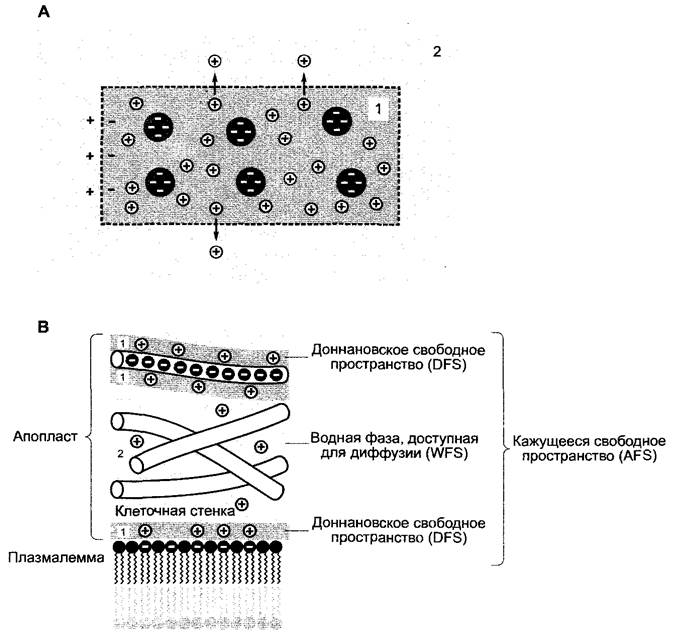
Donnan equilibrium arises when a specific type of ion cannot diffuse across a membrane impermeable to it or is immobilized within a non-diffusible phase (e.g., in cellular structures). Strongly bound or slowly diffusing anions—such as the dissociated carboxyl groups of cell wall Pectins shown in Fig. 6.21, B—attract freely mobile cations from the surrounding environment. If this process continues until the fixed charges are neutralized, although it will lead to the establishment of electroneutrality, a concentration gradient of the cation will persist from the immediate vicinity of the fixed anion (compartment 1) to a more distant region (compartment 2); that is, the system is not in equilibrium. Consequently, cations will diffuse from (1) to (2) until the driving forces (potential gradient, on the one hand, and concentration gradient, on the other) balance each other out.
The resulting equilibrium is known as the "Donnan equilibrium." It is characterized by the fact that the non-diffusible Donnan phase, which contains fixed ions, exhibits a higher total ion concentration relative to the external phase, and a persistent potential gradient (the Donnan potential) exists. The direction of this potential is determined by The Nature of the non-diffusible ion; at a fixed anion, the Donnan phase in The equilibrium state is permanently negatively charged relative to its surroundings.
In addition to pectin carboxyl ions in the apoplast, fixed ions may also occur as protein anionic groups and phosphate groups on the outer surface of the plasmalemma. In any case, negative charges predominate in the apparent free space, causing cations to be tightly bound. As a rule, newly arriving cations (e.g., absorbed from the external solution) do not shift the Donnan equilibrium, but merely displace previously adsorbed cations, meaning that exchange adsorption takes place. For instance, a root kept in a Ca2+ solution will lose its adsorbed Ca2+ when transferred to a solution containing K+ ions, whereas this does not happen in pure water—that is, the root behaves as an ion exchanger.
In the root region, nonspecific diffusion and absorption of ions from the soil solution in a radial direction can proceed only as far as the endodermis. Here, the apoplastic flow is obstructed by Casparian strips (see Fig. 3.18) located in the radial cell walls, which consist predominantly of lignin and suberin deposits (for structure, see 6.17.2, 6.17.3). The Casparian strips disrupt the unhindered penetration of Water and Its dissolved components. At the latest here, as well as all along the pathway from root hairs through the rhizodermis and root cortex, Ion uptake into the symplast takes place (Fig. 6.22). In this process, the plasmalemma serves as a crucial selective barrier, since the lipid phase of Introduction/36.html">Biological Membranes acts as an effective obstacle to the non-selective penetration of ions by diffusion into the root central cylinder (for biomembranes, see 1.5.2, 2.2.5).
Fig. 6.22. Simplified diagram of a Cytology/practical/54.html">Longitudinal section of a root, illustrating the transport processes occurring within it during the uptake of Mineral Substances (ions)

The transport properties of a membrane are in most cases determined by the transmembrane proteins embedded within it, which function as pumps, carriers (carrier), or channels (see Fig. 6.4). Examples of well-characterized ion uptake systems that play a role in the root, along with others important for subsequent Discussion, are shown in Fig. 6.5. These involve secondary active carriers or Ion Channels, because the uptake of mineral element ions from the apoplast into root cells—with the exception of calcium (see below)—is coupled with concentration work and therefore proceeds endergonically (for energy coupling, see 6.1.5). The driving force for this process is provided by the primary active H+-transporting ATPase present in the plasmalemma of all plant cells (proton pump, see Figs. 6.4, 6.5). This relatively large enzyme, consisting of a single polypeptide chain (with a molecular mass of about 100–110 kDa), undergoes conformational changes upon ATP Hydrolysis, during which H+ ions are stoichiometrically transported from the cytoplasm to the apoplast at the expense of ATP. As a result of this electrogenic transport process, a proton-motive force (see 6.1.4.3, equation 6.19) of approximately ≤ -240 mV (ΔpH 2, ΔEm = -120 mV) is generated.
To date, symport carriers for the uptake of nitrate, sulfate, and phosphate, as well as ion channels for The transport of K+, Cl-, and Ca2+ ions, have been characterized at THE MOLECULAR LEVEL in the plasmalemma. To study ion channels, electrophysiological Methods have been developed that make it possible to quantitatively investigate the ion flux through a single ion channel molecule (Box 6.1).
The most important characteristics of substance uptake into the symplast can be explained through the interaction of passive and active processes.
Accumulation: The energy of the proton-motive force is sufficient to perform significant concentrating work. For example, the concentration of the K+ ion in algal and higher plant cells can often be 1000-fold or more higher than that of the surrounding environment. Concentration is more pronounced the more dilute the external solution is. For instance, if beet tissue discs are incubated in running tap water, after some time the K+ concentration inside the cells will stabilize at a level exceeding 10,000:1 compared to the medium, which requires a proton-motive force of at least -240 mV (-59 mV per order of magnitude of accumulation; see equation 6.19).
Selectivity and saturability: The cell's capacity for the selective uptake of certain substances over others (e.g., K+ relative to Na+, phosphate relative to silicate) is high, yet not absolute. On the one hand, a certain degree of non-selective, passive substance uptake occurs continuously; on the other hand, carriers and channels are also not strictly specific. Thus, rubidium ions (Rb+) pass through potassium channels; calcium channels conduct, to a certain extent (aside from calcium), other divalent and monovalent cations as well. It is likely that with sufficiently sensitive methods, all naturally occurring elements could be detected in plants. Finally, alongside high-affinity and highly specific systems, low-affinity, less specific uptake systems also occur (see below).
Box 6.1. Electrophysiological Methods
The patch-clamp technique
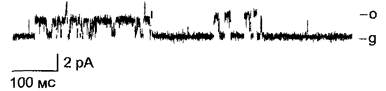
A Glass microelectrode is brought into contact with The surface of the protoplast (or vacuole) (1). By applying slight suction to the cell (2), a very tight seal is formed between the edge of the membrane surface and the glass, with an electrical resistance ranging between 1 and 100 GΩ. In this way, Background noise is reduced to such an extent that the opening and closing of individual ion channels located in the membrane patch beneath the pipette can be recorded. The probability of the channel being open (P0) refers to the fraction of time within a chosen time interval during which the channel under investigation is in the open state (conducting ions) under specific experimental conditions (0 ≤ P0 ≤ 1).
If further suction causes the protoplast to open into the electrode (disrupting the integrity of the protoplast membrane), the total current across the entire surface of the protoplast can be recorded (3). If, conversely, the cell remnants are removed, an isolated patch of The cell membrane remains attached to the pipette, with its cytoplasmic side facing the surrounding solution (4) (patch clamp). This research method is best suited for studying The regulation of ion channels by intracellular factors, since the COMPOSITION OF THE solution on the cytoplasmic side of the membrane can be freely varied at the experimenter's discretion.
A. Principle of the patch-clamp technique

B. Patch-clamp analysis of an ion channel from a plant cell. Recording of current pulses through a potassium channel of SHOOT parenchyma cells of bryony (Bryonia dioica). Configuration type (2) at an applied voltage of +20 mV. o — channel is open, ion current is flowing through it; g — channel is closed, no current is observed
C. Principle of The Lipid Bilayer technique
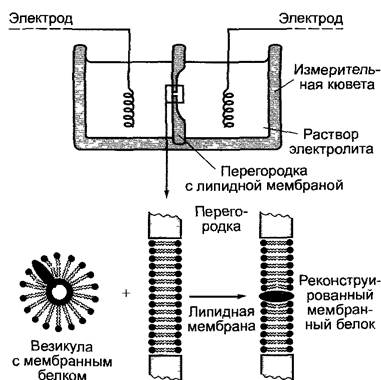
The lipid bilayer technique
The activity of individual ion channels—for example, those in membranes that cannot be studied using the patch-clamp method—can be measured using a fundamentally similar electrical setup, in which two electrodes are immersed in a cuvette divided into two chambers by a partition. In the middle of the partition there is an aperture (≤ 0.2 mm) containing a planar lipid bilayer. Ion channels can be incorporated into this bilayer, and their activity is studied by applying a voltage. A single ion channel protein molecule is sufficient for the analysis.
D. Single-channel activity in a lipid bilayer. Time-course plot of the activity of a single calcium channel from The endoplasmic reticulum of bryony cells, incorporated into a planar lipid bilayer, at an applied voltage of +50 mV

Plotting the uptake of ions by plant roots (or other tissues, such as storage or leaf tissues) against an increasing external ion concentration yields curves that formally follow Michaelis–Menten kinetics (Fig. 6.23), which apply to many enzymes (cf. Fig. 6.9). For instance, the K+ uptake rate in barley roots reaches a maximum at approximately 0.2 mmol l-1 KCl in the external solution, and this maximum is not exceeded even when the concentration is increased to 0.5 mmol • l-1. However, if the KCl concentration is raised to much higher levels (1–50 mmol l-1), the uptake rate increases once again.
Fig. 6.23. Potassium uptake rate (v) as a function of KCl concentration in the medium. The abscissa is broken in the range between 0.2 and 0.5 mmol l-1 KCl. The solid line at low concentrations—uptake phase 1 (continued by the dashed line)—is calculated according to the Michaelis–Menten Equation with Km = 0.021 mmol l-1 and Vmax = 11.9 µmol/g (fresh weight) per hour

The shape of the curve indicates two distinct mechanisms for K+ ion uptake. Mechanism 1 operates at low ion concentrations (< 1 mmol l-1, which correspond to natural ion concentrations in the soil), is specific for K+ (and Rb+), and is independent of The Nature and uptake rate of the accompanying anion. These properties indicate that this transport is mediated by a potassium-specific ion channel. Mechanism 2 has a low substrate affinity and therefore operates efficiently only at high ion concentrations; it is relatively nonspecific (competing with potassium, for example, with Na+ and Ca2+) and is influenced by the accompanying counterion. This suggests that the process relies on a different transport system.
A similar biphasic absorption kinetics has been observed for other cations and anions. For example, under conditions of abundant sulfate supply, roots exhibit only a single, low-affinity, and constitutive (i.e., constitutively expressed) uptake system. As soon as the sulfate content in the medium drops below a certain threshold value, the synthesis of a second, high-affinity sulfate transporter is induced, which functions efficiently even at micromolar ion concentrations.
This presents a particular challenge for the plant, as the absorbed nitrate and sulfate anions are reduced (cf. 6.6, 6.7) and thus removed from electrochemical equilibrium. To maintain electroneutrality, cations left without their counterion (such as K+ upon uptake of K2SO4 or KNO3) must be neutralized by other anions. To achieve this, plants utilize organic anions, primarily malate and oxalate.
The selective uptake of ions from the soil can lead to physiologically significant pH shifts. For instance, when NH4Cl is applied, the plant preferentially absorbs NH4+ through exchange adsorption with protons, leading to an accumulation of hydrogen ions in the soil and, consequently, to soil acidification. Therefore, ammonium chloride acts as a physiologically acidic salt.
Although iron is present in sufficient quantities in most soils, it frequently acts as a limiting factor for plants, particularly in alkaline soils, because only a small fraction of this element remains in a dissolved state (as Fe3+). This is due to the formation of insoluble iron(III) oxide in an alkaline environment, in accordance with the equation 2Fe(OH)3 -> Fe2O3 • 3H2O. Furthermore, roots preferentially absorb iron in the divalent form, Fe2+. However, the concentration of dissolved iron is significantly enhanced by the secretion of organic compounds with Fe3+-chelating properties by soil bacteria and fungi—the so-called siderophores (from Greek sideros, iron; pherein, to bear). Dicotyledons and non-grass monocots (excluding Poaceae) release hydrogen ions to improve the solubility of Fe3+ and organic acids to lower the rhizosphere pH. At The Plasma Membrane of root parenchyma cells, they reduce Fe3+ ions—which diffuse through the apoplast to the cell surface—to Fe2+, which are then taken up into the cell via a specific transport protein.
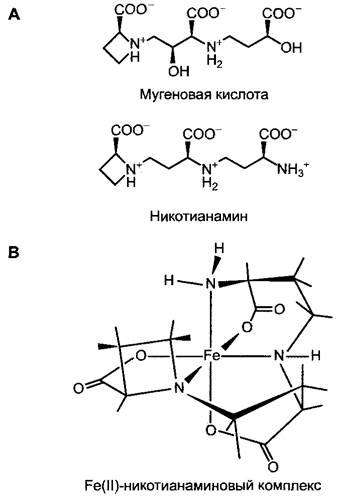
Iron uptake in grasses (Poaceae) is mediated by mugeneic acid, which is secreted by the roots and forms chelate complexes specific for Fe3+. Mugeneic acid and related compounds are therefore also referred to as phytosiderophores. The complex between Fe3+ and mugeneic acid is taken up into root cells via a specific transport protein, where reduction to Fe2+ takes place. The synthesis of mugeneic acid is induced exclusively under iron deficiency and ceases when iron supply is adequate.
Within the plant itself, the transport of Fe2+ also occurs in the form of chelate complexes. The chelator is nicotianamine (Fig. 6.24), which is structurally related to mugeneic acid and also synthesized from methionine; it forms stable complexes not with Fe3+, but with Fe2+ (as well as Mn2+, Zn2+, Co2+, and Ni2+). Nicotianamine
is present in all plants. The tomato mutant chloronerva, which has a defect in nicotianamine synthesis, exhibits severe disturbances in iron distribution that can be corrected by The addition of nicotianamine.
Fig. 6.24. Structure: A — phytosiderophore mugeneic acid (specific for Fe3+) and nicotianamine (specific for Fe2+); B — Fe(II)–nicotianamine complex (atoms involved in iron binding are shown in gray)
In Gram-negative bacteria, such as Escherichia coli, Fe(III)–siderophore complexes (Fe(III)–ferricromes) are actively transported into the periplasm by high-affinity inner-membrane transporters and accumulate there to levels exceeding those in the surrounding medium. The energy for this process is provided by the Electrochemical Potential of the cytoplasmic membrane, which influences transporter activity via a periplasm-spanning protein complex.
Ions that have entered the symplast in the region of root hairs or root cortex parenchyma cells are subsequently passed from Cell to Cell (cf. Fig. 6.22) via plasmodesmata. Due to the Casparian strips, Transport from the endodermal cells into the stele can occur exclusively via the symplast. The processes involved in loading ions into the water-conducting Vascular Tissues of the stele are not yet fully understood. It is likely that active and selective processes located in the endodermis or xylem parenchyma play a major role in the release of ions into the apoplast of the stele (Fig. 6.22).
Root cortical parenchyma cells store mineral nutrients in their large vacuoles; although temporarily withdrawn from direct parenchymatous transport, these reserves can be remobilized whenever needed. This helps to buffer fluctuations in the plant's mineral supply. A similar smoothing of mineral concentration fluctuations occurs through the binding of ions (primarily cations) to charged groups within the cell walls of the water-conducting xylem vessels; when the ion concentration in the xylem sap drops, these ions can be released again (cf. 6.3).
Throughout the water-conducting vessels, mineral salts can pass from the Transpiration stream into the apoplast or symplast (and ultimately also into the vacuoles) of adjacent tissues—the underlying mechanism is fundamentally the same as in the root. In regions of high transpiration rate (e.g., at the cuticle of stomatal guard cells), this can lead to the accumulation of mineral substances.
A fraction of inorganic ions can transfer from the xylem or parenchyma into the phloem assimilate pathways and be distributed together with the assimilates. The phloem mobility of other ions is limited, and finally, some ions are practically immobile (Table 6.10).
Table 6.10. Mobility of mineral elements in the phloem
Mobile |
Moderately mobile |
Immobile |
Potassium |
Iron |
Lithium |
Rubidium |
Manganese |
Calcium |
Cesium |
Zinc |
Strontium |
Sodium |
Copper |
Barium |
Magnesium |
Molybdenum |
Aluminum |
Phosphorus |
Cobalt |
Lead |
Sulfur |
Boron |
Polonium |
Chlorine |
Silver Fluorine |
The first group includes ions that can be redistributed within the plant according to physiological demand—for example, transported from older to younger leaves and other organs. K+ belongs to this group as the most important cation. It is hypothesized that potassium may fulfill specific functions during phloem transport (cf. 6.8). While nitrogen and sulfur are transported in the phloem predominantly as organic compounds, chloride and, above all, phosphate are translocated in substantial quantities as free anions. The relatively high concentrations of free phosphate in sieve tubes (approx. 2–4 mmol • l-1) account for the fact that cations forming sparingly soluble phosphates (such as calcium, barium, and lead) are virtually immobile in the phloem.
This has several far-reaching consequences, primarily for calcium. For instance, it has been suggested that low concentrations of Ca2+—which plays a crucial role in maintaining Membrane Structure within the cell—may cause profound cytological changes in sieve elements (e.g., degeneration of the tonoplast and Cell Nucleus, and partial drastic structural alterations of organelles; cf. 3.2.4.1). The sole biomembrane of the sieve element, the plasmalemma, would have to obtain the required Ca2+ directly from the adjacent apoplast.
Another consequence of the immobility of Ca2+ in the phloem, on the one hand, and its ability to move along with the transpiration stream, on the other, is that the Ca/K ratio in plant ash is lower the more phloem-dominated the organ's nutrition is compared to xylem supply. It is very low, for example, in potato tubers and peanut pods, which are supplied almost exclusively via the phloem. (Since they grow in the soil, they lack a water potential gradient between the root and the organ, making supply via the transpiration stream impossible.) The Ca/K ratio can thus be used to distinguish between plant xylem and phloem parasites; in the former (e.g., Viscum, mistletoe), this ratio is high and can exceed 3:1, whereas in the latter (e.g., Cuscuta, dodder), it is low—around 1:17.
Ultimately, the lack of phloem transport for calcium and other immobile elements leads to their continuous accumulation in organs of high transpiration, particularly leaves. Unlike potassium and phosphate, they are not translocated to other organs (such as the stem) prior to leaf abscission. This continuous, irreversible accumulation of calcium and other phloem-immobile elements is likely the reason why even so-called "evergreen" plants must periodically renew their foliage. For instance, the lifespan of pine needles is 2–3 years, that of spruce growing at low altitudes (<300 m) is 5–7 years, while for those at higher altitudes (1,600–2,000 m) it is 11–12 years; for fir it is 5–7 years, and for mountain pine (Pinus mugo) 6–8 years. The leaf age of evergreen laurel does not exceed 6 years, whereas in ivy and holly (Ilex), leaves rarely live longer than 2 years.
If plants grown in a calcium-rich medium are transferred to a calcium-free medium, the existing leaves will exhibit a calcium excess, whereas the new leaves will show all the symptoms of its deficiency.
Last update: 07/08/2026
Editorial and Educational Adaptation: This material has been compiled based on the primary/original source text. The project team performed an editorial review, corrected technical inaccuracies, structured sections, and adapted the content for an educational format.
What was processed:
- elimination of formatting defects (OCR errors, structural breaks, corrupted characters);
- editorial organization of content;
- standardization of terminology in accordance with academic sources;
- verification of factual statements against the original source text.
All mentions of the author, publication year, and origin of the primary text have been preserved in accordance with the source.