Biological Membranes - A. N. Ogurtsov 2012
Electrogenesis of Biomembranes
Nonequilibrium Thermodynamics of Biomembranes
Electrochemical Potential
Approaches of equilibrium Thermodynamics are applied to describe The transport of matter across Introduction/36.html">Biological Membranes.
In a Cell, chemical transformations and mass transport occur at T = const and p = const. Therefore, the equation
Class="center">
takes the form
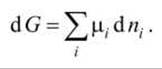
For a single reaction cycle, the number of reactant and product molecules is proportional to the respective stoichiometric coefficients v such that The change in the number of moles is ∆ni = vi. This holds true when the number of molecules reacted in a single cycle is significantly smaller than the total number of reactant molecules in the mixture.
Then the expression
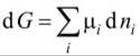
can be written as
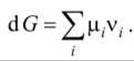
By the sign convention, vi < 0 for reactants and vi > 0 for reaction products.
Let us consider the transport of a substance across a membrane from phase A to phase B, given that the phases differ in their chemical potentials μА and μB. In this case

Since vА = -vB = v, we have

at equilibrium state ∆G = 0, hence

or
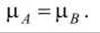
In the more general case, Two Types of processes can occur between two phases separated by a membrane: the transport of uncharged particles driven by a concentration gradient between сA and сB (osmotic work) and the transport of charged particles (electrical work). In this case, the change in Free energy is determined by the difference in electrochemical potentials
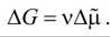
The electrochemical potential  is the total potential that accounts for the chemical potential μ of the system and the electrical work associated with the transport of charged particles
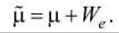
At constant Temperature and system composition, the change in Gibbs free energy for a process that transfers the system from state A to state B is equal to

For a gas of uniform composition, the chemical potential
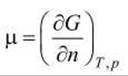
equals the change in Gibbs free energy upon adding one mole of the gas to an infinitely large amount of the same gas. Therefore,
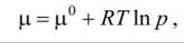
where μ0 is the standard chemical potential at a pressure of 1 atmosphere.
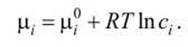
Similarly, the chemical potential of component i in a gas mixture can be expressed taking into account the relation between pressure p and concentration p = cRT. Let μ0i be the standard chemical potential of component z when its concentration is equal to unity. Then the chemical potential of component i in the gas mixture is
The electrical work is given by
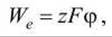
where z is the ion valence; F = 96500 Кл is the Faraday constant (the charge of one mole of monovalent ions); φ is the electrical potential at the phase-environment interface.
For the transport of neutral species and ions across a membrane from phase A to phase B, the change in electrochemical potential is expressed as

The equilibrium condition is ∆G = 0. Thus, in the general case involving the transport of both neutral and charged particles, equilibrium is determined by the relation 
or by the equality of electrochemical potentials 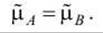
Last update: 13/08/2026
Editorial and Educational Adaptation: This material has been compiled based on the primary/original source text. The project team performed an editorial review, corrected technical inaccuracies, structured sections, and adapted the content for an educational format.
What was processed:
- elimination of formatting defects (OCR errors, structural breaks, corrupted characters);
- editorial organization of content;
- standardization of terminology in accordance with academic sources;
- verification of factual statements against the original source text.
All mentions of the author, publication year, and origin of the primary text have been preserved in accordance with the source.