Biological Membranes - A. N. Ogurtsov 2012
Electrogenesis of Biomembranes
Nonequilibrium Thermodynamics of Biomembranes
Chemical Reaction Affinity
Let us now move from closed systems to open systems, which experience continuous inflows and outflows of matter. In this case, The change in thermodynamic potential depending on the system's composition is driven not only by Chemical Reactions, but also by the influx of matter from the external environment—meaning there are flows of matter across the system boundary. The Role of chemical potential as the "source" of the forces driving these material flows can be illustrated by the following example. If a drop of blue ink is added to a bucket of Water, it will gradually diffuse from the region of high concentration until the ink concentration is uniform throughout the entire volume of the bucket, turning the water a pale, even light-blue. The value of the chemical potential in a concentrated solution is higher than in a dilute one, and the difference in chemical potentials plays the same role in establishing material flows as a Temperature gradient does in Heat transfer.
During a chemical reaction, reactant molecules are consumed synchronously as product molecules are formed. For example, in the ammonia synthesis reaction
Class="center">N2 + 3Н2 = 2NH3
The formation of two moles of ammonia consumes one mole of nitrogen and three moles of hydrogen. Therefore, a quantity known as the degree of completeness of the reaction remains constant
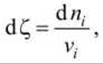
where dni is the change in The amount of the i-th component of the system during the reaction; vi is the corresponding stoichiometric coefficient taking into account the sign convention (in this example, vN2 = -1, vH2 = -3, vNH3 = +2).
The change in Gibbs energy in this reaction is
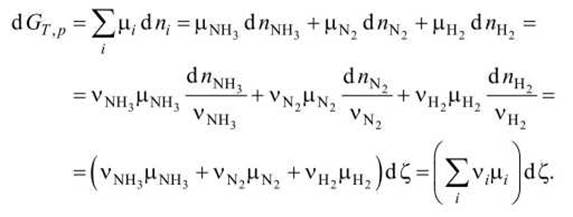
The chemical affinity of a reaction is defined as the sum


At thermodynamic equilibrium, dG = 0, and consequently, A = 0. For the reaction under consideration, N2+ 3Н2 = 2NH, the condition

or, equivalently,

serves as the condition for chemical equilibrium.
Before equilibrium is reached, dG < 0, and therefore,

The time rate of change of Gibbs energy is

where

is The rate of the chemical reaction.
The condition  can only be met if A and v have the same sign.
In the example under consideration, before equilibrium is attained, ammonia molecules are being formed, so the reaction rate is positive; consequently, the affinity A for ammonia synthesis is also a positive quantity

The reaction proceeds spontaneously from left to right as long as the affinity remains positive. If, for example, a certain amount of ammonia is added to the equilibrium mixture (while keeping
the reaction volume constant), the affinity for ammonia synthesis becomes negative; however, at the same time, the affinity for the formation of hydrogen and nitrogen from the dissociated ammonia molecules will be positive, and the reaction will proceed in the reverse direction.
At equilibrium
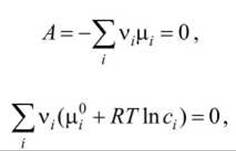
or
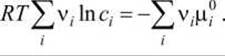
The right-hand side of the equation represents the standard chemical affinity of the reaction at a given temperature, which is the standard Gibbs Free energy change of the chemical reaction

On the other hand
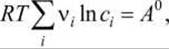
from which it follows that
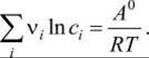
For the reaction under consideration

from which it follows that

For an arbitrary reaction

one can write

Thus, knowing the stoichiometric equation of a reaction, one can use tabulated chemical affinity values to calculate the Equilibrium Constant and predict the feasibility of the reaction.
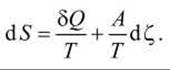
If irreversible processes occur in an open system, the Entropy change can be expressed as
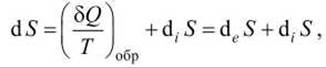
where de S is the entropy change due to exchange with the external environment, and di S is the entropy production (generation) within the system itself resulting from irreversible processes such as thermal conduction, diffusion, and chemical reactions. Since, As a result of a chemical reaction, the change in mass of the i-th component during chemical transformation is given by dmi = viMidζ, we have

where vi is the stoichiometric coefficient; ni is the number of moles of the substance; Mi is the molar mass; ζ is the extent of reaction.
Entropy is an exact differential, and the entropy change S(n1,n2,...ni) can be written as

Since

consequently,
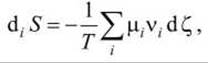
or

The total entropy change in an open system, accounting for energy exchange with the external environment, takes the form
Last update: 13/08/2026
Editorial and Educational Adaptation: This material has been compiled based on the primary/original source text. The project team performed an editorial review, corrected technical inaccuracies, structured sections, and adapted the content for an educational format.
What was processed:
- elimination of formatting defects (OCR errors, structural breaks, corrupted characters);
- editorial organization of content;
- standardization of terminology in accordance with academic sources;
- verification of factual statements against the original source text.
All mentions of the author, publication year, and origin of the primary text have been preserved in accordance with the source.