Biological Membranes - A. N. Ogurtsov 2012
Electrogenesis of Biomembranes
Nonequilibrium Thermodynamics of Biomembranes
Generalized Forces and Generalized Fluxes
Many biological processes occur exclusively in a non-equilibrium state, as they are driven by non-equilibrium forces that, in turn, generate various types of fluxes. Deliberately establishing and maintaining specific non-equilibrium conditions in biotechnological processes is often a key factor in enhancing the efficiency of specific biotechnologies.
A biological system in an equilibrium state is "dead"; time and history do not exist for it. It transitioned into this state from a non-equilibrium state when the system was still "alive" and possessed "forces" that drove various changes, ultimately bringing the system to equilibrium—i.e., to "death". This can be avoided by artificially maintaining the biosystem in a state far from thermodynamic equilibrium.
In non-equilibrium Thermodynamics, the terms "force" or "generalized forces" are attributed to all interactions or changes, including conventional mechanical forces. For instance, a system can be maintained in a prolonged non-equilibrium state by a continuous influx and efflux of matter and energy. Therefore, in this context, The properties of process irreversibility and non-equilibrium represent Two Sides of the same physical phenomenon.
Forces can arise within a non-equilibrium system due to, for example, Chemical Reactions, as well as Temperature and concentration gradients, which represent the differences in the respective values across various Regions of the system.
Forces generate currents, or fluxes, which ultimately deplete the forces that gave rise to them. All gradients gradually dissipate, and the system reaches its final state of equilibrium.
For example, a temperature gradient between two points in an object acts as a source of driving force and generates a heat flux—The transfer of a certain amount of heat per unit area per unit time from the hot part of the body to the cold part. This heat flux raises the temperature of the cold region at the expense of the hot one, gradually driving the system toward a state of thermal equilibrium.
The presence of forces and fluxes in a non-equilibrium system indicates that the system is inhomogeneous and that chemical processes are occurring within it.
A standard approach in describing inhomogeneous systems is to partition the system into infinitesimal volumes, within each of which the system can be considered homogeneous. This allows local variables to be rigorously defined, while the integral Properties of the entire system are obtained by summing over the entire volume. Thus, for the y-th component of the system, py is introduced as the partial mass per unit volume (partial density), with the density defined as
Class="center">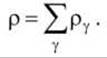
For a system of n moles, molar quantities are used

Then, local quantities can be introduced:  , the Entropy per unit volume (local entropy); and
  , the internal energy per unit volume (local energy).
Volume is no longer an independent variable, since 
Local entropy is a function of local energy and partial densities  , and this functional relationship is described by the local Gibbs equation

which is a particular case of the Gibbs equation

where Ny is the mass of the given component in one mole of the system substance.
The total entropy of the system can be obtained by integrating the local entropy over the entire volume of the system

The properties of irreversibility and state non-equilibrium are thermodynamically expressed through entropy "production" (The change in entropy over time), and our objective is to relate the time derivative of local entropy to the forces (gradients, affinity) and fluxes that maintain the system's non-equilibrium state.
The time derivative of local entropy

as a function of several variables

where p'y≠ py and py are all independent variables whose sum

unlike in closed systems, may not be constant.
From the local Gibbs equation

we obtain the relation
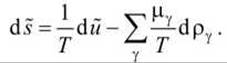
Consequently,

Next, to determine the fluxes, we employ hydrodynamic relations based on the law of conservation of mass.
The law of conservation of mass requires that the time rate of change of mass within a given region of the system (or, effectively, The rate of change of substance density for a unit volume) be caused solely by the flux of matter across the boundary of this region. In this context, system inhomogeneity is accounted for, as before, by introducing local variables, using density instead of mass, and taking the limit as the volume V of the region under consideration approaches zero—that is, by transitioning from integral parameters to local ones (at a given point in the system).
In this case, the law of conservation of mass relates the time derivative of the partial density of a given component y at a given point in space to the scalar divergence of the vector field  representing the outward diffusion flux of matter through the surface enclosing that point.
To ensure locality, we let the volume of the region enclosed by the surface approach zero, yielding the expression
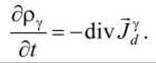
Thus, this relation serves as a mathematical formulation of the law of conservation of mass: at a given point, the substance density can decrease only due to a positive outward flux of matter through the surface bounding the infinitesimal volume around that point.
In addition to material flux, changes in substance density at a given point can occur As a result of chemical reactions that generate the component in question (acting as sources of this component).
In this case, the corresponding term must be added to the right-hand side of the equation

where vr is the velocity; vry is the stoichiometric coefficient of the y-th component in the r-th reaction.
Similarly, the law of conservation of energy requires that the local change in energy at a given point (in the absence of convection, mechanical work, or any other external forces) occur solely due to the energy flux  through a corresponding surface enclosing that point; therefore, we can write
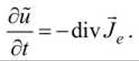
If heat is the sole form of internal energy, the local change in internal energy is related to the heat flux 

Substituting this into the equation

values from the expressions

we obtain

where

In reality, one must also account for the entropy source due to irreversible processes by introducing an additional term with

The first term on the right-hand side—the flux term—represents the divergence of the entropy flux vector field  , which is driven by two processes:
1) the heat flux 
2) the diffusion flux of chemical species 
The second term describes the rate of local entropy production (the entropy source) caused by various irreversible processes driven by generalized forces Xi, which give rise to the corresponding generalized fluxes 

Vector notations are omitted here since generalized fluxes and forces can also be scalar quantities. In our case, for a chemical reaction, the affinity acts as the generalized force, while the reaction rate plays The Role of the generalized flux

The total entropy change of the system

can be expressed as the sum of two terms.
The entropy of a system can change due to (1) the entropy flux across the system boundary Ω

as well as due to (2) entropy production within the system
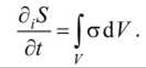
If we isolate the system from external entropy fluxes, then, According to the second law of thermodynamics, the entropy of an isolated system can only increase; consequently,

or

from which follows the condition

Thus, the sum of all values of the quantities JiXi must not be negative, although individual values of JiXi can be negative.
Note that the literature also employs the so-called dissipative function Φ (or dissipation function), which equals the rate of entropy production multiplied by the temperature

Generalized fluxes depend on generalized forces (since they are caused by them), and conversely, the rate of a chemical reaction depends on affinity, and the heat flux depends on the temperature difference. Let us write this functional relationship in a general form as

In The equilibrium state, generalized forces vanish and do not induce any fluxes.
Near equilibrium, the magnitude of generalized forces is small and, accordingly, the magnitude of fluxes is also small. Therefore, expanding the fluxes in a Taylor series

we can restrict ourselves to linear terms only (by definition, Jіравн = 0)

The domain of applicability of such a linear approach is referred to as the thermodynamics of linear irreversible processes.
Phenomenological proportionality coefficients between generalized fluxes and generalized forces

are calculated in the equilibrium state. In the linear approximation
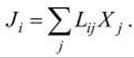
When і = j, the coefficients Lii are called direct (non-coupled) coefficients; they reflect the fact that a given flux is driven by its own corresponding force.
When і ≠ j (the two indices are distinct), the coefficients Lij are called coupled coefficients, meaning in this case that force j induces flux і.
An example of a linear process is Ohm's law

which in differential form has the appearance

or (since

and considering a one-dimensional current along the x-axis)
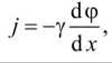
where R is the electrical resistance of the conductor; γ is the electrical conductivity of the conductor;  is the electric field strength; I is the electric current; j is the electric current density; φ is the electric field potential; U is the voltage.
Some Examples of linear irreversible processes of the form J = LX, along with their corresponding conjugate generalized forces and the generated generalized fluxes, are given in Table 6.
Last update: 13/08/2026
Editorial and Educational Adaptation: This material has been compiled based on the primary/original source text. The project team performed an editorial review, corrected technical inaccuracies, structured sections, and adapted the content for an educational format.
What was processed:
- elimination of formatting defects (OCR errors, structural breaks, corrupted characters);
- editorial organization of content;
- standardization of terminology in accordance with academic sources;
- verification of factual statements against the original source text.
All mentions of the author, publication year, and origin of the primary text have been preserved in accordance with the source.