Principles of Biochemistry Volume 1 - A. Lehninger 1985
Biomolecules
Water
The equilibrium state of reversible reactions is characterized by an equilibrium constant
Water molecules possess a very weak capacity for reversible ionization, during which they dissociate into hydrogen ions (Н+) and hydroxyl ions (ОН-); an equilibrium is thereby established between the undissociated molecules and the ions:
Class="center">
Since the reversible Ionization of water is crucial for understanding its properties and role in living Cell function, we need a quantitative way to express its degree of ionization. Let us briefly review Some General Properties of reversible reactions.
The state of equilibrium for any chemical reaction is characterized by an Equilibrium Constant. The equilibrium constant expression for the general reaction

can be readily derived from the law of mass action. According to this law, a chemical reaction described by equation (2) will proceed from left to right until a new equilibrium is established if we increase the concentration of one of the reactants (A or B) or both. Conversely, increasing the concentration of substances C or D, or both simultaneously, will cause the reaction to proceed from right to left until a new equilibrium is reached. This principle can also be formulated more quantitatively. The rate of the forward reaction, v1, proceeding from left to right, is proportional to the product of the active concentrations of the reactants A and B:
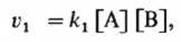
where k1 is the proportionality constant, and the square brackets denote molar concentration. The rate of the reverse reaction, v2, proceeding from right to left, is respectively
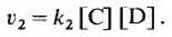
Since equilibrium is defined as the state in which the rates of the forward and reverse reactions are equal, the following equality must hold at equilibrium
v1 = v2
and, consequently:
k2 [А] [В] = k2 [С] [D].
Rearranging this expression yields 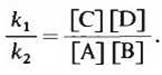
The ratio of the two rate constants  can be replaced by a single new constant, namely the equilibrium constant K'eq, which is equal to
 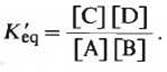 [The prime indicates that the value of the equilibrium constant expresses the ratio of molar (rather than weight or volumetric) concentrations of the reactants and products.]
The equilibrium constant is a fixed value that quantitatively characterizes any chemical reaction proceeding at a given Temperature. It allows us to calculate the COMPOSITION OF THE equilibrium mixture for a given reaction, regardless of the initial amounts of reactants and products. Conversely, if the concentrations of all reactants and end products at equilibrium are known, the value of the equilibrium constant can be easily calculated for a reaction proceeding at a known temperature.
Last update: 06/08/2026
Editorial and Educational Adaptation: This material has been compiled based on the primary/original source text. The project team performed an editorial review, corrected technical inaccuracies, structured sections, and adapted the content for an educational format.
What was processed:
- elimination of formatting defects (OCR errors, structural breaks, corrupted characters);
- editorial organization of content;
- standardization of terminology in accordance with academic sources;
- verification of factual statements against the original source text.
All mentions of the author, publication year, and origin of the primary text have been preserved in accordance with the source.