LEHNINGER PRINCIPLES OF BIOCHEMISTRY - VOL. 1. THE FOUNDATIONS OF BIOCHEMISTRY: STRUCTURE AND CATALYSIS - 2011
PART I. STRUCTURE AND CATALYSIS
2. WATER
2.2. Ionization of Water, Weak Acids, and Weak Bases
Many of the solvent properties of Water can be explained by considering H2O as an uncharged molecule. However, it is occasionally necessary to account for the slight degree of ionization of water and the presence of hydrogen ions H+ and hydroxide ions OH- In aqueous solutions. The ionization of water, like any reversible reaction, is characterized by an equilibrium
constant. When weak acids are dissolved in water, they ionize and contribute additional H+ ions to the solution; weak bases accept H+ and are converted into their protonated forms. Each of these processes is characterized by an Equilibrium Constant. The total concentration of hydrogen ions is determined experimentally and expressed as the pH of the solution. To predict the ionization state of a given substance in solution, one must account for the equilibrium constants of the corresponding ionization reactions. Therefore, we now turn our attention to the ionization of water, as well as of weak acids and bases dissolved in water.
Pure water is only slightly ionized
Water molecules have a small tendency to undergo ionization, i.e., to form hydrogen ions (protons) and hydroxyl ions According to the following equation:
Н2О ⇄ Н+ + ОН (2-1)
We usually write the product of water dissociation simply as H+, but it should be kept in mind that free protons do not exist in water. Hydrogen ions in water are hydrated immediately, forming the hydronium ion (hydroxonium ion) H3O+. Due to hydrogen bonding between water molecules, proton Hydration occurs virtually instantaneously:
Class="center">
The degree of ionization of water can be determined from its electrical conductivity. Pure water conducts electricity because H3O+ migrates toward the cathode and OH- toward the anode. The movement of these ions in an electric field is exceptionally rapid compared to ions such as Na+, K+, or Cl-. This high mobility can be explained by the proton-hopping mechanism illustrated in Fig. 2-13. Specifically, rather than a single specific proton moving a long distance through the bulk water, an entire "bucket brigade" of protons relays the charge between adjacent, hydrogen-bonded water molecules; the net effect is the rapid transport of a proton over a long distance in a remarkably short time. Because of this high mobility of H+ (and OH-, which moves just as rapidly in the opposite direction), acid-base reactions in aqueous solutions typically proceed at extremely high rates. Furthermore, as noted above, this mechanism of proton transfer appears to play a vital role in biological processes (Fig. 2-10; see also Fig. 19-67).
Fig. 2-13. The "proton-hopping" mechanism. Successive "jumps" of protons between adjacent hydrogen-bonded water molecules greatly increase the overall rate of proton transfer over relatively large distances. As soon as a hydronium ion (top left) gives up its proton, a water molecule some distance away (bottom right) almost simultaneously accepts a proton and becomes a hydronium ion itself. The rate of proton transfer via this mechanism is much higher than the rate of diffusion, explaining the remarkably high mobility of the proton compared to other monovalent cations such as Na+ or K+.

Because the reversible ionization of water is crucial for understanding the Role of water in cellular function, we need Methods to express its degree of ionization quantitatively. Let us briefly review Some General Properties of Reversible Chemical Reactions.
The equilibrium of any chemical reaction is characterized by an equilibrium constant Keq, often denoted simply as K. The equilibrium constant for the chemical reaction
A + B ⇄ C + D (2-2) can be expressed in terms of the concentrations of the reactants (A and B) and products (C and D) according to the equation:

Strictly speaking, activities (effective concentrations in nonideal solutions) of each substance should be used in the equation. However, except for certain highly precise experiments, the equilibrium constant can be estimated by measuring the equilibrium concentrations of the substances. The equilibrium constant is a dimensionless quantity, but it must be remembered that concentrations substituted into the equation must be expressed in molarity (moles per liter).
The equilibrium constant is a constant value that serves as a quantitative characteristic of any chemical reaction at a given Temperature. It allows the composition of an equilibrium mixture to be calculated, regardless of the initial amounts of reactants and products. Conversely, if the concentrations of all reactants and end products at equilibrium are known, the equilibrium constant for a reaction proceeding at a given temperature can be readily calculated. As we demonstrated in Chapter 1, the logarithm of the equilibrium constant is directly related to The change in Gibbs Free energy ∆G°.
The ionization of water can be characterized by an equilibrium constant
The ionization of water according to equation 2-1 occurs to only a very small extent; at any given moment at 25 °C, only about two in every 109 water molecules are in an ionized state. The equilibrium constant for the reversible reaction (2-1) can be written as
 (2-3)
(2-3)
In pure water at 25 °C, the concentration of water is 55.5 M (a value obtained by dividing the mass of water in 1 L by its molecular weight: (1000 g/L) / (18.015 g/mol) = 55.5 M). This value can be considered virtually constant compared to the much lower concentrations of H+ and OH-, which are 1 • 10-7 M. Thus, the value of 55.5 M can be substituted into equation 2-3, yielding:

Or (55.5 M) Keq = [Н+] [ОН-] = Kw (2-4)
where Kw is the product of 55.5 • Keq and is called the ion-product constant for water at 25 °C.
The numerical value of Keq, determined from the electrical conductivity of pure water, is 1.8 • 10-16 at 25 °C. Substituting this value into Equation 2-4 gives the numerical value for the ion product of water:
Kw = [Н+] [ОН-] = (55.5 M) (1.8 • 10-16 M) = 1.0 • 1014 M2
This means that the product of [Н+] [ОН-] in an aqueous solution at 25 °C is always equal to 1 • 1014 M2. If the concentrations of Н+ and ОН- ions are exactly equal—which is indeed the case, for example, in pure water—the solution is said to be neutral (having a neutral pH). The concentrations of Н+ and ОН- under these conditions can be calculated using the ion product of water:
Kw = [H+] [OH-] = [H+]2 = [OH-]2
Solving this equation for Н+, we obtain

Since the ion product of water is a constant, it is clear that if the concentration of Н+ ions exceeds 1 • 10-7 M, the concentration of ОН- ions must be less than this value, and vice versa. When the Н+ concentration is very high, as in Hydrochloric acid, the ОН- concentration must be very low, since their product is constant. Thus, using the numerical value of the ion product of water, we can calculate the Н+ concentration if the ОН- concentration is known, and vice versa.
Example 2-3. Calculation of [Н+]
What is the concentration of Н+ ions in a 0.1 M NaOH solution?
Solution. Writing the equation for the ion product of water:
Кw = [Н+] [ОН-]
Solving this equation for [Н+], we obtain for [ОН-] = 0.1 M

Example 2-4. Calculation of [ОН-]
What is the concentration of ОН- in a solution containing 1.3 • 10-4 M Н+?
Solution. Writing the equation for the ion product of water:
Kw = [Н+] [ОН-]
Solving this equation for [ОН-], we obtain for [Н+] = 1.3 • 10-4

When solving these or any other equations, round the result to the appropriate number of significant figures, as shown here.
The pH scale: Designations for Н+ and ОН- Ion Concentrations
The pH scale is based on the ion-product constant of water, Kw (Table 2-6). It provides a convenient way to designate the concentration of Н+, and consequently of ОН- ions, in any aqueous solution ranging between 1.0 M Н+ and 1.0 M ОН-. What is pH?
Table 2-6. The pH Scale
[Н+] (М) |
pH |
[ОН-] (М) |
рОН* |
10°(1) |
0 |
10-14 |
14 |
10-1 |
1 |
10-13 |
13 |
10-2 |
2 |
10-12 |
12 |
10-3 |
3 |
10-11 |
11 |
10-4 |
4 |
10-10 |
10 |
10-5 |
5 |
10-9 |
9 |
10-6 |
6 |
10-8 |
8 |
10-7 |
7 |
10-7 |
7 |
10-8 |
8 |
10-6 |
6 |
10-9 |
9 |
10-5 |
5 |
10-10 |
10 |
10-4 |
4 |
10-11 |
11 |
10-3 |
3 |
10-12 |
12 |
10-2 |
2 |
10-13 |
13 |
10-1 |
1 |
10-14 |
14 |
100(1) |
0 |
* Sometimes pOH is used to express the basicity (OH- concentration) of a solution; by definition, pOH = - lg[OH-]. Note that pH + pOH = 14 at all times.
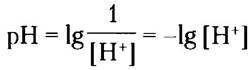
where the symbol "p" denotes the negative logarithm. The pH of a neutral solution at 25 °C, in which the H+ ion concentration is 1 • 10-7 M, can be calculated as follows:

Note that the proton concentration must be expressed in moles (M).
For a neutral solution, pH = 7. This is not an arbitrary value, but a result derived from the ion product of water at 25 °C, where the whole number is obtained by calculation. Solutions with pH > 7 are alkaline because their OH- concentration exceeds their H+ concentration, whereas solutions with pH < 7 are acidic.
It is important to realize that the pH scale is logarithmic. When two solutions are said to differ in pH by one unit, it means that the H+ concentration of one is 10 times that of the other, even though the absolute pH values of the solutions may be unknown. Figure 2-14 shows the pH values of various fluids. Note that the H+ concentration in Coca-Cola (pH 3.0) or red wine (pH 3.7) is approximately 10,000 times higher than that in Blood (pH 7.4).
Figure 2-14. pH (left scale) of some common fluids.

To approximate the pH of an aqueous solution, one can use various Dyes (indicators) such as litmus, phenolphthalein, or phenol red, which change color as a proton dissociates from the dye molecule. Precise pH determination in a chemical or clinical laboratory is performed using Glass electrodes, which are selective for H+ ions while remaining unresponsive to Na+, K+, and other cations. In a pH meter, the electrical signal from a glass electrode immersed in the test solution is amplified and compared with the signal generated by a solution of precisely known pH.
■ pH measurement is one of the most vital and frequently used Procedures in biochemistry, because the Structure and function of many biological macromolecules—notably the catalytic activity of Enzymes (Fig. 2-21)—depend heavily on pH. Measurements of blood and urine pH are routine procedures constantly employed in medical Diagnostics. For instance, in individuals suffering from severe diabetes, blood pH is frequently depressed below the normal value of 7.4, a condition known as acidosis (described in more detail below). In certain other disorders, blood pH may rise above normal; this condition is termed alkalosis. Cases of severe acidosis or alkalosis can be life-threatening. ■
Weak acids and bases are characterized by dissociation constants
Hydrochloric, sulfuric, and nitric acids, commonly referred to as strong acids, are completely ionized in dilute aqueous solutions. Similarly, the strong bases NaOH and KOH are also completely ionized. However, weak acids and bases—those that do not ionize completely in aqueous solutions—are of much greater significance in biochemistry. They are ubiquitous in biological systems and play an active role in METABOLISM and its regulation. The behavior of aqueous solutions of weak acids and bases is easier to understand after first reviewing a few Definitions.
Acids can be defined as proton Donors, and bases as proton acceptors. A proton donor and its corresponding acceptor form a conjugate acid-base pair (Fig. 2-15). An example of a conjugate acid-base pair is acetic acid (CH3COOH, the proton donor) and the acetate anion (CH3COO-, the proton acceptor). They are linked by the following reversible reaction:
CH3COOH ⇄ H+ + CH3COO-
Figure 2-15. A proton donor and acceptor constitute a conjugate acid-base pair. Some compounds, such as acetic acid or the ammonium ion, are monoprotic, meaning they can dissociate to release only a single proton. There are also diprotic acids (such as carbonic acid (H2CO3) or Glycine) and triprotic acids (for example, phosphoric acid (H3PO4)). The dissociation reactions for several conjugate acid-Base Pairs shown in the figure are arranged according to the pH gradient. The dissociation constants (Ka) and their negative Logarithms (pKa) are given for each reaction. For an explanation of the apparent contradiction in the pKa values of carbonic acid (H2CO3), see page 99.

A characteristic property of any acid is its tendency to lose a proton in water. The stronger the acid, the greater this tendency. The capacity of any acid, HA, to release a proton and form its conjugate base, A-, is defined by the equilibrium constant (K) of the reversible reaction
HA ⇄ H+ + A-
where

The equilibrium constants for ionization reactions are commonly referred to as ionization constants or acid dissociation constants. Numerical values of the dissociation constants for several acids are presented in Figure 2-15. Stronger acids, such as phosphoric or carbonic acid, have higher dissociation constants, whereas weaker acids, such as the HPO42- anion, are characterized by lower values.
Figure 2-15 also provides pKa values, which, by analogy with pH, are defined according to the equation:
pKa = lg (1/Ka) = -lgKa
The greater a compound's tendency to donate a proton, the stronger the acid it is, and the lower its corresponding pKa value. As we will see shortly, the numerical pKa values of weak acids are relatively easy to determine.
The pKa values of weak acids can be determined from titration curves
To determine The amount of acid in a given solution, a titration is performed. This involves adding a strong base (usually sodium hydroxide, NaOH) of known concentration to a precisely measured volume of the acid solution. The base solution is added in small increments until the acid is fully neutralized, which is detected using a pH meter or a color indicator. The acid concentration in the test solution can then be calculated based on the volume and concentration of the added NaOH solution.
A graph plotting the pH of the titrated solution against the concentration of the added base is called a titration curve. The pKa of a weak acid can be determined from this curve. Let us trace the titration of a 0.1 M acetic acid solution (designated simply as HAc here) using a 0.1 M NaOH solution at 25 °C (Fig. 2-16). The process involves two reversible reactions:
Н2O ⇄ H+ + ОН (2-5)
НАс ⇄ Н+ + Ас- (2-6)
These reactions are characterized by their respective equilibrium constants:
Кw = [Н+] [ОН-] = 1 • 10-14 М2 (2-7)
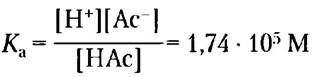 (2-8)
(2-8)
At THE START OF the titration, before any NaOH is added, acetic acid is already slightly ionized. The degree of this ionization can be calculated if the dissociation constant is known (Equation 2-8).
Fig. 2-16. Titration curve of acetic acid. The pH of the acetic acid solution is measured after The addition of each increment of NaOH. This value is plotted on the ordinate, while the abscissa shows the fraction of the total NaOH required to convert all the acetic acid into its deprotonated form, i.e., acetate. A smooth curve is drawn through the resulting data points. The boxed structures indicate the predominant Ionic Forms of acetic acid at the corresponding pH values. At the midpoint of The titration curve, the concentrations of the proton donor and proton acceptor are equal, and the pH at this point is numerically equal to the pKa. The shaded blue region corresponds to the buffering range of the system (where 10% to 90% of the titrated acetic acid is ionized).

As NaOH is added, the OH- ions combine with free H+ ions to form water molecules. Consequently, the concentrations of both ions in the solution must continually satisfy the ion product of water (Equation 2-7). As soon as free H+ ions are bound, the acetic acid HAc dissociates further in accordance with its own dissociation constant (Equation 2-8). As a result, with each addition of alkali, the concentration of HAc steadily decreases while the concentration of the Ac- anion increases. At the midpoint of the titration, which corresponds precisely to the addition of 0.5 equivalents of NaOH, half of the original acid is in the dissociated form; this means that the concentration of the proton donor HAc equals the concentration of the acceptor Ac-. At this point, a very important relationship holds: the pH of a solution containing equal molar concentrations of acetic acid and the acetate ion—specifically 4.76—is exactly equal to the pKa of acetic acid (compare the values in Figs. 2-15 and 2-16). The Significance of this relationship, which applies to all weak acids, will soon become clear.
As we continue the titration by adding further portions of NaOH, the remaining undissociated acid is gradually converted into acetate. The titration endpoint occurs around pH 7.0, where all the acetic acid has transferred its protons to OH- ions, yielding water and acetate. Throughout the entire titration process, two interconnected equilibria exist (Equations 2-5 and 2-6), each characterized by its own equilibrium constant.
Figure 2-17 compares the titration curves of three weak acids with vastly different dissociation constants: acetic acid (pKa = 4.76), the dihydrogen phosphate ion (pKa = 6.86), and the ammonium ion (pKa = 9.25). Although their titration curves share the same general shape, they occur at different pH values because the acids differ in strength. Acetic acid has the highest Ka (the lowest pKa) and is the strongest of these three weak acids (releasing its proton most readily); at pH 4.76, it is already half-dissociated. Dihydrogen phosphate gives up its proton less easily and is half-dissociated at pH 6.86. The weakest of the three is the ammonium ion, which is only 50% dissociated at pH 9.25.
Fig. 2-17. Comparison of the titration curves of three weak acids: СН3СOOН, Н2РО4-, and NН4+. The boxed structures show the predominant ionic forms of these compounds at the indicated pH values. The corresponding buffer regions are marked on the right. Conjugate acid-base pairs serve as effective buffer systems at pH values where the proton donors are 10% to 90% ionized.

The most important Conclusion to be drawn from the titration curves of weak acids is that their characteristic shape points to the feasibility of using weak acids and their anions as buffers, which will be discussed next.
Summary of Section 2.2. Ionization of Water, Weak Acids, and Weak Bases
■ Pure water is weakly ionized, containing equal amounts of hydrogen ions (hydronium ions, Н3O+) and hydroxide ions. The extent of water ionization is defined by an equilibrium constant

From this expression, the ion product of water (Kw) can be derived. At 25 °C, Kw = [Н+] [ОН-] = 55.5K = 10-14 М2.
■ The pH of an aqueous solution expresses the hydrogen ion concentration on a logarithmic scale: pH = lg (1/[Н+]) = - lg [Н-].
■ The higher the acidity of a solution, the lower its pH. Weak acids partially dissociate to release a hydrogen ion, thereby lowering the pH of an aqueous solution. Weak bases accept a proton, raising the pH. The tendency of any given acid or base to accept or donate a proton is characterized by its dissociation constant (Ka):

■ The pKa value reflects the relative strength of a weak acid or base in logarithmic units: pKa = lg (1/Ka) = -lgKa.
■ The stronger the acid, the lower its pKa value; the stronger the base, the higher its pKa value. The pKa value can be determined experimentally: it equals the pH value at the midpoint of the titration curve for the given acid or base.
Last update: 06/08/2026
Editorial and Educational Adaptation: This material has been compiled based on the primary/original source text. The project team performed an editorial review, corrected technical inaccuracies, structured sections, and adapted the content for an educational format.
What was processed:
- elimination of formatting defects (OCR errors, structural breaks, corrupted characters);
- editorial organization of content;
- standardization of terminology in accordance with academic sources;
- verification of factual statements against the original source text.
All mentions of the author, publication year, and origin of the primary text have been preserved in accordance with the source.