Biological Membranes - A. N. Ogurtsov 2012
Electrogenesis of Biomembranes
Nonequilibrium Thermodynamics of Biomembranes
Thermodynamic Potentials
In Thermodynamics, special system state Functions are introduced, the decrease of which in a reversible process running at a constant specific pair of thermodynamic parameters equals the maximum useful work.
By analogy with mechanics, where the work of constant potential forces is determined by the path-independent potential difference of these forces between the initial and final states of the system, in thermodynamics these functions are called thermodynamic potentials. They are a special case of the so-called characteristic functions.
A characteristic function is a state function by means of which (and its partial derivatives of various orders with respect to corresponding variables) all thermodynamic Properties of the system (p,V,T,S,...) can be expressed most simply and explicitly.
Natural variables are thermodynamic parameters at constant values of which the decrease in the thermodynamic potential during a reversible process equals the maximum work.
Depending on the process conditions, there are four thermodynamic potentials:
1) the isochoric-isothermal potential—Helmholtz Free energy A;
2) the isobaric-isothermal potential—Gibbs free energy G;
3) the isochoric-isoentropic potential—internal energy U;
4) the isobaric-isoentropic potential—enthalpy H.
The dependence of thermodynamic potentials on their natural variables is described by the fundamental equation of thermodynamics, which combines the First and Second laws. This equation can be written in four equivalent forms
Class="center">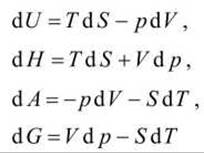
(for closed systems only, in which solely mechanical expansion work is performed).
The relationship between thermodynamic potentials
G = U - TS + pV = H - TS = A + pV
is clearly illustrated in Figure 164.
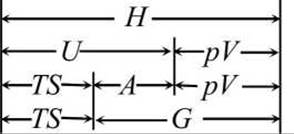
Figure 164 - Diagram of relations between thermodynamic potentials
For systems of variable composition, the number of moles of the system components is also a state parameter.
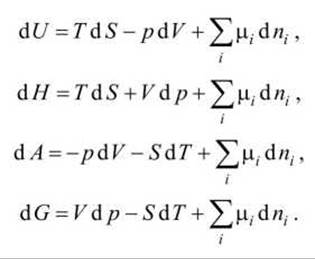
The chemical potential of a component μі is defined as the derivative of the thermodynamic potential with respect to the number of moles of that i-th component, serving as the partial molar property of the thermodynamic potential

where nj is the constant quantity of all components except the one whose variation is being considered (j ≠ i).
Unlike U,H,A,G, the quantity μ strictly corresponds to METABOLISM/2.html">THE CONCEPT OF potential, since by definition a potential does not depend on The amount of substance, whereas U,H,A,G are extensive properties.
Using the chemical potential, the fundamental equation of thermodynamics can be rewritten as
Last update: 13/08/2026
Editorial and Educational Adaptation: This material has been compiled based on the primary/original source text. The project team performed an editorial review, corrected technical inaccuracies, structured sections, and adapted the content for an educational format.
What was processed:
- elimination of formatting defects (OCR errors, structural breaks, corrupted characters);
- editorial organization of content;
- standardization of terminology in accordance with academic sources;
- verification of factual statements against the original source text.
All mentions of the author, publication year, and origin of the primary text have been preserved in accordance with the source.