Biological Membranes - A. N. Ogurtsov 2012
Electrogenesis of Biomembranes
Nonequilibrium Thermodynamics of Biomembranes
Biochemical processes occurring within a Cell are accompanied by The transfer of energy and matter across Biomembranes. Thermodynamics analyzes the Energy balance and the direction of Chemical Reactions. If we consider a certain isolated part of a living cell as an equilibrium chemical system, equilibrium thermodynamics can help answer the following questions.
1. Will a given reaction proceed spontaneously?
2. Can it perform biologically useful work?
3. How do Changes in external conditions affect the yield and direction of the reaction?
4. What amount of energy is released or absorbed in a biochemical reaction?
However, not all properties of biological systems can be described in this way. Life is fundamentally a non-equilibrium dynamic process; therefore, a phenomenological description of transmembrane processes, among others, requires the framework of non-equilibrium thermodynamics.
Non-equilibrium thermodynamics is a natural continuation of equilibrium thermodynamics, encompassing the latter as a part or limiting case (much like relativistic mechanics reduces to classical mechanics in the limit of speeds much lower than the speed of light).
Thermodynamics is based on several empirical postulates known as the Laws of Thermodynamics. METABOLISM/2.html">THE CONCEPT OF Temperature as a property inherent to any thermodynamic system defines the zeroth law of thermodynamics: If two bodies A and B are each in thermal equilibrium with a third body C, they are also in thermal equilibrium with each other; in other words, thermal equilibrium is characterized by equal temperatures at all points in the system.
This principle forms The basis of all thermometry—bringing a thermometer into thermal contact with the system under study ultimately leads to thermal equilibrium between the two, at which point the thermometer's temperature equals that of the system.
The First Law of thermodynamics is the law of conservation of energy: the energy of an isolated system is constant.
In a non-isolated system, the heat Q received from the external environment is spent on increasing the internal energy ∆U and performing work W by the system,
Class="center">Q = ∆U + W.
Internal energy is a state function of the system, whereas work and heat are forms of energy transfer that depend on the path of the process, making them process Functions. This is reflected in the differential formulation of the first law of thermodynamics
dU = δQ - δW.
Using the simplest model thermodynamic system—a gas under a piston in a cylinder—it is evident that the internal energy of the gas depends on temperature, pressure, and the number of moles (amount of substance), expressed as U = U(T, p, n). Increasing these system parameters increases its internal energy and, consequently, The amount of work the system can perform.
Even if we neglect dissipative processes (such as friction), i.e., in an ideal approximation, supplying a certain amount of heat to the gas under the piston does not result in the complete conversion of heat into work. Part of the energy is converted into the internal energy of the gas. In the ideal approximation, we can use the concept of a reversible process. A process is termed reversible if, at any given moment, an infinitesimal change in the surrounding conditions can cause it to reverse its direction.
Real natural processes are irreversible and typically proceed spontaneously in a preferred direction. For example, an open bottle of perfume will irreversibly evaporate into the surrounding space, a cup of hot coffee will cool to room temperature, and a Glass of ice will conversely warm up to room temperature. Spontaneous return to the initial state is impossible without the intervention of another process operating in the direction opposite to the original one. Relying solely on the first law of thermodynamics (energy conservation) does not explain what prevents the aromatic perfume molecules in an isolated room from returning into the bottle, or the ambient air heat from reheating the cup of coffee, and so on.
To predict the direction in which real processes unfold, a new law must be established based on a new property of systems. This property is Entropy, and the new law is The Second Law of thermodynamics: the entropy of an isolated system increases until it reaches its maximum value.
When considering thermodynamic cycles in classical thermodynamics, it is proven that the cyclic integral

The infinitesimal amount of heat δQ is positive if heat is absorbed by the system, and negative otherwise.

Figure 163 - Entropy change in a cyclic process
If we consider a reversible transition from state A to state B and back (Figure 163), then since

the following equality holds true

Thus, entropy—a new property—is independent of the path taken and acts as a state function. Its change during a process can be expressed as the difference between its final (B) and initial (A) values

For irreversible transitions

The infinitesimal change in entropy for reversible processes is equal to

whereas for irreversible processes it is equal to
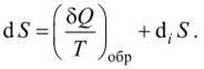
Here,  represents the entropy flux driven by interaction with the environment, and diS is the entropy generation caused by irreversibilities within the system.
In isolated systems, no entropy exchange occurs with the surroundings; therefore,

entropy increases during irreversible processes and remains constant in reversible ones.
Entropy is a function of state parameters, S = S(T,V,n), and is an extensive property (the entropy of a system is equal to the sum of the entropies of its individual parts).
For completeness, let us also state the third law of thermodynamics (the Nernst heat theorem): the entropy of any system approaches zero as the absolute temperature approaches zero.
Last update: 13/08/2026
Editorial and Educational Adaptation: This material has been compiled based on the primary/original source text. The project team performed an editorial review, corrected technical inaccuracies, structured sections, and adapted the content for an educational format.
What was processed:
- elimination of formatting defects (OCR errors, structural breaks, corrupted characters);
- editorial organization of content;
- standardization of terminology in accordance with academic sources;
- verification of factual statements against the original source text.
All mentions of the author, publication year, and origin of the primary text have been preserved in accordance with the source.