Biological Membranes - A. N. Ogurtsov 2012
Electrogenesis of Biomembranes
Mechanisms of Action Potential Generation
Generation of the Nerve Impulse
Cell/33.html">Plasma Membrane Na+/K+-ATPases establish the physiologically high concentration of K+ and low concentration of Na+ in The Cell Cytosol relative to the extracellular environment. The movement of K+ ions down their concentration gradient through potassium channels generates the Resting Potential across The Plasma Membrane (Figure 126).
If sodium ions could freely pass through sodium channels, the Membrane Potential they generate would counteract the potential generated by potassium ions (Figure 90).
Class="center">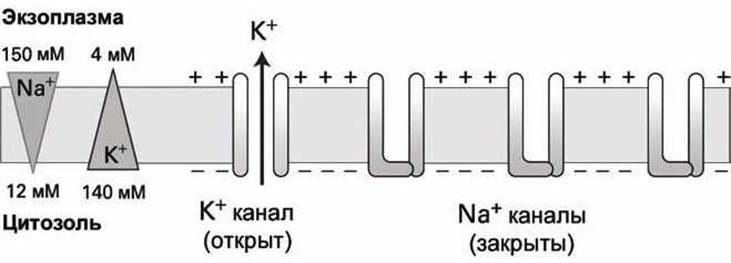
Figure 126 - State of plasma membrane Ion Channels at rest
However, most plasma membrane sodium channels are closed when the cell is at rest, meaning that virtually no energetically favorable (Figure 102) inward movement of Na+ into the cell takes place.
If A large number of sodium channels open such that the net influx of Na+ ions exceeds the efflux of K+ ions through open potassium channels in the plasma membrane, more cations will enter the cell than leave it. As a result, the cytosol will shift from negatively charged (at rest) to positively charged relative to the extracellular environment (Figure 127).
The negative charge on the exoplasmic face of the membrane in the depolarization zone is maintained by uncompensated Cl- ions that remain outside the cell.

Figure 127 - Membrane depolarization upon the opening of sodium channels
The amplitude of the membrane potential during depolarization approaches the equilibrium potential for Na+ ions calculated using the Nernst equation.
The cycle of membrane depolarization, repolarization, hyperpolarization, and return to the resting potential takes 1-2 milliseconds and, in typical Neurons, can occur hundreds of times per second (Figure 124).
These cyclic shifts in membrane potential result from the sequential opening and closing, first of Voltage-Gated Sodium Channels, and then of Voltage-Gated Potassium Channels.
Last update: 13/08/2026
Editorial and Educational Adaptation: This material has been compiled based on the primary/original source text. The project team performed an editorial review, corrected technical inaccuracies, structured sections, and adapted the content for an educational format.
What was processed:
- elimination of formatting defects (OCR errors, structural breaks, corrupted characters);
- editorial organization of content;
- standardization of terminology in accordance with academic sources;
- verification of factual statements against the original source text.
All mentions of the author, publication year, and origin of the primary text have been preserved in accordance with the source.