BOTANY WITH BASICS OF HYDROBOTANY (AQUATIC PLANTS OF UKRAINE) - B.Ye. Yakubenko - 2011
III. WATER AND ITS ECOLOGICAL AND COENOTIC SIGNIFICANCE FOR AQUATIC PLANTS
Water is of exceptional importance to plants. It is an essential component of Cytoplasm and accounts for up to 80-90% of a plant's body mass. Its content is low only in spores, fruits, and seeds. Water is necessary for enzymatic activity, the absorption and Transport of mineral salts and plastic substances, Photosynthesis, Respiration, Transpiration, and Fertilization. Plants require vast amounts of water. For instance, the transpiration required to biosynthesize 1 g of dry matter in corn ranges from 350 to 550 g.
Class="center">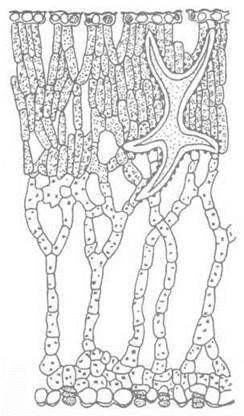
Fig. 1. Cytology/practical/72.html">Cross section of a floating leaf of yellow water-lily
Plants absorb the bulk of their water from the soil, sourced primarily from precipitation and fog.
The edaphotope plays a crucial ecological role in supplying plants with water, mineral salts, and biogenic elements. It contains the primary reservoir of moisture that plants absorb to carry out metabolic processes.
Because edaphotopes are structurally heterogeneous, plants develop corresponding ROOT systems.
Edaphotopes and their ecological conditions dictate The Development of root systems. In floodplain meadow communities with a shallow groundwater table, plants typically develop fibrous and taproot systems. In bogs and waterlogged areas, plants form a shallow, surface-level root system. For example, pine trees growing in such conditions exhibit an underdeveloped primary root and numerous lateral roots situated within a depth of 0-20 cm.
The Osmotic Pressure of plant Cell sap is of paramount ecological significance for water uptake. A plant absorbs water from the edaphotope only when its intracellular osmotic pressure exceeds the osmotic pressure of the edaphotopic solution. This mechanism enables water to be drawn from deeper soil horizons.
The evolutionary transition of plants FROM an aquatic to a terrestrial lifestyle was accompanied by a physiological reorganization aimed at minimizing water consumption. Algae remained in the water, others—such as mosses and ferns—became partially submerged, while gymnosperms and angiosperms successfully adapted to life under conditions of limited water supply.
Based on their water requirements, plants are categorized into 4 ecological types (ecotypes): hydrophytes, hygrophytes, mesophytes, and xerophytes. Intermediate ecotypes also exist, such as mesoxerophytes, mesohygrophytes, hydromesophytes, etc. Here, we will focus exclusively on hydrophytes and hygrophytes, which are characteristic of aquatic plants.
Hydrophytes are plants that are completely or largely submerged in water. The unique conditions of the aquatic environment have driven the evolution of specialized morphological and physiological traits in these plants. They have developed a relatively large surface area (particularly leaf surface area combined with reduced leaf thickness). All Organs of aquatic plants are coated with mucilage produced by secretory Cells and hairs. This mucilage protects plant Tissues from the leaching of salts and deters herbivores. The high density of water results in a weak development of mechanical tissues; where such elements are present, they are concentrated in the central axes of stems and leaves to provide flexibility and tensile strength. Intercellular air spaces are exceptionally well developed in the vegetative organs (leaves, stems, roots), often forming a continuous aerenchyma. The cuticle and epidermis are typically poorly developed, allowing gases and nutrients to be absorbed directly from the water across the entire leaf surface. Submerged leaves exhibit a typical shade-adapted Structure, whereas floating and emergent leaves display a clearly defined sun-adapted structure. The mesophyll of submerged leaves lacks differentiation into palisade and spongy parenchyma. Hydrophytes possess a poorly developed root system, which is entirely absent in some species. Vegetative propagation is exceptionally widespread, whereas sexual reproduction via seeds is of secondary importance in most species. In many species, vegetative propagation organs take the form of overwintering buds known as turions (from Latin *turio* – SHOOT). Autumn buds, laden with nutrient reserves, sink to the bottom of the water body. During the winter, these stored reserves are consumed for Cellular metabolic processes, while gases generated as microscopic bubbles accumulate within the intercellular spaces. As a result, the buds float back to the surface in the spring [67].
Hydrophytes comprise two main groups: submerged plants anchored to the bottom substrate (e.g., water-soldier, Vallisneria), and plants suspended freely in the water Column (e.g., bladderworts, planktonic algae). These plants have strict water requirements and inhabit marine, lacustrine, and river ecosystems.
The aquatic environment differs markedly and advantageously from the aerial environment by offering high thermal stability. Temperature fluctuations typically only begin at depths of 5-10 m in rivers and lakes, and 20-30 m (rarely 50 m) in seas and oceans. For hydrophytes, the surface layer of water bodies holds the greatest ecological significance, as planktonic plants reside there, while benthic plants predominantly position their leaves and Generative organs within this zone.
The aquatic environment significantly influences hydrophyte development through light intensity and spectral composition. Red light wavelengths are virtually absorbed within the top one-meter layer of water, whereas blue-violet rays penetrate to depths of 30-40 m. This leads to the vertical bathymetric zonation of hydrophytes in seas, lakes, and littoral zones (Figs. 2, 3, 4).

Fig. 2. General appearance of a typical hydrophyte, water violet (Hottonia palustris), featuring dissected leaves
Anatomical and morphological ecotypes of hydrophytes. Because dissolved oxygen and CO2 levels are lower in water than in air, hydrophytes have adapted to absorb them by increasing their surface area through extensive dissection of the plant body (e.g., water-soldier, frogbit, pondweeds, bladderworts). Heterophylly is a common feature among hydrophytes, resulting from their exposure to two distinct mediums: leaves situated in the air are entire, whereas those submerged in water are deeply dissected (e.g., floating fern, water crowfoot, nodding bur-marigold) (Fig. 3). The leaves of floating plants are differentiated into palisade and spongy parenchyma, possess a cuticle, and feature a high density of Stomata (400-600 per 1 mm²) on the upper epidermis. Hydrophytes produce hydathodes, specialized structures for excreting excess liquid water in the form of guttation droplets. The stems of these plants lack adaptations for protection against excessive transpiration, as they are constantly supplied with abundant moisture.

Fig. 3. Heterophylly.
The illustration shows: A - submerged leaves of water crowfoot; B - aerial leaves of the same species;
C - ribbon-like submerged leaves and arrowhead-shaped aerial leaves of broadleaf arrowhead
Growing in a uniform buoyant medium, hydrophytes possess poorly developed mechanical tissue and an extensive network of intercellular spaces and air canals, which account for up to 60-70% of the plant's total volume (Fig. 4).
Hydrophytes have a poorly developed or reduced root system. According to V.P. Horbyk and Sh. Husak [18], the group of hydrophytes—that is, plants submerged in the water of the Kyiv Reservoir—includes: water violet (Hottonia palustris), bog starwort (Lemna trisulca), sharp-leaf pondweed (Potamogeton acutifolius), Berchtold's pondweed (P. berchtoldii), flat-stemmed pondweed (P. compressus), curled pondweed (P. crispus), Fries' pondweed (P. friesii), blunt-leaf pondweed (P. obtusifolius), lesser pondweed (P. pusillus), water-soldier (Stratiotes aloides), lesser bladderwort (Utricularia minor), greater bladderwort (U. vulgaris), horned pondweed (Zannichellia palustris), and others.

Fig. 4. Vallisneria (Vallisneria spiralis):
1 - female plant with spirally twisted pedicels;
2 — male plant with male flowers that detach and float on the water surface
Hygrophytes are plants of permanently or temporarily water-logged habitats, with the greater part of their body located in the air environment. They do not experience moisture deficiency. Hygrophytes are characteristic of bogs and wetlands, high-altitude areas, as well as lacustrine and riparian habitats. V. P. Horbyk and Sh. Husak (1983) report that the plant group of the Kyiv Reservoir includes: water foxtail (Alopecurus '>'•/-wv s aequalis), marsh calla (Calla palustris), hedge bindweed (Calystegia sepium), brown flatsedge (Cyperus fuscus), Michel's flatsedge (Dichostylis micheliana), needle spikerush (Eleocharis acicularis), great willowherb (Epilobium hirsutum), Lamy's willowherb (E. lamyi), marsh willowherb (E. palustris), square-stalked willowherb (E. parviflorum), marsh spurge (Euphorbia palustris), marsh bedstraw (Galium palustris), clustered rush (Juncus conglomeratus), spearmint (Mentha spicata), water chickweed (Myosoton aquaticum), water-pepper (Polygonum hydropiper), pale persicaria (P. lapathifolium), small waterpepper (P. minus), soft knotweed (P. mite), great yellowcress (Rorippa amphibia), marsh yellowcress (R. palustris), marsh dock (Rumex maritimus), Ukrainian dock (R. ucrainicus), skullcap (Scutellaria galericulata), marsh woundwort (Stachys palustris), marsh stitchwort (Stellaria palustris), bog stitchwort (S. uliginosa), Teucrium scordium, water speedwell (Veronica anagallis-aquatica), brooklime (V. beccabunga), marsh speedwell (V. scutellata), and others.
Anatomical and morphological ecologisms of hygrophytes. These plants feature intensive shoot and stem growth, with delicate and large leaves. The leaves possess a poorly developed cuticle or lack it entirely. Hygrophytes have an optimally developed parenchyma, air passages, and an intercellular system. Vascular bundles are few in number. The Root System is weakly developed. The suction pressure of their cells is higher than that of hydrophytes.
Ecology of helophytes. Helophytes are plants of bogs and marshy or excessively moistened soils. They possess specific ecological adaptations that ensure their survival under hydrologically extreme conditions. The limiting factors for them are excessive moisture and oxygen deficiency. Due to high water-holding capacity and oxygen depletion, dead plant remains do not decompose completely and are preserved in the form of a natural biogenic body—peat. Its accumulation over millennia has led to The formation of peat deposits in bogs, the reserves of which are used in agriculture as fertilizers, bedding, and peat-humus pots.
Among helophytes, mosses are of considerable importance, absorbing moisture well in excess of their own mass. Per 100 parts by weight of air-dry Magellanic sphagnum, there are 2016 parts of water. Sphagnum mosses rapidly absorb atmospheric moisture and release it slowly. Therefore, in drained bogs, these plants suffer more from moisture deficiency than from excess. Herbaceous helophytes are characterized by the following ecomorphic features: the predominance of rhizomatous and tussock-forming species with a well-developed aerenchyma system and air passages, and leaves with a xeromorphic structure (rolled into a tube, covered with hairs, epidermis with a cuticle). Typical species include: sheathed cottongrass, common reed, tall bulrush, волосистоплодна осока (Carex lasiocarpa), white beaksedge.
A specific ecological group is formed by Insectivorous Plants (round-leaved, English, and lesser sundews). The latter two are rare in the bogs of Ukraine. Water wheel plant and Loesel's bladderwort also occur rarely. Their characteristic feature is digestive glands, the secretion of which shimmers in the sun and attracts insects; upon touching the glands, an insect sticks to them and is digested by Enzymes secreted by the plants. This is how the plants acquire the nitrogenous compounds necessary for their development.
Another group comprises species of the genus bladderwort, on the dissected leaves of which trapping apparatuses develop for capturing and digesting small aquatic Arthropods. The plant feeds on the products derived from this Digestion.
Subshrub species play an important role in the composition of bog flora. A distinct ecological group is formed by subshrubs with flat leaves (leatherleaf, marsh Labrador tea, bog rosemary, small cranberry, and bog cranberry). The latter is rare in the flora of Ukraine and is listed in the Red Data Book of Ukraine. By nature, they are psychrophytes. Their characteristic features include: hard and leathery leaves, rolled-back margins, an epidermis covered with a cuticle, and stomata sunken into the mesophyll tissue.
A separate group consists of evergreen xeromorphic dwarf shrubs with an upright leaf structure (common heather, crowberry). They feature numerous small leaves with margins rolled downwards and lined with hairs, while stomata open into a tubular cavity formed by the leaves. It is precisely due to these xeromorphic structural traits that these plants tolerate the unfavorable conditions of excessive moisture.
It should be noted that the helophytes of the upper part of the Kyiv Reservoir include: sweet flag (Acorus calamus), sea clubrush (Bolboschoenus maritimus), marsh parsley (Peucedanum palustre), marsh spikerush (Eleocharis palustris), water dropwort (Oenanthe aquatica), reed canary grass (Phalaroides arundinacea), common reed (Phragmites australis), arrowhead (Sagittaria sagittifolia), lake bulrush (Scirpus lacustris), greater water-parsnip (Sium latifolium), branched bur-reed (Sparganium emersum), erect bur-reed (S. erectum), marsh fern (Thelypteris palustris), lesser bulrush (Typha angustifolia), and other species [18].
Last update: 07/08/2026
Editorial and Educational Adaptation: This material has been compiled based on the primary/original source text. The project team performed an editorial review, corrected technical inaccuracies, structured sections, and adapted the content for an educational format.
What was processed:
- elimination of formatting defects (OCR errors, structural breaks, corrupted characters);
- editorial organization of content;
- standardization of terminology in accordance with academic sources;
- verification of factual statements against the original source text.
All mentions of the author, publication year, and origin of the primary text have been preserved in accordance with the source.