Plant Physiology - M.M. Musiienko 2001
Root Nutrition of Plants
Transport of mineral nutrients throughout the plant organism
Once mineral nutrients enter the xylem of the ROOT's central cylinder, their movement within the plant begins with the Transpiration stream (Fig. 124).
Class="center">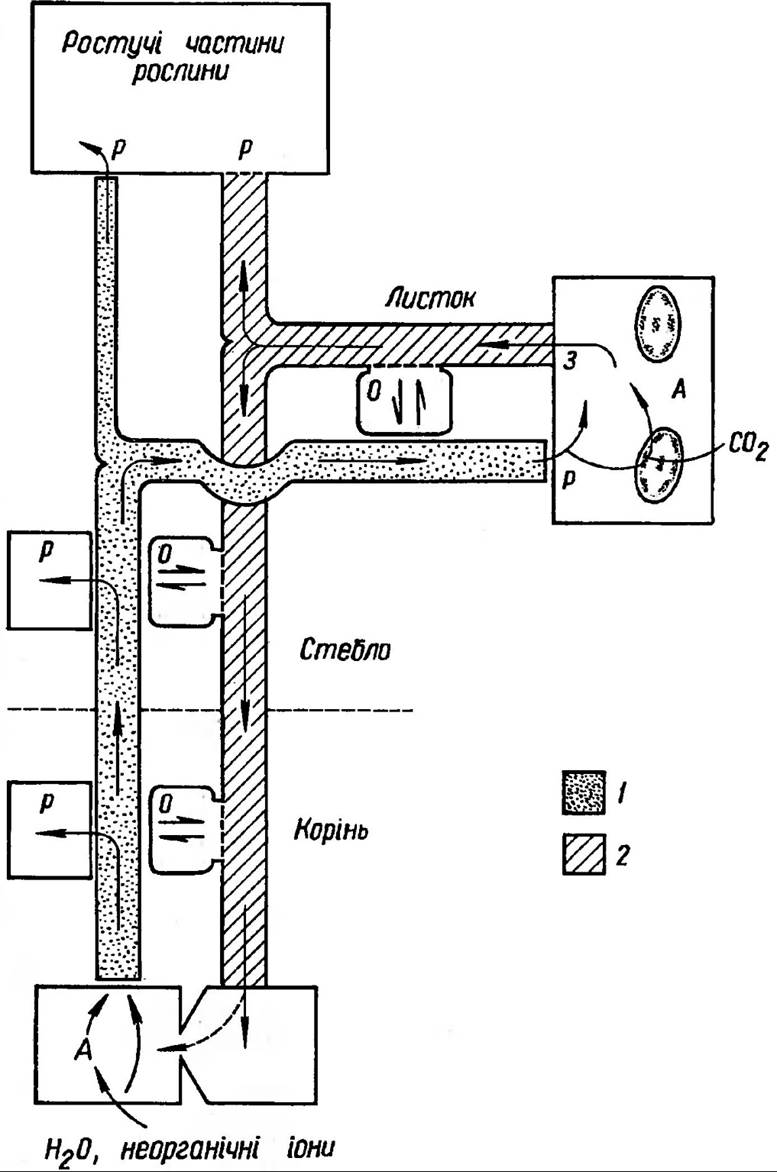
Fig. 124. Diagram of the Circulation of Water, inorganic ions, and assimilates in a plant. Water and inorganic ions absorbed by the root move upward through the xylem with the transpiration stream. Some of them move laterally into the Tissues of the root and stem, while the rest are transported to growing parts and mature leaves. In the leaves, a significant amount of water and inorganic ions moves into the phloem and is exported along with sucrose in the assimilate stream. Growing parts, which have relatively limited capacity for water uptake via transpiration, receive the bulk of their nutrients and water through the phloem. Both water and solutes entering the roots via the phloem can be transferred to the xylem. The letter А indicates sites specialized in the absorption and assimilation of raw Materials from the external environment. The letters 3 and Р indicate loading and unloading sites, respectively; О represents the main points where exchange between xylem and phloem occurs: 1 — xylem, 2 — phloem
Analysis of xylem sap indicates that a significant portion of nitrogen is transported in the form of Amino Acids and other Organic compounds, and only a minor fraction as nitrates or ammonium ions. Organic compounds of sulfur and phosphorus are also transported in small amounts. Thus, there is clearly no strict division where only organic salts move through the phloem and mineral ones through the xylem. Mineral elements are transported mainly to regions of active growth, Meristems, developing fruits, flowers, and various storage Organs. Xylem unloading occurs at the tips of the finest Veins via diffusion, active uptake, or through specialized transfer Cells, which are modified companion cells. A characteristic feature of these cells is that their thickened Cell walls have numerous internal ingrowths, which increase the surface area of the Plasmalemma lining the wall tenfold. These cells are capable of transferring substances to neighboring cells through a highly developed, complex system of plasmodesmata.
Many elements exhibit the phenomena of recirculation and remobilization. For instance, phosphorus migrates quite rapidly and continuously through the xylem and phloem, sulfur is incorporated into METABOLISM during its initial circulation, and calcium remains where it was delivered. During leaf senescence and The Development of flowers, fruits, and seeds, the remobilization of elements, particularly phosphorus, sulfur, nitrogen, and potassium, actively occurs.
Last update: 07/08/2026
Editorial and Educational Adaptation: This material has been compiled based on the primary/original source text. The project team performed an editorial review, corrected technical inaccuracies, structured sections, and adapted the content for an educational format.
What was processed:
- elimination of formatting defects (OCR errors, structural breaks, corrupted characters);
- editorial organization of content;
- standardization of terminology in accordance with academic sources;
- verification of factual statements against the original source text.
All mentions of the author, publication year, and origin of the primary text have been preserved in accordance with the source.