BOTANY: VOLUME 1 — CELL BIOLOGY. ANATOMY. MORPHOLOGY — 2007
1. MOLECULAR BASIS — THE BUILDING BLOCKS OF CELLS
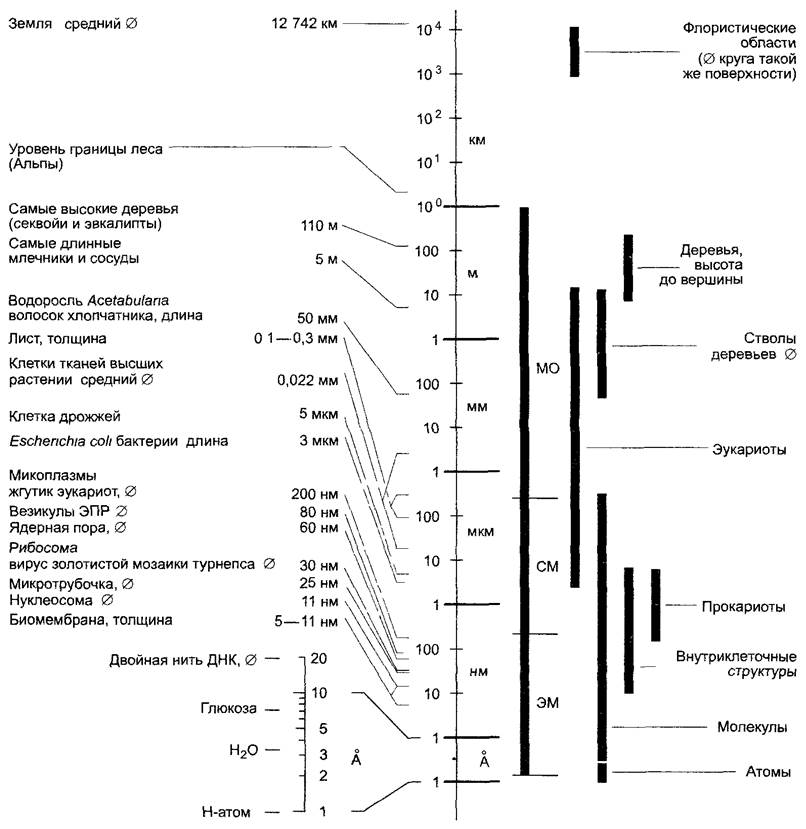
Botany examines living systems of various scales—ranging from FLORISTIC REGIONS AND ecosystems spanning thousands of kilometers down to the invisible molecular world measured in millionths of a millimeter (nanometers), which represents a span of more than 15 orders of magnitude (Fig. 1.1). In this textbook, we will explore the material along a rising scale, Cell/3.html">From Molecules to ecosystems.
Class="center">Fig. 1.1. Scale of relative sizes (after P. Sitte)
Ranging from the diameter of a hydrogen atom (H) to the diameter of the Earth, the scale of dimensional values spans 17 orders of magnitude, from 10-10 m (1 Å) to 107 m (10,000 km). Macroscopic objects (MO) are visible to the naked eye; adjacent to this is the size range for light Microscopy (LM) and, finally, the domain accessible only to the Electron microscope (EM). The scale of dimensions is logarithmic and has no zero point; each division represents a tenfold increase over the preceding value and a tenth of the following one. Thus, vast numerical differences can be represented on a uniform scale, encompassing dimensions from atomic to cosmic. The SI unit of length is the meter (m); common prefixes decrease each unit by three orders of magnitude: milli- (thousandth part, 10-3, abbreviated as m), micro- (millionth part, 10-6, µ), nano- (billionth part, 10-9, n), or increase the unit of measurement: kilo- (thousand, 103, k). 1 nm = 103 µm = 106 mm = 10-9 m = 10-12 km. The angstrom unit (1 Å = 0.1 nm) is not part of the SI system, but is frequently used because it is very convenient for describing atomic and Molecular dimensions: the diameter of a hydrogen atom is 1 Å, the diameter of a DNA double helix is 20 Å, and the distance between atomic nuclei in a covalent chemical bond is about 1 Å.
Every living cell contains a multitude of different molecules. A bacterial cell, whose mass is only a thousandth that of a plant cell, consists of approximately 6,000 types of molecules, whereas a plant cell contains roughly ten times as many.
As a rule, about 70% of the Cytoplasm's mass is made up of Water. Vacuolated plant and fungal Cells contain an even higher proportion of water. Cells also contain about 2% inorganic ions and 8% low-molecular-weight substances. Low-molecular-weight Organic compounds are those with a molecular mass below 1,000 Da (= 1 kDa, 1 × 10³ Da), or exceptionally up to 4,000 Da. The dalton (Da) is a unit of atomic mass, where 1 Da = 1.66 × 10⁻²⁴ g, corresponding to 1/12 of the mass of a 12C atom. Molecular mass is calculated as the sum of the masses of all atoms making up the molecule. Atomic and molecular masses are relative values that should not be confused with molar mass (expressed in grams per mole). The amount of substance of 1 mole (the mole being the unit of measurement) corresponds to the number of particles contained in 12 g of the carbon isotope 12C (Avogadro's constant $N_A = 6.0220 imes 10^{23}$ particles). With this Definition of the mole, the numerical values of relative atomic and molecular masses are identical to molar masses. A substance with a molecular mass of 18 Da (e.g., H2O) also has a molar mass of 18 g mol-1. Most low-molecular-weight substances are metabolites—molecules that undergo continuous transformation during cellular METABOLISM (see Chapter 6).
The remaining fifth of The Cell's mass is accounted for by macromolecules. These include Nucleic Acids, Proteins, and Polysaccharides. We are referring here to molecules with a mass greater than 4,000 Da (4 kDa). Macromolecules often serve structural purposes, such as structural proteins, structural polysaccharides, and certain nucleic acids. Many proteins function as biocatalysts; they are also called Enzymes. Most nucleic acids are required for the storage and transfer of information, while numerous polysaccharides serve as energy and carbon reserves.
Biologically important macromolecules are polymers, meaning they are formed by the creation of covalent bonds between monomers, typically with the release of water. This process is called polymerization. When a macromolecule is formed by only a single type of monomer building block—such as Cellulose, which consists of β-D-glucose—it is referred to as a homopolymer; when two or more different monomers make up the macromolecule, it is called a heteropolymer. Proteins and nucleic acids are Examples of heteropolymers. Polymers formed via Condensation reactions can easily break down again into monomers through chemical or enzymatic Hydrolysis. The breakdown of reserve starch during cereal grain germination is based on hydrolysis and is catalyzed by amylases (see 6.17.1.2). Protein breakdown proceeds hydrolytically with the aid of proteases. A special place among heteropolymers is occupied by Lignin, a structural polymer typical of plants (a component of wood). It is formed from several types of monomers via free-radical polymerization. Lignin is extremely stable due to the variety of bonds between its monomers within the molecule; it does not undergo hydrolysis and is extremely difficult to break down even with enzymes (see 6.17.2).
Metabolites and various metabolic reactions are discussed in Chapter 6 (Metabolic Physiology). Below is a Brief Overview of The Structure of biologically important macromolecules and Lipids. Although not macromolecules, lipids occur in cells as structural elements, primarily as constituents of Introduction/36.html">Biological Membranes. First, however, we must discuss and understand the special properties of water, the universal biological solvent.
1.1. Structure and Properties of Water
In cells, water serves as a solvent. Water is a polar medium; its molecules are strong electrical dipoles (Fig. 1.2, A, B). This is due to the high electronegativity of oxygen compared to hydrogen (Table 1.1), which causes a shift of the electrons shared by oxygen and hydrogen toward the oxygen atom, polarizing the covalent bond. Oxygen imparts a partial negative charge (δ-) to the water molecule, and hydrogen a partial positive charge (δ+). In the electric field of ions, water dipoles align in a specific manner, forming a Hydration shell (Fig. 1.2, C). Such screening of the electrical charges of anions and cations prevents them from combining via ionic bonds; they remain in solution. Hydration shells also form around molecules containing polarized bonds (e.g., C—O or C—N bonds). For this reason, water is an excellent solvent for charged and polar substances.
Table 1.1. Electronegativity of biologically important elements (electronegativity of fluorine set at 100%)
Element |
Relative electronegativity, % |
Oxygen (O) |
85 |
Nitrogen (N) |
75 |
Carbon (C) |
65 |
Sulfur (S) |
65 |
Hydrogen (H) |
55 |
Phosphorus (P) |
55 |
Fig. 1.2. STRUCTURE AND PROPERTIES of water (after A. L. Lehninger, D. L. Nelson, M. M. Cox)
A — ball-and-stick model of a water molecule; B — space-filling model of a water molecule (dots represent lone pairs of electrons of the oxygen atom); C — arrangement of water molecules surrounding anions and cations to form hydration shells; D — upon collision, water molecules form easily rearranging Hydrogen Bonds with one another; E — crystal structure of ice: each oxygen atom is surrounded by four hydrogen atoms, with only 15% of the hydrogen bonds breaking during melting; F — most frequently occurring hydrogen bonds between Structural elements of Biomolecules

In the liquid phase, hydrogen bonds (bridges) form between water molecules: the opposing partial charges of H and O atoms create electrostatic attraction (Fig. 1.2, D, E). The formation of these hydrogen bonds gives water unique properties, such as comparatively high values of surface tension, heat of vaporization, and density. Cohesive forces between water molecules are of great importance for water transport in plants (see 6.3.5). In ice crystals, each oxygen atom is surrounded by four hydrogen atoms (Fig. 1.2, E); in liquid water at room Temperature, an oxygen atom is in contact with three to four other hydrogen atoms (an average of 3.4).
Hydrogen bonds not only form within water, but also readily arise between hydrogen atoms attached to any other electronegative atom (typically nitrogen or oxygen) of another or the same molecule. Examples of frequently occurring hydrogen bonds can be seen in Fig. 1.2, F. The stabilization of the structure of Nucleic Acids and Proteins is also achieved through hydrogen bonds (see Figs. 1.6; 1.10; 1.14). By forming intermolecular hydrogen bonds, cellulose molecules assemble into bundles (microfibrils) and thereby contribute to increasing the mechanical strength of Plant Cell Walls (see 2.2.7; 6.17.1.1).
Substances that possess a sufficient number of polar groups—enabling them to integrate into the network of hydrogen bridges in the aqueous phase and thus remain soluble in water—are called hydrophilic (from Greek philia — affinity). Hydrophilicity is enhanced if, In addition to polar groups, There are also ionizable groups such as the carboxyl group (—COOH ⇌ —COO- + H+) or amino group (—NH2 + H+ ⇌ —NH3+), which promote the formation of extensive hydration shells.
Compounds that are insoluble in water are called hydrophobic (from Greek hydrophobia — fear of water). They are characterized by a high proportion of nonpolar bonds or the presence exclusively of such bonds. In nonpolar covalent bonds, both partners have similar electronegativity, so that no partial electrical charge arises on the atoms forming the bond. Such groups do not form hydrogen bridges. Common examples of nonpolar bonds are carbon-hydrogen and carbon-carbon bonds. For this reason, pure Hydrocarbons, such as benzene or carotenoids, dissolve very poorly in water, but dissolve in nonpolar organic Solvents like oils, and are therefore called lipophilic (from Greek lipos — fat, oil).
In complex molecules, solubility depends on the quantitative ratio of polar and nonpolar bonds. This is why all transitions exist between extremely hydrophobic compounds (e.g., hydrocarbons) and extremely hydrophilic substances (e.g., polyanions like polygalacturonases with A large number of acidic groups), which can bind water in amounts up to 100 times their own mass.
Last update: 07/08/2026
Editorial and Educational Adaptation: This material has been compiled based on the primary/original source text. The project team performed an editorial review, corrected technical inaccuracies, structured sections, and adapted the content for an educational format.
What was processed:
- elimination of formatting defects (OCR errors, structural breaks, corrupted characters);
- editorial organization of content;
- standardization of terminology in accordance with academic sources;
- verification of factual statements against the original source text.
All mentions of the author, publication year, and origin of the primary text have been preserved in accordance with the source.