MEDICAL BOTANY - A.G. Serbin - 2003
SECTION 4. ECOLOGY, PHYTOCENOLOGY, PHYTOGEOGRAPHY
FLORISTIC REGIONS AND BIOCLIMATIC ZONES
Comparative studies of global flora have made it possible to divide the Earth's landmass into natural floristic regions (Fig. 4.6) and bioclimatic zones (Fig. 4.7). The boundaries of floristic kingdoms were first defined in 1890 by the German phytogeographer O. Drude, and have since been repeatedly refined as new data accumulated. To date, six floristic regions are distinguished: Holarctic, Paleotropical, Neotropical, Australian, Cape, and Antarctic. Each of these is characterized by the endemism of its families, genera, and species. However, these regions continuously exchange species, less frequently genera, and very rarely families.
Class="center">Fig. 4.6. Floristic Regions of the Earth: 1 — Holarctic; 2 — Paleotropical; 3 — Neotropical; 4 — Cape; 5 — Australian; 6 — Antarctic
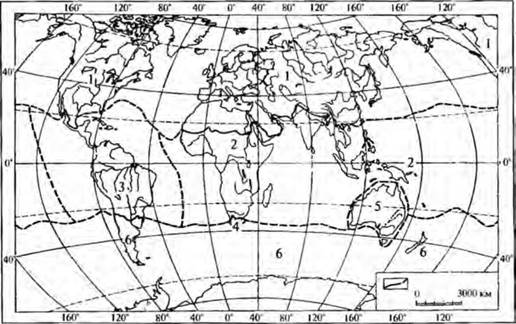
Fig. 4.7. Bioclimatic zones (according to Bazilevich, Rodin, and Rozov). 1 — polar; 2 — boreal; 3 — 5 — temperate (humid, semiarid, arid); 6 — 8 — subtropical (humid, semiarid, arid); 9 — 11 — tropical (humid, semiarid, arid); 12 — continental ice

1. The Holarctic region is the largest in terms of area. It spans all of Europe, Asia (excluding Hindustan and Indochina), North Africa, North America, and Greenland, encompassing the temperate and subtropical latitudes of the Northern Hemisphere. All climate types except tropical are found within this region. The modern Holarctic flora is characterized by families that thrive in temperate latitudes. Many tropical families are entirely absent, such as the Piperaceae and Cactaceae. Among the palm family, only a single species grows wild — the European fan palm (Chamaerops humilis).
The Holarctic region, in turn, is subdivided into subregions that differ in climate, landscape, and plant species diversity: Arctic, Euro-Siberian, Sino-Japanese, South European, Caucasian, Mediterranean, North African-Indian, Macaronesian, Atlantic North American, North American Prairie, and Pacific. The poorest is the Arctic subregion, whose landscape is tundra covered with mosses and Lichens. The Euro-Siberian subregion is renowned for its forests — deciduous in the west and coniferous in the east. The Sino-Japanese subregion abounds in wild fruit plants (cherries, apples, blackberries, walnuts, actinidia, grapes) and vegetable crops (cabbage, onions, radish, buckwheat, hemp, millet). In Afghanistan, Iran, and Mongolia (the South European subregion), steppe and semi-desert flora predominate. Syria, Israel, Spain, Italy, Sicily, and Corsica (the Mediterranean subregion) are characterized by evergreen forms (olive — Olea europea, pomegranate — Punica granatum, Lebanon cedar — Cedrus libani, cork oak — Quercus suber) and herbaceous xerophytes from the families Lamiaceae and Apiaceae. The vegetation of the Sahara and the Arabian Desert (the North African-Indian subregion) is sparse, dominated by acacias (Acacia tortilis, A. gummifera, A. stephania), glassworts (Salsola), and a small sand-binding grass, Odyssaea mucronata.
Endemics such as the dragon tree (Dracaena draco) and the Canary date palm (Phoenix canariensis) are found exclusively on the Canary and Azores islands of the Macaronesian transitional subregion. The flora of the Pacific North American subregion is distinguished by the predominance of conifers. Giant sequoias have survived only in California.
2. The Paleotropical region encompasses Indonesia, the Philippine Islands, the islands of Polynesia and Melanesia, northern Australia, tropical America, subtropical South Africa up to the Cape Province, and tropical Arabia (Yemen). Tropical evergreen forests, deciduous tropical forests, and savannas cover a significant portion of its territory. The region is divided into three subregions: Indo-African, Malesian, and New Zealand. In tropical Africa and Madagascar (the Indo-African subregion), various species of coffee (Coffea), fig (Ficus), cola (Cola), and the oil palm (Elaeis guineensis) grow. The Malesian subregion (the islands of Java, Sumatra, Ceylon, the Philippines, New Guinea, etc.) is covered by rain forests. Characteristic families include Bombacaceae, Piperaceae, and palms (coconut, sugar, and Ceylon palms); the clove tree (Syzygium aromaticum) and nutmeg (Myristica fragrans) also grow here, along with numerous tropical legumes, especially from the genus Cassia. The durian tree (Durio zibethinus), whose fruits have an uninviting odor but a divine taste, is considered a prized treasure by the locals. Typical of New Zealand and some of its adjacent islands (the New Zealand subregion) are Phyllocladus with its broad cladodes, the kauri conifer (Agathis), Representatives of the Lauraceae family, and others.
3. The Neotropical region. The Neotropical region occupies Central and tropical America (down to 40° S), humid tropical areas (Brazil), deserts (in Mexico, Peru, Brazil, and Chile), the high-altitude Andes, and extratropical zones (Argentina, Uruguay). It is distinguished by great species diversity, featuring tropical families endemic to the New World. Three subregions are distinguished: Central American, Tropical, and Andean. They are equally rich in the originality of their plant cover. For example, about 50 species of the genus Pinus grow on the mountain slopes of Mexico, while the plateau is inhabited by robust Mexican succulents of the cactus family (Cactaceae) and arborescent monocots — various agaves, yuccas, furcraeas, etc. Mexican valleys are covered with cycads, palms, bromeliads, Theobroma cacao, and others. The vast Tropical subregion occupies Central America. It abounds in true rain forests transitioning into savannas and steppes; the area is covered with palms (Oenocarpus, Chamaedorea, etc.), the Brazil nut (Bertholletia excelsa), and rubber trees of the genera Hevea and Castilla. Steppe vegetation is common in the Cordilleras (numerous species of lupines — Lupinus), along with many wild potato species. The forests harbor the cinchona tree, the coca plant, and species of cotton (Gossypium).
4. The Cape region occupies the Cape Province of the Republic of South Africa. Its territory is small, but its flora is exceptionally rich (over 12,000 species). The most widespread families are Ericaceae (the genus Erica alone includes over 450 species), Proteaceae, Aizoaceae, Amaryllidaceae, and others. There is a great variety of fragrant species of the genus Gladiolus. Small, dull-colored leaves are characteristic of the evergreen shrubs.
5. The Australian region occupies the entire continent and Tasmania, which lies to the south. The flora of Australia consists of 3/4 endemic species. A total of 12,000 vascular plant species are found here. Tropical and subtropical vegetation grows along the coast, while the interior of the mainland is occupied by Deserts and semi-deserts. Here one finds 342 species of eucalyptus (Eucalyptus), 486 species of acacia (Acacia), original "grass trees" (Xanthorrhoea), spinifex bushes (Spinifex), xerophytic grasses (Poaceae), various Rubiaceae, and others.
6. The Antarctic region covers the southern part of South America, including Tierra del Fuego and the Antarctic islands. The flora is sparse and largely represented by lichens. Tierra del Fuego is covered with bog vegetation and thickets of stunted shrubs, with various species of southern beech (Nothofagus) also present.
Human Impact on the Geographical Distribution of Plants
The quantitative distribution of species across the globe is uneven; some regions are poor in species, while others are remarkably richly endowed by nature. The species distribution in various areas of the globe is as follows: Franz Josef Land — 40, Novaya Zemlya — 200, Arctic islands — 330, Greenland — 390, Finland — 1140, British Isles — 1300, Denmark — 1310, Norway — 1340, Japan — 5800, Central Asia — 6000, Borneo — 11,000, Cape region — 12,000, Tropical Africa — 13,000, Central America — 14,000, China — 20,000, India — 21,000, Brazil — 40,000.
The floristic wealth of the globe has served as a reservoir of a vast number of species suitable for cultivation. Wherever humans settled, the landscape underwent significant alteration. In addition to spreading cultivated forms, humans also dispersed wild ones. The Development of transport and the movement of plant raw Materials, livestock, and other goods have always been accompanied by the Introduction of plant seeds to new locations.
Any transfer of a plant by humans from one region to another is called introduction. It occurs in two ways: through natural Selection from a population that has entered new conditions, and As a result of artificial selective selection based on the modifying action of the environment. Acclimatization is the process by which a perennial plant adapts to growing and fruiting in a new region that is historically and naturally foreign to it. It can be successful only when species are propagated by seeds. During naturalization, a perennial plant takes ROOT and bears fruit in a new region very similar to its original homeland. Achieving positive results in plant introduction depends on the correct selection of an ecotype suited to the soil, winter dormancy period, drought, diseases, and pests.
Through their capacity for thought and inquiry, and by using tools and chemicals, humans have learned to manage plant life. Below is information on regions that served as the source of many introduced crop plant species. Africa (Sudan, Nigeria, South Africa) is the homeland of the watermelon, castor bean, sorghum, date palm, and rose geranium. Australia is the homeland of the eucalyptus and most acacia species. Eurasia (central and northern parts) is the homeland of cereals (wheat, rye), legumes (broad beans, peas, lentils, grass peas, mustard), flax, hops, cranberries, lingonberries, onions, garlic, spinach, and others. Hindustan and Burma are the homeland of rice, eggplant, cucumber, chickpea, black pepper, sugarcane, sesame, tree cotton, bamboos, and others. Indochina and Indonesia are the homeland of the banana, ginger, nutmeg, coconut, breadfruit, clove tree, Manila hemp, and others. Iran and Asia Minor are the homeland of cabbage, anise, aniseed, carotene-rich carrots, and others. Central Asia (Afghanistan and Punjab) is the homeland of the opium poppy, pistachio, melon, apricot, almond, oleaster, and others. The Mediterranean is the homeland of durum wheat, the olive tree, the carob tree, lavender, and others. Southern Mexico and Central America are the homeland of corn, beans, squash, sweet potato, chili pepper, cotton, tobacco, avocado, papaya, ground cherry, tree tomato, guayule, and others. South America is the homeland of wild potato species, squash, pineapple, feijoa, peanut, cacao, tomato, tobacco, Peruvian cotton, and others. Ethiopia is distinguished by a diversity of wheats, barley, teff, coffee, castor bean, and others.
The introduction of wild plants into cultivation has paved the way to Abundance by increasing soil productivity and restoring the balance of nature.
Last update: 07/08/2026
Editorial and Educational Adaptation: This material has been compiled based on the primary/original source text. The project team performed an editorial review, corrected technical inaccuracies, structured sections, and adapted the content for an educational format.
What was processed:
- elimination of formatting defects (OCR errors, structural breaks, corrupted characters);
- editorial organization of content;
- standardization of terminology in accordance with academic sources;
- verification of factual statements against the original source text.
All mentions of the author, publication year, and origin of the primary text have been preserved in accordance with the source.