BIOCHEMISTRY - V. V. Emelyanov - 2016
SECTION 4. LIPID METABOLISM
4.1. Biological Role of Lipids
Lipids are a chemically diverse group of naturally occurring Organic compounds that are sparingly soluble in Water and readily soluble in non-polar Solvents. They play a vital role in Cell Functioning by performing several key Functions:
- serving as a crucial component of Introduction/36.html">Biological Membranes, the state of which dictates cellular METABOLISM;
- providing an energy reserve;
- fulfilling an energetic function (The oxidation of 1 g of lipids yields 9.3 kcal);
- performing regulatory and thermal insulation functions.
Human lipids contain A wide variety of Fatty acids. The body acquires fatty acids from dietary lipids and through the synthesis of fatty acids from CARBOHYDRATES. The Main Pathways of fatty acid transformation are illustrated in the following diagram:
Class="center">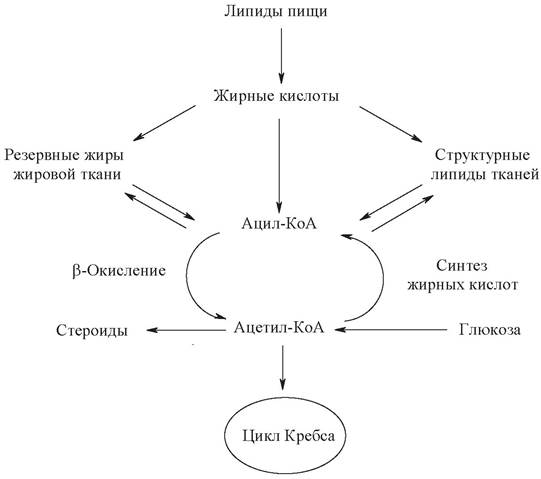
Fatty acids are predominantly utilized in three major ways:
- incorporation into storage fats;
- incorporation into Complex Lipids;
- oxidation into carbon dioxide and water to release energy for ATP synthesis.
4.2. Lipid Digestion
The bulk of dietary lipids consists of triacylglycerols (fats). The daily human requirement for fats ranges from 50 to 100 g, depending on dietary habits and Energy Expenditure. Lipid digestion occurs primarily in the Small Intestine through the action of lipase Enzymes. These processes do not take place in the Oral Cavity or The Stomach. Lipase breaks down triacylglycerols in a nearly neutral medium, rendering it virtually inactive in the stomach due to low pH levels. In the duodenum, food is exposed to Bile AND PANCREATIC juice. Pancreatic juice delivers lipase to the duodenum in its inactive form, prolipase. Bile simultaneously supplies bile acids, which activate the lipase. The First stage involves lipid emulsification facilitated by bile acids, which enter the intestine as a component of bile. Bile acids orient themselves around fat droplets, lowering surface tension and breaking them down into smaller droplets:

Lipase adsorbs onto The surface of these tiny droplets and hydrolyzes the ester bonds within the triacylglycerol molecules. As a result, fatty acid residues are sequentially cleaved from glycerol. The released fatty acids further enhance fat emulsification. Bile acids form a complex with Fatty Acids and monoacylglycerols that easily penetrates the Cells of the intestinal mucosa. Within the mucosal tissue, bile acids dissociate from the fatty acids and return to the Liver via portal Blood flow, where they are reincorporated into bile.
The primary digestion products—fatty acids, β-monoacylglycerols, and partially free glycerol—are absorbed by the wall of the small intestine, where the synthesis of fats characteristic of The Human Body takes place (fat resynthesis):

Newly synthesized triacylglycerols, Phospholipids, and other absorbed lipids exit the mucosal cells, entering The Lymphatic system first and subsequently the bloodstream. Because these substances are insoluble in aqueous environments, they are transported in complexes with Proteins, forming Lipoproteins (Table 6). In the intestine, resynthesized triacylglycerols are incorporated into chylomicrons. The core of these particles consists of triacylglycerols and Cholesterol esters, while the shell is composed of a complex of phospholipids, proteins, and free cholesterol. Exogenous fats are delivered to Organs and tissues via chylomicrons. Tissue uptake of exogenous fats is mediated by the enzyme lipoprotein lipase. This enzyme is localized in the vascular endothelium and catalyzes the Hydrolysis of triacylglycerols within chylomicrons into glycerol and fatty acids. As a result of lipoprotein lipase action, chylomicrons decrease in size and transform into so-called remnant chylomicrons, which are captured from the bloodstream by The Liver and undergo final degradation there.
Table 6. Human Blood Lipoproteins
Lipoproteins |
Density, g/mL |
Molecular weight |
Diameter, nm |
Blood concentration, g/L |
Main component |
Site of synthesis |
Function |
Chylomicrons |
0.95 |
1-10 billion |
30-500 |
1-2 |
Triacylglycerols |
Small intestine |
Transport of TGs from intestine to tissues |
VLDL (pre-β) |
0.95-1.00 |
5-100 million |
30-75 |
1-1.5 |
Triacylglycerols |
Liver |
Transport of TGs from liver to tissues |
LDL (β) |
1.00-1.06 |
2-4 million |
20-25 |
2-4 |
Cholesterol |
Blood |
Transport of cholesterol to tissues |
HDL (α) |
1.06-1.21 |
200-400 thousand |
10-15 |
1-3 |
Protein and phospholipids |
Liver |
Transport of cholesterol from tissues to liver |
The primary consumers of fatty acids are adipose and Muscle Tissues, which utilize fatty acids either as energetic fuel or as building blocks.
4.3. Fat Storage
Fats, much like Glycogen, serve as energy storage forms, with fats acting as significantly more efficient Energy Sources. During fasting, human fat reserves are depleted within 5-7 weeks, whereas glycogen stores are fully exhausted in roughly a day. When fat intake exceeds the body's energy demands, the excess is stored in specialized adipose tissue cells known as adipocytes. Conversely, if carbohydrate intake surpasses what is required for glycogen storage, a portion of the glucose is likewise converted into fats.
Thus, fats accumulate in adipose tissue through two main pathways:
- synthesis from fatty acids generated by the lipolysis of triglycerides within chylomicrons and very-low-density lipoproteins, facilitated by the enzyme lipoprotein lipase;
- synthesis from glucose, the metabolism of which in adipose tissue cells yields glycerol phosphate and fatty acids.
4.4. Fatty acid oxidation
Fatty acids play a vital role as an energy source in the body. The primary pathway of fatty acid oxidation is β-oxidation, so named because it involves the oxidation of the β-carbon atom of the fatty acid residue.
β-Oxidation takes place within the Mitochondria of The Cell, whereas the fatty acid is delivered from the bloodstream into the Cytosol, where it is activated by attaching CoA to form acyl-CoA:

The mitochondrial membrane is impermeable to fatty acids even in their activated form; therefore, acyl-CoA binds to a specialized carrier called carnitine. This produces acylcarnitine, which crosses into the mitochondrial matrix and is once again split back into carnitine and acyl-CoA.
Strictly speaking, the β-oxidation process (the Knoop–Lynen cycle) is a spiral metabolic pathway in which each turn shortens the fatty acid residue by 2 carbon atoms, comprising 4 distinct stages (Fig. 20):
1. Oxidation — dehydrogenation of acyl-CoA to dehydroacyl-CoA involving an FAD-dependent dehydrogenase;
2. Hydration — addition of water to dehydroacyl-CoA at the β-position to form hydroxyacyl-CoA via a hydratase;
3. Oxidation — dehydrogenation of hydroxyacyl-CoA to β-ketoacyl-CoA using an NAD-dependent dehydrogenase;
4. Thiolysis — Cleavage of the thioester bond by a thiolase, yielding acyl-CoA and acetyl-CoA.
Fig. 20. β-Oxidation of Fatty acids

As a result of these four sequential reactions of β-oxidation, a two-carbon fragment is cleaved and transferred to coenzyme A, producing acetyl-CoA, which can then enter the Krebs cycle for complete oxidation. The shortened acyl chain (acyl-CoA) re-enters the β-oxidation spiral, beginning once more with the reaction catalyzed by acyl-CoA dehydrogenase.
The oxidation of palmitic acid is illustrated below:

The oxidation of palmitic acid (C16) proceeds through the sequential removal of two-carbon fragments from the carboxyl end of the fatty acid, yielding 8 molecules of acetyl-CoA after 7 cycles of β-oxidation.
4.5. Energy Yield of Fatty Acid β-Oxidation
This yield depends directly on the length of the hydrocarbon chain. To calculate the energy yield for a specific fatty acid, one must know the number of β-oxidation cycles and the number of acetyl-CoA molecules produced.
In each cycle of β-oxidation, the acyl-CoA is shortened by 2 carbon atoms and 1 molecule of acetyl-CoA is released. Consequently, the number of generated acetyl-CoA molecules equals half the number of carbon atoms in the acyl-CoA. The oxidation of each acetyl-CoA molecule in The Tricarboxylic Acid Cycle drives the synthesis of 12 ATP molecules. Furthermore, each cycle of β-oxidation generates 1 molecule of FADH2 and 1 molecule of NADH2, whose subsequent oxidation in the Respiratory Chain yields 2 and 3 ATP molecules, respectively (5 ATP in total). In the final cycle of β-oxidation, two molecules of acetyl-CoA are formed simultaneously. Hence, the complete conversion of a fatty acid residue into acetyl-CoA requires one fewer β-oxidation cycle than half the total number of carbon atoms in the acyl-CoA.
For instance, palmitic acid (C16) undergoes 7 cycles of β-oxidation, producing 8 molecules of acetyl-CoA, 7 molecules of FADH2, and 7 molecules of NADH2. Accordingly, the ATP yield comprises 35 ATP from β-oxidation and 96 ATP from The Citric Acid Cycle, totaling 131 ATP molecules. Accounting for the single ATP molecule consumed during the initial activation of the fatty acid, the net ATP yield is 130 molecules.
4.6. FATTY ACID Biosynthesis
Along with the oxidation of fatty acids, cells also perform The process of their synthesis. The primary site of fatty acid synthesis is the cytosol, unlike β-oxidation, which takes place in the mitochondria.
The immediate precursor of fatty acids is malonyl-CoA. This compound is synthesized by adding carbon dioxide to acetyl-CoA, which is transported from the mitochondria. The main product of this synthesis is palmitic acid. The enzyme palmitate synthase (fatty acid synthase) plays a central role in fatty acid synthesis by catalyzing a series of reactions. The overall equation for the synthesis of palmitic acid comprises 7 cycles:
Acetyl-CoA + 7 Malonyl-CoA + 14 NADPH2 —> Palmitate + 8 HS-CoA + 7 CO2 + 14 NADP+ +7 H2O.
Palmitic acid serves as a precursor for other fatty acids in the body. The elongation of the carbon chain occurs through the additional incorporation of acetyl-CoA or malonyl-CoA, facilitated by Other Enzymes located in both the cytosol and mitochondria. For instance, The addition of acetyl-CoA to palmitic acid, followed by the reduction of the p-carbonyl group, leads to The formation of stearic acid. Most Unsaturated fatty acids are produced by the dehydrogenation of saturated acids. The pathways for the formation of certain fatty acids are illustrated in the diagram:
Humans and animals are incapable of synthesizing fatty acids with two or more double bonds from palmitic acid. Therefore, linoleic, linolenic, and arachidonic acids (in the absence of linoleic acid) are essential and must be obtained through the diet.
4.7. Biosynthesis of Triglycerides, Phospholipids, and Cholesterol
Triglycerides are synthesized from glycerol phosphate and acyl-CoA. In the first stage, two acyl groups are attached; subsequently, under the action of a phosphatase, the phosphate group is removed, and a third acyl group is added.
The Synthesis of phospholipids also originates from glycerol phosphate and fatty acids, but additionally requires ethanolamine, Choline, Serine, or Inositol to form the polar "HEAD" of the molecule.
Cholesterol is synthesized from acetyl-CoA in the cell cytosol: 80% in the liver, 10% in intestinal cells, and 5% in Skin cells. The rate of cholesterol synthesis depends on The amount of exogenous cholesterol obtained from the diet. When 2–3 g of cholesterol is ingested daily, the synthesis of endogenous cholesterol ceases.
In the liver, cholesterol is converted into bile acids, which are essential for lipid digestion. In the skin, cholesterol serves as a precursor for vitamin D3, a regulator of calcium-phosphorus metabolism. Furthermore, cholesterol is the substrate for the synthesis of Steroid Hormones: mineralocorticoids and glucocorticoids are produced from it in the adrenal cortex, while androgens, estrogens, and gestagens are synthesized in the Gonads.
4.8. Synthesis and Breakdown of Ketone Bodies
During starvation, prolonged physical exertion, and impaired cellular glucose utilization (due to Insulin deficiency in Diabetes Mellitus), fatty acids derived from the hydrolysis of adipose tissue triglycerides become the primary energy source. Fatty acids undergo β-oxidation, producing large amounts of acetyl-CoA in all organs except the Brain. Because oxaloacetate, which is required for The entry of acetyl-CoA into The Citric Acid cycle (TCA cycle), cannot be synthesized from fatty acids, the excess acetyl-CoA cannot be rapidly oxidized in the TCA cycle. The liver possesses a unique ability to convert these large amounts of acetyl-CoA into ketone bodies.
Ketone bodies include three structurally similar compounds: acetoacetate, 3-hydroxybutyrate (β-hydroxybutyrate), and acetone:
Their synthesis begins with the Condensation of two molecules of acetyl-CoA, catalyzed by the enzyme thiolase, to form acetoacetyl-CoA. A third molecule of acetyl-CoA then reacts with acetoacetyl-CoA to yield 3-hydroxy-3-methylglutaryl-CoA (HMG-CoA). Subsequently, HMG-CoA lyase catalyzes the cleavage of HMG-CoA into free acetoacetate and acetyl-CoA:
The acetoacetate produced in this reaction can either be released into the bloodstream or reduced to 3-hydroxybutyrate. Under conditions of active β-oxidation, a high concentration of NADH2 is generated, which drives the reduction of most of the acetoacetate, making 3-hydroxybutyrate the predominant ketone body in the blood.
At high concentrations of acetoacetate, a fraction of it may undergo irreversible decarboxylation to form acetone. Acetone is not utilized by tissues and is eliminated via expired air, urine, and sweat, helping the body rid itself of excess ketone bodies.
The reactions involved in the utilization of ketone bodies essentially reverse the steps of their synthesis. In the cell cytosol, 3-hydroxybutyrate is oxidized, and the resulting acetoacetate enters the mitochondria, where it is activated by succinyl-CoA:
Acetoacetate + Succinyl-CoA —> Acetoacetyl-CoA + Succinate.
This reaction is catalyzed by the enzyme succinyl-CoA:acetoacetate-CoA transferase. This enzyme is absent in the liver, meaning the liver does not use ketone bodies as an energy source, but rather produces them "for export." The activated acetoacetate is subsequently converted into acetyl-CoA, which is oxidized in the TCA cycle:
The biological role of ketone bodies lies in the fact that these molecules (3-hydroxybutyrate and acetoacetate) serve as an alternative energy source for cells during glucose deficiency, offering the distinct advantages over fatty acids of a small molecular size and high water solubility. Consequently, during starvation, ketone bodies can supply energy even to Nervous Tissue, which is unable to utilize fatty acids from the blood. However, 3-hydroxybutyrate and acetoacetate are acidic compounds and, at high concentrations, lower blood pH, leading to acidosis. Acidosis disrupts normal physiological functions and can be fatal.
1. Lipids: definition, Classification, biological functions. Fatty acids: key representatives, relationship between physicochemical properties and the length and saturation of the hydrocarbon chain, biological functions. Triglycerides and phospholipids: Structure, relationship between physicochemical properties and composition, biological significance. Cholesterol: structure, biological significance.
2. Biological membranes: composition (lipid, carbohydrate, and protein components) and functions. Fluid-mosaic model of membranes. Transport of substances across membranes. Lipoproteins: definition, general Structural Organization of blood lipoproteins, Specific features of composition and functions of individual classes.
3. Pathways of acetyl-CoA metabolism in the cell: Synthesis and degradation of fatty acids and ketone bodies, cholesterol synthesis, Catabolism of ketogenic Amino Acids, underlying mechanisms and biological significance.
4. $\beta$-oxidation of fatty acids: stages, enzymes, regulation. Energy yield of Fatty acid and triglyceride oxidation. Biosynthesis of Fatty acids: stages, regulation, biological significance. Synthesis and degradation of triglycerides and phospholipids. Interconnection of Lipid Metabolism with the Krebs cycle, Carbohydrate Metabolism, and Amino acid metabolism. Role of hormones and The Nervous system in the Regulation of Lipid Metabolism.
Written Homework
Mandatory
1. Oleic acid is the predominant fatty acid in the triglycerides of human adipose tissue. Write the structural formula of the triglyceride 1,3-dioleoyl-2-stearin. Outline The pathway of its complete catabolism to CO2 and H2O, and calculate the energy yield of this process.
2. Write the structural formula of the phospholipid palmitoyllinolenoylphosphatidylcholine. Demonstrate how this phospholipid can be incorporated into biological membranes and blood lipoproteins. What is the common name for phospholipids containing the amino alcohol choline?
3. The phospholipid molecule described in the previous problem is a component of a high-density lipoprotein (HDL) particle. Catalyzed by lecithin-cholesterol acyltransferase (LCAT), the linolenic acid residue is transferred from the phospholipid molecule to the hydroxyl group of cholesterol, converting the phospholipid into lysolecithin. Write the structural formulas of cholesterol, its ester cholesteryl linolenate, and the resulting lysolecithin. How will the water solubility of these lipids change as a result of this reaction? Will the spatial Location of these molecules within the HDL particle change?
4. Palmitic acid labeled with radioactive carbon 14C at carbon-1 was added to a liver cell culture. After some time, the introduced radioactivity was detected in the released carbon dioxide. The experiment was repeated with hepatocytes pretreated with insulin: radioactive CO2 was not released, and the introduced radioactivity accumulated in the hepatocyte cytosol. Explain these observations based on the pathways of hepatic lipid metabolism. In what other substances might the radioactive label have been detected?
Optional
1. Most milk triglycerides contain short-chain fatty acids with an even number of carbon atoms: caprylic (C8), capric (C10), and lauric (C12). Outline the pathway of the complete catabolism of the triglyceride trilaurin to CO2 and H2O, and calculate the energy yield of this process.
2. Write the structural formula of the phospholipid stearoylarachidonoylphosphatidylserine and illustrate its role in The structure of biological membranes. Can a Lipid Bilayer Membrane be formed exclusively from molecules of this phospholipid? What classes of biologically active compounds can be synthesized from the hydrolysis products of this phospholipid?
Sample Test Questions on the Topic “Lipid Metabolism”
Instructions: Unless otherwise specified in the question, choose the single correct answer.
1. What is the name of the compound with the following structure:

a) stearoyllinoleylphosphatidylethanolamine;
b) palmitoyloleylphosphatidylcholine;
c) stearoyloleoylphosphatidylethanolamine;
d) palmitoyloleoylphosphatidylethanolamine;
e) stearoyloleylphosphatidylcholine.
2. Select the classes of lipids that are components of biological membranes:
a) fatty acids and triglycerides;
b) triglycerides and phospholipids;
c) phospholipids and free cholesterol;
d) cholesterol and its esters;
e) fatty acids and free cholesterol.
3. Glucose is transported across The cell membrane down its concentration gradient via a carrier protein without the expenditure of ATP energy. This type of transport is called:
a) Active Transport;
b) secondary active transport;
c) simple diffusion;
e) exocytosis.
4. Which chemical reaction can be used to prove the unsaturation of vegetable oil:
a) saponification;
b) hydrolysis;
c) Esterification;
d) halogenation;
5. How many β-oxidation cycles are required for the complete catabolism of linoleic acid:
a) 7;
b) 8;
c) 9;
d) 17;
e) 18.
6. Choose the name of the enzyme that catalyzes the following reaction of the Knoop-Lynen cycle:

a) acyl-CoA synthetase (AMP-forming);
b) enoyl-CoA hydratase;
c) acyl-CoA hydrolase;
d) acyl-CoA : H2O oxidoreductase;
e) enoyl-CoA hydrolase.
7. Which class of lipoproteins is formed in the blood and designed to transport cholesterol into cells:
a) VLDL;
b) LDL;
c) HDL;
d) CM.
8. In which metabolic processes can acetyl-CoA be utilized:
a) synthesis of cholesterol, fatty acids, and ketone bodies;
b) synthesis of non-Essential Amino Acids, glucose, and lipids;
c) synthesis of acetylcholine, fatty acids, and glucose;
d) synthesis of cholesterol, non-essential amino acids, and ketone bodies;
e) synthesis of fatty acids, acetylcholine, and glucose.
9. Fill in the blanks (3 Answers) in the sentence: "During fasting, blood insulin levels ..., which leads to The breakdown of adipose tissue ... and ... in the blood concentration of non-esterified fatty acids".
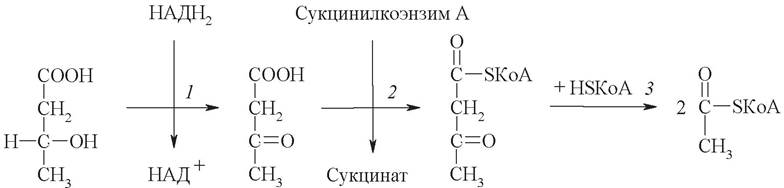
10. Provide the names and class numbers of the enzymes (6 answers) that catalyze reactions 1, 2, and 3:
Last update: 06/08/2026
Editorial and Educational Adaptation: This material has been compiled based on the primary/original source text. The project team performed an editorial review, corrected technical inaccuracies, structured sections, and adapted the content for an educational format.
What was processed:
- elimination of formatting defects (OCR errors, structural breaks, corrupted characters);
- editorial organization of content;
- standardization of terminology in accordance with academic sources;
- verification of factual statements against the original source text.
All mentions of the author, publication year, and origin of the primary text have been preserved in accordance with the source.