Biochemistry - The Chemical Reactions of Living Cells Volume 2 - D. Metzler 1980
Biosynthesis; how new molecules are formed
Metabolism of triglycerides, phospholipids, and glycolipids
Synthesis of phospholipids and glycolipids
Most bacterial Phospholipids are formed by The conversion of phosphatidic acids into CDP-diglycerides (Fig. 12-8, reaction e). The latter react with various nucleophiles, a process accompanied by the release of CMP. Specifically, interaction with L-Serine yields phosphatidylserine (reaction f), whereas reaction with Inositol (reaction i) synthesizes phosphatidylinositol. Evidence indicates that The enzyme catalyzing phosphatidylserine formation is associated with Ribosomes [60, 61]. In contrast, most Other Enzymes involved in phospholipid Biosynthesis are embedded in or closely bound to the cytoplasmic membrane. One of these membrane-bound enzymes catalyzes the decarboxylation of phosphatidylserine to form phosphatidylethanolamine (reaction h, Fig. 12-8) [63]. Although phosphatidylcholine is not a major component of bacterial Lipids, it can be synthesized from phosphatidylethanolamine through a three-step Transmethylation using S-adenosylmethionine as the methyl group donor.
In animals, The formation of phosphatidylcholine and phosphatidylethanolamine can proceed via an alternative pathway, indicated by the dashed line in Fig. 12-8. The first step of this pathway involves the phosphorylation of a free base—Choline or ethanolamine—using ATP. The resulting choline phosphate reacts with CTP to form CDP-choline [equation (11-26)]. Subsequently, the choline phosphate moiety is transferred to a 1,2-diglyceride, synthesizing lecithin. Phosphatidylethanolamine is formed from CDP-ethanolamine in an entirely analogous manner.
In animal Tissues, phosphatidylserine is synthesized via an exchange reaction [equation (12-19)]. Simultaneously, phosphatidylserine is decarboxylated back into phosphatidylethanolamine, so that the overall process essentially represents a catalytic cycle of serine decarboxylation to ethanolamine. The latter reacts with CTP, initiating the synthesis of new phospholipid molecules. Direct methylation of phosphatidylethanolamine to phosphatidylcholine is also of substantial importance:
Class="center">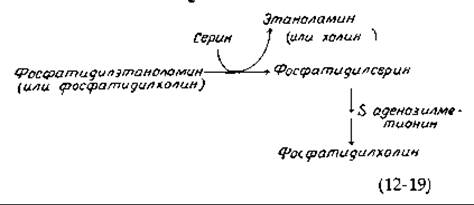
Returning once more to Fig. 12-8, we note that glycerophosphate, like serine, can react with a CDP-diglyceride to yield phosphatidylglycerophosphate (reaction k). Following the removal of the phosphate group, phosphatidylglyceric acid remains, which can be further converted into diphosphatidylglycerol (cardiolipin). One variant of this process, characteristic of A number of Bacteria, is shown in Fig. 12-8 (reaction m). Here, the joining of two phosphatidylglycerol molecules is accompanied by the release of a single glycerol molecule. In Cell/35.html">Mitochondria, and apparently also in certain bacteria, the process may proceed differently—namely, through The transfer of a phosphatidic acid moiety from a CDP-diglyceride to phosphatidylglycerol with the release of CMP [64]:
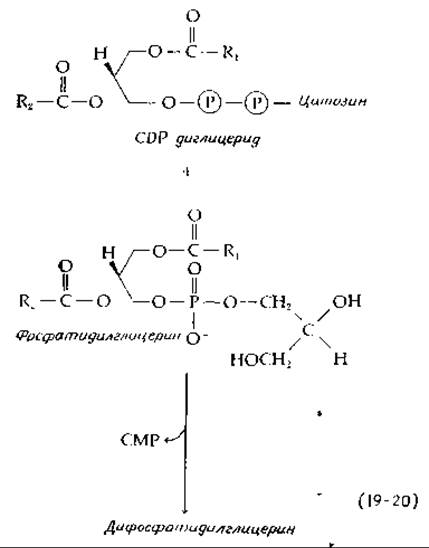
Galactolipids found in METABOLISM/14.html">Chloroplasts represent yet another class of compounds derived from 1,2-diglycerides (Fig. 2-25). The transfer of a single galactosyl ring to a 1,2-diglyceride synthesizes galactosyldiglyceride, whereas the subsequent transfer of a second galactose residue leads to the formation of digalactosyldiglyceride:

Last update: 06/08/2026
Editorial and Educational Adaptation: This material has been compiled based on the primary/original source text. The project team performed an editorial review, corrected technical inaccuracies, structured sections, and adapted the content for an educational format.
What was processed:
- elimination of formatting defects (OCR errors, structural breaks, corrupted characters);
- editorial organization of content;
- standardization of terminology in accordance with academic sources;
- verification of factual statements against the original source text.
All mentions of the author, publication year, and origin of the primary text have been preserved in accordance with the source.